Fake News: What Psychiatric Wards Aren’t Telling You On Twitter

Emoji Anon

Did you know that psychiatric wards run their own Twitter accounts now? What’s next, Instagram?  Perhaps we can lose the Care Quality Commission and start carrying out reviews of hospitals on Trip Advisor instead.

Sussex Partnership Foundation Trust has an extensive Twitter network, with official ‘ward twitters’ and multiple ward staff running their own accounts. They call the patients ‘service leaders’ – language that denies the actual status of patients, often detained against their will, on psychiatric wards. The staff are referred to as ‘leader leaders’, trained through the ‘Leader Leader Academy’ which promises ‘quality improvement through Clarity, Competence, Control and Courage’ (is satire dead?). These ideas are taken from an American naval captain, turned public speaker, who suggests every business should adopt a ‘leader-leader’ model of management rather than a ‘leader-follower’ approach. The aim is to push responsibility as low on the organisational hierarchy as possible and for all employees to take ownership of leading the business. I somehow don’t think he was talking about patients detained under mental health legislation when he came up with that.

Am I really a ‘service leader’ while locked on a ward with little say about when I leave, whether I take medication and what belongings I have access to? If we flatten hierarchies to the point that we deny their existence, aren’t we just gaslighting those at the bottom? My own experience in a Sussex Partnership hospital was not one of a ‘service leader’. The problem with using such dishonest language is that it obscures the power and responsibility of those who can actually wield it. For example, a Sussex Partnership nurse tweeted a debrief form that had been filled in by a ‘service leader’ after they’d been restrained. What led to such poor judgement? Perhaps an unintended consequence of this language change is that staff begin to actually believe that patients have equal power, and that it’s OK to share their private, medical information on Twitter.

One of the wards using these terms is a psychiatric intensive care unit at Mill View Hospital. I was appalled to see multiple pictures of ‘service leaders’ posted on their Twitter feed, with smiley emojis superimposed on their faces. One of these pictures was posted by the ward manager, then ‘liked’ and retweeted by the CEO of Sussex Partnership, Samantha Allen. The patients would be clearly identifiable to anyone who knew them and the photos were humiliating, degrading and in clear contravention to multiple data protection laws (not least, that staff had the original, unedited pictures of patients on their phones).

Who are these Twitter accounts serving? Every kind of ‘professional’ Twitter sphere can come across as self-congratulatory, but the stakes are so high here. While I can understand the value in mental health professionals using Twitter to share best practice, it should never be at the expense of dignity and confidentiality. The tone of these ward accounts is all wrong – happy, smiley emojis covering the faces of those detained, talk of infantilised fun with the ‘service leaders’ – it paints an idealistic picture of life on the ward that is pure fantasy. I don’t go into hospital looking for ‘fun’. I hope that I receive timely care, that my human rights will be upheld, and that my dignity and confidentiality will be respected. Sadly, none of this has been the case in my own recent experience of Sussex Partnership hospitals.

The emoji pictures of patients have since been removed, after an uproar from professionals and service users alike. However, data still remains that could be used to make a jigsaw identification of a patient. The ward ‘newsletter’ includes a patient blog section where details about patient’s care and life stories are shared, and so-called ‘service leaders’ are still visible in some pictures.

It is all the more galling because the problems at Mill View Hospital have been well documented in recent years. There was a death on one of their wards as recently as December last year, that resulted in a coroner ordering an immediate investigation into safety. She described the ward involved as “mismanaged and chaotic”, and accused Mill View staff of giving the subsequent police investigation “the run around”. I am left wondering how the families of those who died there would feel about this kind of gratuitous self-promotion on social media.

Another problem on Twitter is that the ideas shared can be lost in their repurposing. One ward in Leicestershire, posted a picture of postcards with motivational quotes on, stating they were writing a personalised crisis plan on the back for each of their patients being discharged. A nurse from Sussex Partnership took this idea and recreated it, but instead of a personalised crisis plan, they listed generic crisis numbers on the back. What was a nice idea – personalised crisis plans on more than just hospital stationery – lost all it’s substance and became just another opportunity for ‘likes’ on Twitter. I left a Sussex Partnership hospital earlier this year without a proper care plan. If they had given me a motivational postcard with generic crisis numbers taped to the back, it would have felt like a punch in the face.

There are real people in vulnerable situations behind these Twitter blunders, that are having their human rights totally disregarded by Sussex Partnership staff – just for some ‘likes’ on social media. It suggests a culture where PR is valued over anything else. Until Sussex Partnership take raising their standard of care seriously, we should watch their Twitter rebrand with caution.

Recovery In The Bin (RITB) is covered by a Creative Commons Attribution-NonCommercial-NoDerivatives 4.0 International (CC BY-NC-ND 4.0) License 88x31.png

More Evidence Of Service’s Suicidal Neglect

Thanks to Suicide Crisis and their founder Joy Hibbins for this excerpt, the full report can be downloaded HERE > Research Into Deaths By Suicide In Gloucestershire, Report of First Six Months (June to December 2017) Headline Findings

Patients with Emotionally Unstable Personality Disorder expected to “take responsibility” for their safety.

It appeared that a level of responsibility was being given to patients with Emotionally Unstable Personality Disorder (Borderline Personality Disorder) to keep themselves safe, even when they were detained under the Mental Health Act or “sectioned” in psychiatric hospital. “Keeping safe” was used in the sense of refraining from self-harm or suicidal acts.

However, it was not apparent what preparation or help they had been given to enable them to “take responsibility” for their safety.

Having spoken to family members, there are indications that there will be more evidence of this being repeated in other cases, in inquests to be heard in 2018.

In terms of the inquests already attended:-

AF was detained under the Mental Health Act in psychiatric hospital.  AF had been given a diagnosis of Emotionally Unstable Personality Disorder/Borderline Personality Disorder.

The psychiatric staff giving evidence spoke repeatedly about the need for AF to “take more responsibility” for maintaining her own safety. The coroner asked if she had “the tools” to do this.

AF had not been provided with therapies such as those referred to in the NICE guidelines for Borderline Personality Disorder e.g. Dialectical Behaviour Therapy (DBT). NICE refers to DBT as “an intensive psychological treatment that focuses on enhancing a person’s skills in regulating their emotions and behaviour. The therapy can help a person gain control of behaviours such as self-harm and substance abuse”. Psychiatric staff gave no indication of what they had done to prepare and support AF to be able to “take more responsibility” for her safety.

Therapies are particularly important as there is no specific medication. Indeed the NICE guidance (Clinical Guideline 78) states: “You should not usually be offered medication specifically to treat Borderline Personality Disorder or for any related symptoms or behaviour (such as self-harm, unstable moods and risky behaviour).”

SH had been given a diagnosis of Mixed Personality Disorder (Borderline Personality Disorder and Antisocial Personality Disorder). His family told us that they felt he had been given too much responsibility for maintaining his own safety and refraining from suicidal acts. SH was not provided with mental health care and support (such as the Crisis Team) after suicide attempts or self-harm incidents during the last few months of his life.

There was no indication at inquest that SH had been provided with therapies referred to in the NICE guidelines for Borderline Personality Disorder, including DBT which NICE states can help a person “gain control” of self-harm. There was also no indication that he had been given the recommended treatment for Antisocial Personality Disorder.

The NICE guideline on Antisocial Personality Disorder recommends psychological therapies for managing and treating the symptoms and behaviours associated with Antisocial Personality Disorder. “Group‑based cognitive and behavioural therapies help to address problems such as impulsivity, interpersonal difficulties and can help to reduce offending”.

Recovery In The Bin (RITB) is covered by a Creative Commons Attribution-NonCommercial-NoDerivatives 4.0 International (CC BY-NC-ND 4.0) License 88x31.png
Unrecovery As KerPlunk!

3mgi-fpr07_2

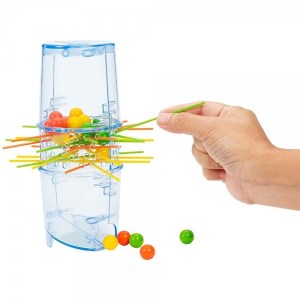
We have all played Kerplunk I hope. But as a recap there is a tube with holes, sticks are crisscrossed holding up some balls, and the trick is to remove the sticks without all the balls falling.

Our mental health is like a game of Kerplunk, and our issues are a combination of the balls and sticks. ‘Recovery’ is the ability to remove the sticks without the balls falling. As a slight adaptation to this analogy some of the balls can be removed by moving sticks, and ‘life’ adds balls all the time. The sticks are ‘safety’ adaptations that stop all the balls falling at once.

This game of Kerplunk is mostly played by us alone (in our own minds), so in this analogy the game is played in a room on your own. But we can always hear people telling us which sticks we ‘should’ remove, whilst we are sitting there looking at the problem, even though these people are not in the room with us. Government policy also demands we remove sticks, and moreover can add balls (as can other aspects of life), as well as remove sticks if we don’t keep an eye on them.

Unrecovery practices are an ad hoc practice, that is a temporary solution to keep control of our own Kerplunk game, knowing that a wrong move can send all the balls falling. ‘Bad’ recovery is one size fits all and insists on this or that stick must be removed, and then blames you when the balls fall. ‘Good’ Recovery, and other therapeutic practices, listens to your knowledge of what you can see of the game, and merely supports you with your autonomy whilst you play the game. This latter ideal however from our observation seems to be at odds with current government policy and market/ capitalist needs, as it doesn’t meet the outcomes measures of outside forces.

For those who don’t know the term, that I have added some changes to the games with sticks and balls being added and removed whilst you play, like a Heath Robinson machine, is what is called an assemblage. Unrecovery is an ad hoc practice with which to deal with such an assemblage.

Recovery In The Bin (RITB) is covered by a Creative Commons Attribution-NonCommercial-NoDerivatives 4.0 International (CC BY-NC-ND 4.0) License 88x31.png

I Won by Sam Ambreen

{CN for suicide, self harm, mental health}

13 months after my personal independence payments were cut, I won my 2nd tribunal. 13 months of crowdfunding my rent. 13 months of reducing my food intake, buying the cheaper brand, going without, and feeling humiliated but on Friday, a panel ruled in my favour. There was no objection from the DWP representative who, I could have sworn, was even crying at one point. I felt bad for scowling at her after that!

I self harmed 4 times during that period, when I absolutely could not comply with the measures I’ve worked at to protect myself. I dissociated more frequently. I got as far as buying the instruments I would need to end it. Drew up a plan. Resisted writing the suicide note because that would make it final, and only because the people around me pulled through when I shared my invasive thoughts (a thing I was only able to do because I’d been taught, by my first therapist). They reminded me I’d managed to survive this long because people wanted to help me. They made me think about the people who look to me for strength and how my demise would impact on them. I didn’t really care in that split second but when the feverish urges passed I felt a bit sheepish I’ll admit. People do take strength from my courage.

When the DWP cut me off and sent me their decision, they said they were not disputing the fact that I had these disabilities just whether or not I qualified for personal independence payments. 13 months on and I’ve just been told I do. So was it really necessary to put me through this? What is its purpose otherwise? Survival of the fittest? It’s not strictly true anymore though is it? I’m nowhere near the fittest but I have recourse; to advocates, to friends who work in the public sector and health professionals who actually listen. Perhaps this mum didn’t?

Even with all the support I have, I came the closest I ever have to ending it. I didn’t enjoy asking for help, again and again, I was isolated and lonely as a result. I might be an anarcho-communist but I still have the hardwiring of a society that celebrates charity as a virtue but not if you’re on the receiving end. The shame still lingers. I didn’t want to die, I felt I had no other choice.

Recently I read about a young woman called Holly Cowlam who took her own life when she was diagnosed with depression. Holly had been studying psychology and so had some understanding of mental health. I get the sense, because she knew her chances in life would be greatly affected, as they are in a society that demonises mental health, she felt she had no other option. I know what that’s like; the shame and hopelessness. I refused to acknowledge my own mental health for 20 years, telling myself I was stronger than those others who had succumbed. In the end, you can’t really prevent it. I am the sum total of all the violence and treachery inflicted on me but with the right support, and freedom, and protection, I know I can get better.

holly-cowlam

What I do not need, and could have really done without, was being treated like I’m making it up. As a repeat victim of sexual and domestic violence, gaslighting is a straight up trigger for my PTSD. Being treated like I am insignificant and somehow asking for more than what is my right, having paid into a system for many years and on an emergency tax code more often than not (I did a lot of temp work because I was sick even then only I wouldn’t admit it) eventually wore me down in a way my mental and physical conditions do not, because I believe I can overcome them (to an extent). I needed time and space to heal not to be hindered by a cruel and abusive process.

Advocates for humanity must ramp up the pressure on this government and demand justice for all those who’ve needlessly died in our country. The architects of social cleansing must be tried for their crimes against our humanity.

You can judge a country by the way it treats its animals/poor/prisoners/women/disabled folk.

Republished (23/02/19) by kind permission, Sam Ambreen blogs at Left At The Lights

If you need help dealing with the DWP see our Advice Links page.

Note: PIP application processes generally require disclosure of diagnoses, medication, and supporting evidence, making it significantly discriminatory and arduous for many people. Professionals are often uninformed about how best to help people, this is a good guide.

Recovery In The Bin (RITB) is covered by a Creative Commons Attribution-NonCommercial-NoDerivatives 4.0 International (CC BY-NC-ND 4.0) License 88x31.png

The unRecovery Excellence Framework #uREF2019 – A request for peer reviewers.

81109FCE-0EE6-4E84-9912-EEFCAEEFA0BA

Recovery in the Bin would like to invite allies and peers to review a list Rita Bins has collated of publications that reference Recovery in the Bin!

What did Rita do? (Methods)

Rita collated a reference list after making a public request on Twitter and after systematically searching google scholar, google news and google search.  These tools were chosen as they are freely available to all on the internet – they are not hidden behind paywalls and do not need to be accessed via membership of an academic institution.

Rita decided that she would include all types of publications in her reference list, respecting and privileging all forms of publication democratically.  This included peer reviewed journals, books and textbooks, theses, reports, magazine and newspaper articles, blogs, presentations and posters.

To be included in this list, all publications were required to reference Recovery in the Bin OR explicitly name Recovery in the Bin (via a secondary citation or without providing a reference).  All publications by Recovery in the Bin were excluded.

What can I do to help Rita?

Please contact us via email recoveryinthebin@gmail.com or by Twitter DM @RITB_ if you notice that your publication has been omitted from Rita’s work.  Or indeed, if you have any corrections.  The full reference list can be found here.

What will Rita do next?

Once we have received feedback from our allies and peers, we will publish the unRecovery Excellence Framework #uREF2019 as a blog in due course.

We will also be working behind the scenes, under Rita Bins’ leadership, to synthesise and analyse what people are saying about us.  We will be publishing the methods and results of our survivor led scoping review in a journal.  Rita Bins is an unacademic with some impressive methodological and literary skills.

Rita would like to thank all translators who have supported this work:

Andreas Vedeler – Danish and Norwegian.

Recovery In The Bin (RITB) is covered by a Creative Commons Attribution-NonCommercial-NoDerivatives 4.0 International (CC BY-NC-ND 4.0) License 88x31.png

Neopaternalism – New Wave Paternalism In UK Mental Health Services

neopaternalism

Artwork by: @JADEELIZB

Neopaternalism refers to the practice, often seen in MH services, of professionals imposing their versions of ’empowerment’ and ‘independence’ etc. on individuals in their care regardless of the individuals own views. Typically, ‘independence’ in this context is near synonymous with discharge or cuts to care provision.

Neopaternalism prioritises the professional’s worldview, agenda, values and goals. As such, it mirrors traditional paternalism, but the content and language used is different. Emphasis on independence in neopaternalism is often framed as contrasting to traditional paternalism in which providing care is perceived as restricting a person’s liberty and autonomy. However, this obscures the fundamental similarity in which both approaches impose the powerful’s agenda on the less powerful.

Neopaternalism is in some ways worse than traditional paternalism, which at least resulted in some care. Traditional paternalism involved helping by ‘doing to’ an individual in their perceived best interests, whether or not the individual found it helpful. Neopaternalism involves ‘helping’ by not doing anything (supposedly ‘empowering’), whether or not the individual finds that helpful. Neopaternalism is oppression skulking behind an empowerment façade.

Neopaternalism pervades the co-opted neoliberal recovery approach which is every bit as coercive as other models: there is an obligation to recover, find certain things helpful & failure to do so is pathologised by both services (PD) & alternative models (sick role). Underlying neopaternalism is pressure on individuals to fulfil neoliberal policy outcomes, conflating individual/citizen needs with government agendas.

 Example:

“We’ve decided for you that you must not be dependent on us. Your opinion doesn’t matter because we are doing this for you, in your best interests. We are empowering you by discharging you to promote your independence. You must take responsibility. Nb We will not admit it has anything to do with neoliberal ideology or cuts”

Recovery In The Bin (RITB) is covered by a Creative Commons Attribution-NonCommercial-NoDerivatives 4.0 International (CC BY-NC-ND 4.0) License 88x31.png
The RITB-Warwick-Edinburgh Neoliberal Mental Wellbeing Scale

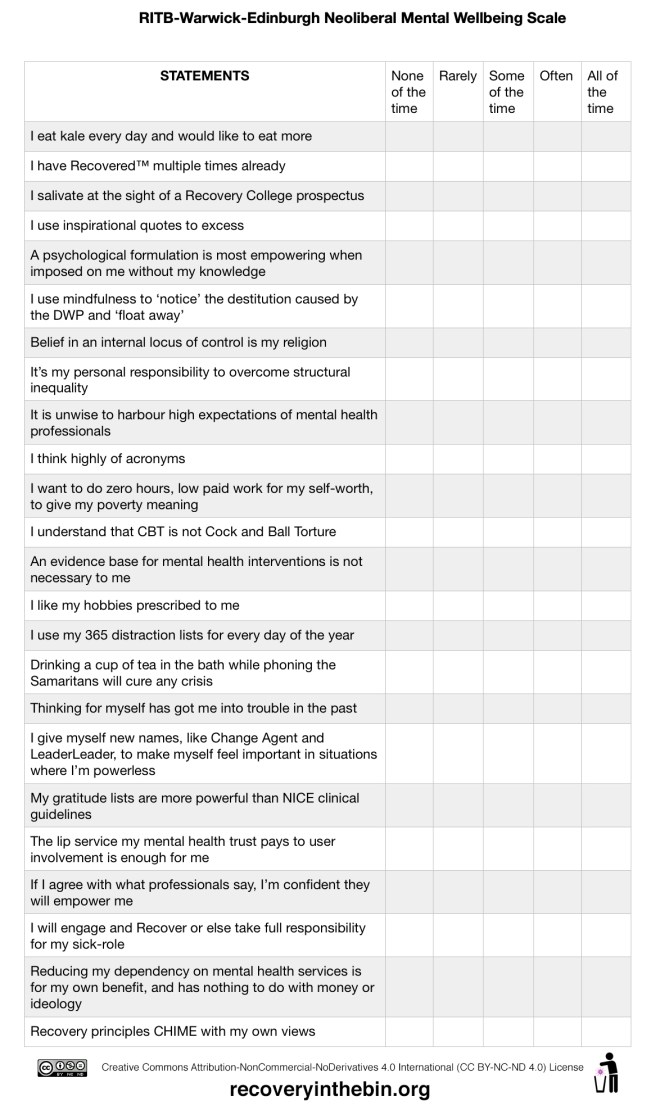
Building on the Warwick-Edinburgh Mental Wellbeing Scale (WEMWBS), The RITB-Warwick-Edinburgh Neoliberal Mental Wellbeing Scale (RITBWENMWBS), is a 25 point scale that has not been validated on any population. We expect the scale to be used widely nationally and internationally in all recovery orientated mental health services.

It draws on the total lack of evidence base for the items it measures, to rate Recovery™ Dependency and Conformity. It is the individual’s responsibility to measure their Recovery outcomes so a score sheet will not be made available. This will empower individuals and ensure the scale forms a meaningful addition to their recovery journey. Or else…

Click to embiggen image HERE or download your own PDF copy to fill in>>>RITB-Warwick-Edinburgh Neoliberal Mental Wellbeing Scale

The RITB-Warwick-Edinburgh Neoliberal Mental Wellbeing Scale 1

Recovery In The Bin (RITB) is covered by a Creative Commons Attribution-NonCommercial-NoDerivatives 4.0 International (CC BY-NC-ND 4.0) License 88x31.png

Problems With The ICD-11 Classification Of Personality Disorder @WHO #ICD11

D7Gkv41X4AUbTzw.jpg-large

By Dr. Jay Watts, Social Psychiatry, Queen Mary, University of London,

The forthcoming International Classiffication of Disease, 11th revision (ICD-11), includes a reconceptualisation of the categorisation of personality disorders with an explicitly expansionist objective. The ICD working group assumes this is a positive step, yet the grounds for this assumption are unclear.

Personality disorders will no longer be classified categorically, but rather using dimensions of severity— mild, moderate, or severe.1 An additional category of personality difficulty will be demarcated not as a disorder, but as the equivalent of a z-code in ICD-10—ie, a non- disease factor that affects health status and encounters with health services. Following assessment of severity, clinicians will then have the option of specifying one or more of five domain trait qualifiers: negative affectivity, anankastia, detachment, dissociality, and disinhibition. ICD-11 will include new guidance for personality disorders to be diagnosed during childhood, albeit with caution, as they had previously been “inappropriately set at late adolescence or early life adult life”[1]. Additionally, the revision will include a borderline pattern qualifier that is not dissimilar to the symptom profiles outlined in ICD-10 and the Diagnostic and Statistical Manual of Mental Disorder, 5th edition.

In their proposals, WHO are neglecting to incorporate progress in alternative approaches. The Hierarchical Taxonomy of Psychopathology transdiagnostic system follows quantitative nosology to its logical conclusion, side-stepping construct validity problems by focusing on internalising, externalising, detachment, thought disorder, and somatisation, as they apply across the spectrum of psychiatric diseases [2]. The #TraumaNotPD movement reframes borderline as a form of complex trauma, evidenced not only by a robust literature connecting childhood trauma and the psychosocial environment with identity disturbance and interpersonal difficulties [3], but also patient testimonials supporting the benign face validity of such an approach.

With the publication of ICD-11, it is likely that more patients than before will be told they have a personality disorder. An explicit aim of the WHO remit for the ICD working group was to increase the diagnosis of personality disorder, on the basis that only around 8% of patients in the UK received this diagnosis, despite suggestions that prevalence of personality disorder is about 40–90% for inpatients and outpatients with psychiatric disorders [1]. The only eld study of ICD-11 diagnosis in practice looked at prevalence in 722 patients presenting with either health anxiety or anxiety and depressive disorders, or inpatients with psychiatric disorders. It showed not only that ICD-11 led to more patients being diagnosed with personality disorder (292 [40·4%] of 722) than did ICD-10 (244 [33·8%] of 722), but also that an additional 248 (34·3%) of the 722 patients were classified as having personality difficulties.2 Thus, 540 (74·8%) of 722 patients were diagnosed as having personality difficulty or disorder [4]. The assumption from WHO is that diagnosis using ICD-11 will prevent patients receiving treatments that they might not benefit from, introduce new treatments, and decrease the stigma that can be associated with personality disorders. However, no evidence as yet supports these assumptions.

In a systematic review investigating personality disorder diagnosis and different clinical populations, a diagnosis often procured negative effects on identity and hope(similar to a diagnosis of psychosis) and did not provide functional utility (such as access to treatments) [5]. This is because the idea of a personality disorder often prejudices clinicians to situate symptoms of distress as manipulative, attention-seeking, and wilful6 and enables disdainful, neglectful, and sometimes even abusive responses that would be recognised as gross misconduct elsewhere in the mental health system, such as ignoring or disbelieving suicidal ideation [7].

The shaping effects of labelling someone as having personality disturbance or disorder appear to be entirely absent from consideration in the revision of the classification of personality disorder, with little or no consultation with service-user led organisations best placed to comment on real-world implications. Clinicians see treatment outcome less optimistically if they are told that someone has borderline personality disorder [8]. Patients have regularly reported that being diagnosed with a personality disorder is the ultimate character slur [9], leading to realisation of every worst fear one has had about themselves, and often reinforcing messages from abusers that they are inherently problematic [10]. To impose this discourse on even more patients, including adolescents, risks setting up a self-fulfilling prophecy by which expectations of a negative trajectory are established, and subsequently met.

Expansionism becomes more dangerous still when we consider that an explicit aim of the WHO working group was to develop a proposal that could be used in low-resource settings by people who are health workers with minimal professional training [1]. Encouraging such a cursory approach to personality diagnosis not only promotes negative thinking regarding differences in mental health and problematic norms, but also gives clinicians in severely overstretched services worldwide a ready signifier to block access to care to anyone who makes them uncomfortable, challenges them, or complains [11]. This will exacerbate discrimination against those from low-income settings, or with a poor education, who are more likely to meet diagnostic criteria for a personality disorder [12].

Borderline pattern has also been included in ICD-11. There is no scientific basis for inclusion, with “noticeable absence of evidence it’s a uni ed syndrome”, and overlap with mood, stress, and dissociation, rather than personality disorders [1]. Indeed “when an assessment was made of borderline features” in the modelling of personality traits “the domain structure seemed to disintegrate, and examining the full implications of this involved a great deal of the group’s time and early studies” [1]. Retention of borderline as a so-called hand- me-down diagnosis not only undermines the scientific claims of the new dimensional model, but also ensures that even patients who find diagnosis legitimising are disadvantaged, being coupled with a diagnosis that is openly contested.

Borderline has only been included in ICD-11 because of relentless campaigning from lobbyists, starting with a letter from the European Society for the Study of Personality Disorders in 2016, followed by campaigning from both the International and the North American Societies for the Study of Personality Disorders [1][13]. This led to a separate working group, though the Chair of the ICD-11 committee chose to exclude himself [1], having written “nothing about it is driven by personality. The very name borderline personality disorder betrays an abrogation of diagnosis” [14]. The discourse from WHO is that the pragmatic compromise of including a borderline pattern to assuage these lobbyists is now unanimous [1]. Unanimous for whom? Certainly not patients, the majority of whom are traumatised women who remain largely unheard and ideologically restricted (coshed) by this most misogynistic of classifications [7] and who cannot take refuge in a narrowly de ned new diagnosis of complex post-traumatic stress disorder, as so many had hoped.

1 Tyrer P, Mulder R, Kim YR, Crawford MJ. The development of the ICD-11 classiffication of personality disorders. Annu Rev Clin Psychol 2019; published online Jan 2. DOI:10.1146/annurev-clinpsy-050718-095736.

2 Kotov R, Krueger RF, Watson D,et al. The hierarchical taxonomy of psychopathology (HiTOP): a dimensional alternative to traditional nosologies. J Abnorm Psychol 2017; 126: 454–77.

3 Giourou E, Skokou M, Andrew SP, Alexopoulou K, Gourzis P, Jelastopulu E. Complex posttraumatic stress disorder: the need to consolidate a distinct clinical syndrome or to reevaluate features of psychiatric disorders following interpersonal trauma? World J Psychiatry 2018; 8: 12–19.

4 Tyrer P, Crawford M, Sanatinia R, et al. Preliminary studies of the ICD-11 classiffcation of personality disorder in practice. Personal Ment Health 2014; 8: 254–63.

5 Perkins A, Ridler J, Browes D, Peryer G, Notley C, Hackmann C. Experiencing mental health diagnosis: a systematic review of service user, clinician, and carer perspectives across clinical settings. Lancet Psychiatry 2018; 5: 747–64.

6 Black DW, Blum N, Pfohl B, et al. Attitudes toward borderline personality disorder: a survey of 706 mental health clinicians. CNS Spectr 2011; 16: 67–74.

7 Phillips S, Stafford P, Turner K. Personality disorder in the bin. 2017. http://aspd-incontext.org/wp-content/uploads/2016/11/PDintheBin- London-PS-KJT-3.5.17-1.pdf (accessed March 28, 2019).

8 Lam DC, Poplavskaya EV, Salkovskis PM, Hogg LI, Panting H. An experimental investigation of the impact of personality disorder diagnosis on clinicians: can we see past the borderline? Behav Cogn Psychother 2016; 44: 361–73.

9 Shaw C. The most savage insult. Equilibrium Magazine 2012; 46: 23–26.

10 Gary H. A diagnosis of ‘borderline personality disorder’. Who am I? Who could I have been? Who can I become? Psychosis: Psychological, Social and Integrative Approaches 2018; 10: 70–75.

11 Recovery in the bin. A simple guide to avoid receiving a diagnosis of ‘Personality Disorder’. Clinical Psychology Forum 2016; 279: 13–16.

12 Coid J, Yang M, Tyrer P, Roberts A, Ullrich S. Prevalence and correlates of personality disorder in Great Britain. Br J Psychiatry 2006; 188: 423–31.

13 Reed GM. Progress in developing a classiffication of personality disorders for ICD-11. World Psychiatry 2018; 17: 227–29.

14 Tyrer P. Borderline personality disorder and mood. Br J Psychiatry 2014; 205: 161–62.

First Published in The Lancet

Recovery In The Bin (RITB) is covered by a Creative Commons Attribution-NonCommercial-NoDerivatives 4.0 International (CC BY-NC-ND 4.0) License 88x31.png
Neoliberal Mental Health Rating Scale

dial nlb

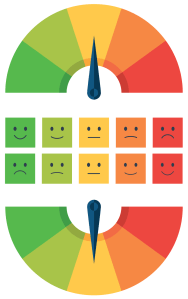
0-29: Totally inadequate life, which does not address the requirements of capitalism. Shows extensive understanding of how to be a productive worker but wilfully resists. Pervasive political engagement on the Left, including direct action. Rejects A-B marches (the only state-sanctioned form of quasi-protest). Has a bustcard tattooed on arm.

30-39: Mostly inadequate life which involves some mildly productive labour, but does not show much evidence of embracing capitalism or working towards improving economic productivity.

40-49: Poor life, which shows some evidence of economic productivity and understanding of what needs to be done, but lacks conscientiousness. Frequent A-B march attendee.

50-59: Satisfactory contribution to capitalism, showing an awareness of the need to make bosses rich and belief in the constructs of “meritocracy” and “social mobility”. However, shows some evidence of political engagement on the Left and dissent.

60-69: Good work, which treats capitalism with the respect it is due. However, still some mild political engagement, including attendance at A-B marches.

70-79: Excellent work, which displays exceptional contribution to bosses’ salaries including developing novel approaches to economic growth. No political engagement beyond laughing at socialist ideas expressed on BBC Question Time.

80-100: Outstanding economically productive work in virtually all areas of life. Married. Straight. Two children. Owns north London house. Donates to established neoliberal parties and corporate charities – in line for OBE for doing so. Has enabled multiple chief execs to buy yachts. Has a tech startup which will revolutionise mental health in corporate environments, seed capital for which came from remortgaging house. Vocal advocate of mindfulness in schools initiatives. Did a TED talk on helping others achieve their potential.

Recovery In The Bin (RITB) is covered by a Creative Commons Attribution-NonCommercial-NoDerivatives 4.0 International (CC BY-NC-ND 4.0) License 88x31.png
What is Recovery? Who defines it? Why am I unrecovered?

Screen Shot 2019-04-26 at 16.46.47

What does recovery mean to me? Well, after thinking about this for many days, the simple answer is that I have no idea. I don’t know what it might be like or feel like. What am I supposed to be recovering from? How do I recover? I’m not sure I can recover from some of the things that have happened and are happening to me. Neither am I sure I actually want to. I realise that the reason it’s hard for me to define recovery in my own terms is because the word has been so trampled over. Recovery has been sold to me by the MH system and other organisations. I’m bombarded with positive affirmations and stories from those who have recovered. I’m regularly told that I can recover but not how this is actually possible. Care Plans are now called Recovery Plans, Peer Support Workers are called Recovery Workers. I’m expected to fill in a Recovery Star before and after a MH crisis. I’m told I should go to the Recovery College. I see that being employed is linked with recovery.

I feel sick! I feel that I haven’t tried hard enough and that I am to blame. The oh so familiar feelings that I can’t label and that I have had since I was a kid return. Uuuurgh. I don’t choose to be unrecovered. Yet, I long for this thing they call recovery and am pleased for those that have recovered. It’s complicated and confusing. I think it has something to do with power, privilege and opportunities. I wonder whether to delete this sentence as I don’t want to offend anyone. I decide to leave it in for now.

I decide to look for a definition of recovery online. I look at a Trust Recovery Strategy:

“Our purpose is to create a culture and context in which people can recover: to provide interventions that enable people to take back control of their lives, to believe in the potential of everyone we work with so that they too can feel hopeful about their futures. We give access to opportunities so that people really can live the lives they want to lead.”

“Recovery can be seen as a process and can be most helpfully defined by three core concepts: hope, control and opportunity.”

I start laughing out loud to myself. I have none of these three things. One of the reasons that I’m unrecovered is because of the mental health system itself. This hostile environment is not a culture conducive to recovery. In my experience it has actually got worse and I don’t see it improving any time soon. How can I recover from having the shit and sticky label of ‘Bullshit Psychiatric Disorder’ slapped on to me two and a half decades ago. A label that is tantamount to saying that my difficulties come from within myself? I can’t get it changed or updated to CPTSD. I’ve tried. I’m told I’m lacking insight and that I’m failing to accept my diagnosis. My anger and complaints are pathologised as so called traits of a disordered personality. The label and all that comes with it is are the complete opposite of helpful and has led to neglect, abuse, and cruelty. I need a diagnosis to enable me to get support for my difficulties and for the best chance of getting welfare benefits. It’s MH services themselves who decide when to discharge me and this could happen at any time for failing to engage or for not recovering.

The childhood trauma I suffered has been ignored and in many ways I’m seen as a walking diagnosis and a set of symptoms which limits the choices of therapy I can access and how I am perceived as a human being. The group therapy I have had so far (DBT and Therapeutic Community) did not help. It made me feel worse. The few professionals that do understand say they are as frustrated as me about the MH system. How could they be? How do I recover from an illness I never had? How do I recover from childhood trauma when I have had no specific meaningful help to do this, and still feel like a victim and not a survivor? There is no specific trauma therapy as standard in the Trust and I have been turned down for funding by the CCG because of my ‘BPD’ label. I think about what recovering from incest would feel like. I don’t know. I wonder whether if I did recover, would this mean that I had forgiven my abuser? I don’t want to. I wonder how I can recover from the suicide of my little bro. Does anyone recover from something like this? If I did recover would that mean that I never think of him?

How do I recover from ongoing iatrogenic harm? The powerful, coercive, and controlling nature of the mental health system has caused me to be locked up many times against my will, sometimes I now realise illegally. I’ve been on a cocktail of drugs with no informed consent for decades that are contrary to NICE guidelines. I have had no support to taper and stop these drugs from services despite asking for many years. I’ve been restrained several times. Threats of MHA assessments, threats that if I don’t turn up for appointments that the police will come looking for me. My daughters have been contacted on several occasions and told to look after me 24/7 until a bed can be found and to call the police if needed. Our relationship has been ruined. I can’t recover from the continued loss of my human rights. How do I start to be kind to myself when the people who were and are supposed to care for me have and still do hurt me so badly?

How do I recover from transphobia? I’ve been told by professionals that I have ‘BPD’ because I am transgender or that I am transgender because I have ‘BPD’. The Trust do not follow their policy for Transgender Patients and I am doing my best to inform the professionals I see about transgender issues as I have not met any who understand. They need more training especially surrounding the way gender dysphoria and transphobia can affect my mental distress. I was outed as being transgender to my family by a MH professional who thought it a good idea to change my name on the system without thinking to ask my permission. My daughter was contacted as my nearest relative when I went AWOL from a locked up place. My family knew that I was transgender I’m sure, but I was gently and sensitively leading up to telling them in my own way and in my own time. They now equate a mental illness and a time they thought of me as completely crazy to my being a trans guy. They do not accept that this is who I am and always have been. Our relationship has been further ruined.

How do I recover from the coercive welfare benefits system and the doom filled feelings that come with this? DWP assessment processes, the fear of the brown envelope through the letter box, the sanctions, being investigated for fraud. Trying to prove to them that I am not able to work and that my difficulties are severe enough to get enough social security to survive on. The push I see from the Government to get everyone back into employment whatever the cost and that apparently work is good for my mental health and aids this thing called recovery. The fear that I may lose some of my disability benefits at any time which may force me into work when I simply am not able. This would lead to sanctions and debt and possible homelessness. How do I recover from the fact that I can’t afford to pay for therapy that may well help me? How do I recover from the fact that the Personal Budget I receive to employ a Personal Assistant to support me has decreased to almost nothing? The one thing that has helped me to be in control of having some sort of quality of life and social inclusion?

I still have no idea what recovery means to me or what it might be like or feel like. This I realise is because I am unrecovered. I can’t see that changing anytime soon. I do know that I have given up on the idea that I should live up to the definitions of recovery from others and the false ideals of what people think I should be and should do. I’m sometimes asked by professionals “what do you think would help you?” My answer remains the same as it always has been “To be dead”. But I’m not dead and I’m here aged 58 writing this blog. It’s painful this thing called ‘life’. I realise that I am privileged because I can and want to write down my own story of unrecovery and I think of the many that don’t want to or can’t. I think of how other people’s stories will be different to mine. I think of those who are not alive to tell their stories, some whose blogs I have read and some who didn’t get to write down their words.

I think it’s important that the stories of those that are unrecovered are heard. People like me are not invited to do keynote speeches at conferences or events and to be honest I feel too unrecovered to do so if asked. I can’t attend events to get my unrecovered voice heard unless they are free and travel expenses are covered in advance. I’m not the kind of service user who is included in co-production. Does anyone actually want to hear from the unrecovered? Could they learn anything from us? The drive towards this thing called recovery by the many powerful ones that don’t help me to recover is catch 22. I’m fighting to take back some power hope, and control but it isn’t working and this leaves me feeling suicidal. I wonder whether the words I have written will make sense to any of you reading them? I wonder whether people will comment to say how I should define recovery and how to work towards it? I don’t want my story misrepresented or twisted to fit into someone else’s narrative. It’s my story not yours.

By G

Recovery In The Bin (RITB) is covered by a Creative Commons Attribution-NonCommercial-NoDerivatives 4.0 International (CC BY-NC-ND 4.0) License 88x31.png