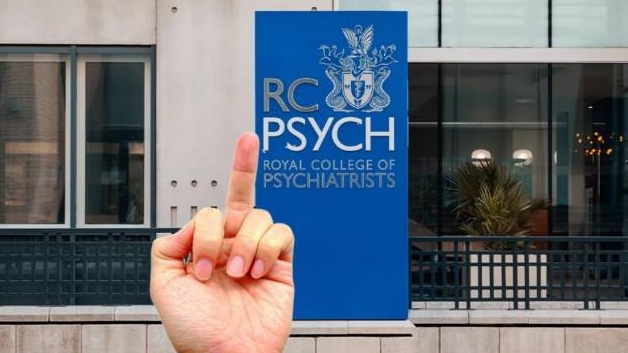
A survivors response to the Royal College of Psychiatrists (2026) Position Statement PS04/26 – ‘Addressing the impact of non-recent child sexual abuse on the mental health of adults’
In August 2026, the Royal College of Psychiatrists published a “landmark” position statement on the impact of non-recent child sexual abuse. It seemingly acknowledges that survivors have been disbelieved, retraumatised, misdiagnosed, and harmed by mental health services. It recognises the relationship between childhood sexual abuse and experiences extending beyond traditionally defined PTSD, including substance use, dissociation, and psychosis. It acknowledges Dissociative Identity Disorder (DID) as a real and historically contested diagnosis, and that this controversy has contributed to survivors being underdiagnosed and misdiagnosed. It appears to confront the harms of psychiatric diagnosis itself: the medicalisation of distress, shame, stigma, diagnostic overshadowing, and the fragmentation of people across multiple diagnoses. Splashed across the pages, prominently displayed survivor testimony describes generations of sexually abused women pathologised as personality disordered, calling the personality disorder (PD) construct systemically harmful, demanding its abandonment. And, extraordinarily, the President of the Royal College apologises for the “avoidable” harm survivors have experienced within mental health services.
These seem like pretty bloody significant admissions. There are things in this statement that survivors, activists, and critical professionals have fought for centuries to have psychiatry acknowledge. There is something enormous about seeing them written down in an official statement from psychiatry’s own professional body. Some of what is contained in these 94 pages would have been almost unimaginable as an institutional position not very long ago.
My first response when I read it was: They can get fucked.
Perhaps I was supposed to feel vindicated. Here, finally, was psychiatry acknowledging things survivors have spent our lives trying to make it acknowledge. Instead, I felt incensed. Because acknowledgement without responsibility is an insult. These things didn’t simply happen to us. People did them. Psychiatrists did them. And now, after all this time, I was being offered a half-arsed apology from a PDF. I don’t want a half-arsed apology from a PDF. I don’t want to be told that survivors have suffered “avoidable harm” because psychiatry was sometimes insufficiently aware, insufficiently trained, or accidentally got things wrong. I want a person to look at what was done to me and my peers and name it; I want them to acknowledge that we objected while it was happening; I want them to tell us that we were right, that they were wrong, and that it should never have happened. I want someone to own what psychiatry – and psychiatrists – did to us. Instead, within a paragraph of its “apology”, the College is already looking after the psychiatrists. “This will feel like an uncomfortable and unfair criticism”, we are warned, of professionals who “dedicate their lives to helping their patients”, particularly those who “do work hard to get this right.” Harm becomes “unintentional”, caused by “what is considered best or normal practice”, lack of training or awareness, or healthcare systems and structures.
But you see, I. Don’t. Care. whether you “intended” to hurt me. Intention is not accountability. “Did you mean to harm us?” is a fundamentally different question from “Did you harm us, did you know you were harming us, and what did you do when we told you?” If it was “avoidable”, why wasn’t it avoided?
Flicking through, page by page, it’s startlingly obvious how professional innocence and need for staff safety is repeatedly preserved. Even in a document supposedly about the psychiatric harm experienced by survivors of child sexual abuse, considerable space is made for professionals’ own self-care, and potential to be harmed vicariously by hearing about our trauma. Elsewhere, clinicians faced with inadequate trauma services are described as potentially experiencing “ethical dilemmas” and “moral injury” when they can’t help but harm us. Apparently even our mistreatment requires consideration of how distressing mistreating us might be for them.
Somehow, throughout the entire document, unless they are patting themselves on the back, or comforting each other about how hard it is to harm their patients, professionals are entirely removed. Services seemingly run themselves, while patients are assessed, diagnosed, treated, detained, restrained, abused, neglected, and harmed by some nebulous, undefined power beyond the control of the profession. Psychiatrists magically appear when there is compassion, hard work, or good intention to take credit for – but when there is harm, suddenly nobody is holding the pen. Nobody in this document wants to be the person who did anything wrong.
The same instinct appears when the College approaches sexual abuse perpetrated within the mental health system itself (I say “approaches” – it generously apportions one whole sentence out of 94 pages). It tells us that it is important to acknowledge that, “even if rare”, some survivors were sexually abused within children’s mental health services. “Even if rare” is doing an extraordinary amount of work there. The harm is minimised before it has even been acknowledged. At no point does it say who is abusing the children (staff? patients?), while children confined and abused on adultpsychiatric wards disappear from the sentence entirely – their highly documented and widely shared experiences of abuse don’t even exist. Most extraordinarily, or perhaps not, nowhere is there an apology from psychiatry for the fact that children were (and still are) sexually abused within psychiatric services. Psychiatry is apparently prepared to (sort of) apologise for the harm it caused survivors of CSA, while quietly acknowledging that some of that CSA was actually perpetrated within its own institutions, by its own staff, without apologising for that. Bit too uncomfortable is it? Once again, nobody did anything. Nobody abused the children who were abused; nobody failed to protect them; nobody allowed it to happen. It just happened “within children’s mental health services”.
This is what makes the College’s repeated appeals to “lack of awareness” so difficult to stomach. Psychiatry did not discover the relationship between childhood sexual abuse and mental distress in 2026.
It has always known.
In 1857, Dr Auguste Ambroise Tardieu documented the sexual abuse of children, including abuse within families. In the nineteenth-century Salpêtrière hospital, Charcot encountered sexually abused women among those diagnosed with “hysteria”. Freud’s patients told him about childhood rape and sexual assault, and in 1896 he publicly connected childhood sexual experiences with “hysteria” and “obsessional neurosis” before taking a dramatic u-turn – subsequently (and disgustingly) relocating the origin of CSA into fantasy. Across these histories, knowledge of sexual violence repeatedly collided with theories which located pathology inside the people subjected to it; and within it all, psychiatry had the power. This was not an abstract disagreement about how best to conceptualise distress. Survivors of sexual violence were disbelieved, detained, confined, sterilised, subjected to electroshock, insulin comas, lobotomies, and other damaging and even deadly interventions. Their resistance itself often became – and still becomes – evidence of pathology. Their accounts of what had happened to them were – and still are – transformed into evidence about what was wrong with them.
The College did not officially exist when this history began, but this is part of the intellectual and institutional ground on which it was built. The College’s predecessor, the Association of Medical Officers of Asylums and Hospitals for the Insane, was founded in 1841 – right at the heart of these early academic and clinical discussions. You do not get to inherit the authority, knowledge, and professional lineage of your predecessors while becoming historically weightless when somebody asks who bears responsibility for what that profession did, hiding behind words like “normal practice”. “Normal practice” is not the fucking weather. Professions create normal practice. They teach it, publish it, defend it, reproduce it, and enforce it. If generations of survivors tell you that your “normal practice” is harming them, you cannot indefinitely call the resulting harm an unfortunate consequence of insufficient awareness. If we told you that you were hurting us and you carried on, the problem was never that you didn’t know.
I am a survivor of child sexual abuse, and sexual violence as an adult. This has been the heart of most of my interactions with mental health services for the past 14 years. Like most people with my history and presentation, I was labelled with personality disorder. I was later diagnosed with DID and trauma-related psychosis, but the harm was already done, and continues to be done. This position statement isn’t abstract for me, it’s about my life. Not only that, but my name appears twice in the citations – my own survivor testimony used to create the document. Putting aside my anger, I tried to read it with some sense of objectivity, there were some good things – DID was being recognised; psychosis was too; personality disorder appeared highly criticised; and ‘false memory syndrome’ was finally put to bed. There were things I disagreed with also, such as the conclusion that formulation was the way forward, with absolutely no consideration for how many survivors experienced formulation as exposing and unsafe. Nobody appeared to have thought about the administrative usefulness of a diagnostic label in retaining a person’s confidentiality, dignity, or sense of control. I guess none of them have ever thought about what it would be like to submit a document detailing all the ways you were sexually abused to the local council to get a blue badge, or to your university to get reasonable adjustments…“What happened to you?” sounds wonderfully humane until the resulting formulation containing your most shameful and humiliating secrets is taken from you and forced to travel through bureaucratic systems, baring your soul to anyone and everyone who works at a desk. There was also an overall sense of the statement lacking teeth. DID was recognised, but there was no statement that the College would be pushing for NICE guidelines for dissociative disorders. Despite overwhelming evidence of the link between CSA and self-harm/suicidality, the words “self-harm” were only used twice, while suicide wasn’t discussed at all – there was no guidance on how this should be approached in practice. I wondered if they had perhaps published the first draft instead of the finished document. Where was the actual change it implied it was creating? It became a bit much, I had to have a break. As angry as I was upon the first reading, it was only when I came back and read the statement again after a few weeks that I realised it was actually even worse than my first impression.
On my first reading, my eyes had been drawn to the large, brightly coloured quotations scattered throughout the document. They say the things survivors have been screaming at the mental health system for decades: “Don’t attach the sticky label of borderline personality disorder”; “The personality disorder construct is systemically harming childhood sexual abuse survivors”; “We have known about this harm for many years”; “It is time to abandon the ideas behind this diagnosis”. One contributor says that while working in a personality disorder service they realised almost every patienthad been sexually abused as a child. Another says that if you disclose childhood sexual abuse and you are a woman, you are more than likely to end up diagnosed with personality disorder. It felt extraordinary reading these in an official College position statement – no wonder I thought the College had admitted something enormous.
Then I read the document again without reading the bright boxes, and nothing happened. Remove the survivor quotations from this supposedly co-produced document and the position statement remains intact. There are no holes in its argument, no missing steps, no paragraphs rendered incomprehensible because the knowledge on which they depended has disappeared. The survivors’ words sit visually front and centre, but the institutional argument does not depend upon them.
Look at what happens when those survivor voices collide with the College’s actual words.
Survivors say the personality disorder construct is overdiagnosed, systemically harming survivors, and should be abandoned. The College says “a proportion” of survivors have been treated in personality disorder services, which “have often been the only specialised psychological services to provide long-term care for patients with complex presentations”. Patients are described as “obtaining a diagnosis of EUPD” to access that treatment – as though we wandered into a hospital and picked one up at the gift shop. When the harms they don’t want to acknowledge around personality disorder are discussed, the institutional acceptance and authority disappears, and we are left with “survivors describe”, instead of “personality disorder is harming”. The college immediately reminds us that personality disorder “remains a controversial area within psychiatry”. Then the statement explicitly pivots to tell us: “This isn’t a matter of contested concepts, disputes about labelling or diagnostic models”, before criticising NICE for allowing PD to be diagnosed without structured assessment or collateral history – as if NICE guidelines themselves do the diagnosing. Later, the statement recommends (on the basis of survivor work which I contributed to) that specialist trauma services need to be separate from personality disorder services, while also, incredibly, concluding that despite this, “a significant number of survivors may not require specialist trauma services”. (Deep sigh). The personality disorder service survives. The construct survives. So does the contradiction of knowing that the people supposedly belonging there are overwhelmingly survivors. Specialist trauma services probably aren’t even that important.
The College has found an ingenious way to borrow the radicalism of survivor testimony without adopting its conclusions. Survivors are given visual prominence while the institution retains deniability. Their words make the document look brave, while in reality, nothing new is said. In the most incredible display of cowardice, the statement even tells us that these quotations are personal perspectives which “do not necessarily represent the views of the College”. That matters. Rape Crisis, responding to the statement, praised the way survivors’ “truths are rightly front and centre”. I initially read it similarly. But, in reality, their truths are front and centre on the page. They are not front and centre in the position.
This is not what co-production means. Co-production is not writing an institutionally comfortable document and decorating it with survivors’ words in pretty boxes. If survivor knowledge has no consequence for the argument, if it can be removed without changing its meaning, and if the clearest demands can be printed in enormous coloured letters while the actual position walks straight past them, then their presence is simply stolen legitimacy for conclusions they did not produce. And perhaps that is what I find most unbearable about this statement. Psychiatry cannot say that survivors have not told it. It cannot say that the critique was unavailable. It cannot even say it failed to hear the survivors involved in producing this document. You heard them closely enough to transcribe them; you heard them closely enough to type up their words; you heard them closely enough to put them in brightly coloured boxes. And then you carried on.
But this is bigger than some brightly coloured boxes. The boxes are simply a reflection of the problem that runs through this entire statement, and through the history it refuses to acknowledge. Psychiatry knew sexually abused women had been sexually abused, and diagnosed them with hysteria anyway. Psychiatry knew what had happened to survivors while it confined them, pathologised them, sterilised them, electrocuted them, lobotomised them, and subjected them to treatments that harmed and killed them. It knew when generations of survivors told psychiatrists that their disbelief, theirdiagnoses, their restraints, their detentions, and their withdrawal of care were harming us. It knows that children have, and continue to be, sexually abused inside the institutions psychiatry itself created and controls. It knows what happens to survivors funnelled into personality disorder services, because survivors have been telling it for decades. It knows because its own 94-page statement says so. And where survivors have gone further than the College is prepared to go, it knows that too, because it has printed their words in separate boxes, and added a quiet disclaimer.
This is not a problem of awareness. You knew what was happening to us. You knew what had happened to us. You knew what you were doing to us. We told you. Other survivors told you. Your own literature told you. And still, apparently, our suffering wasn’t sufficient to make you stop.
So fuck you. You knew, you still know, and nothing in this document can convince me that you have any intention of changing anything. I don’t believe that you are sorry. I don’t think you even know what the word means.
Wren Aves


