by Diana Rose
Abstract
Introduction: This paper makes a specific contribution to the history of mad people / survivors through theoretical argument and the analysis of five transcripts of people who were interviewed for a general project but have died since the time of their interview.
Method: Five transcripts were analysed using a Critical Discourse Analysis framing. Nvivo 12 was used with a focus on the ‘Annotations’ function of the software.
Results and interpretation: General aspects of the interviews are presented followed by four recurring narratives: organisations; knowledge; change over time and hopes for the future
Conclusions: The paper at the least extends the method of oral history. It also identifies those things that were most significant for these early activists and knowledge makers with lessons for today.
INTRODUCTION
This article is a very specific contribution to the history of the survivors’ movement, particularly in the Global North. Writing this history in general has many obstacles. At a ‘disciplinary’ level, survivors have mainly concentrated on their relations with psychiatry and mental health systems more widely and latterly, in the UK at least, on the social welfare system. History has had less attention or devotes very little space to survivors (Crossley 2006). But there is a bigger if analogous hurdle in that history as a discipline has approached psychiatry ‘from above’ – the famous psychiatrists, the turning points in policy, the intersection with law., the scandals and cover-ups and so on. We lack, as Blayney puts it, “a history from below”, a history of the multiplicity of resistances on the part of those disenfranchised in this domain (Blayney 2022). There is not a complete absence, of course. In respect of the United States, Morrison has interviewed people active in the 1970s and 1980s in a book entitled Talking Back to Psychiatry (Morrison 2013). Mad Studies has produced important historical work but most famously in the form of (auto)biographies situated in the historical and political conditions of their formations. Reville worries, but cogently, that Mad people do not know their own histories (Reville 2021). Reville and Church give an account of Mad Studies specifically in Toronto over five decades (Reville and Church 2012). This work crossed the Atlantic with the establishment of a course on Mad History and Identity in Edinburgh (Ballantyne, Maclean et al. 2020). This course is now threatened with closure highlighting the fragility of such work in the neoliberal academy ( see also (Beresford and Russo 2016). I cannot do justice to the debates involved here but am arguing that this ‘history from below’ is only beginning and is facing major obstacles.
More information can be gleaned from the grey literature and websites, the most cited of which (at least in the UK) of is the Survivor History Group’s timeline (www.studymore.com). The SHG has also published a paper on questions of historical theory and method (The Survivors History Group 2012). The website is comprehensive, containing varied items including many first-hand accounts, but it is also fragmented. As I write, it is being thoroughly updated. Smaller collections, such as Anne Plumb’s Ear to the Ground is more local but carefully catalogued, containing objects, photographs and art as well as text and deposited in the Archive Section of Manchester (England) Central Library (with the correct ambient temperature). It is free to view by the public or at least will be in a few months: for the moment it is accessible to researchers( A. Plumb personal communication 17/04/24). Judi Chamberlin’s (see Chamberlin, 1991) personal archive in Boston is similarly carefully catalogued and can be searched digitally. As would be expected, it contains a wealth of information from one of the leading figures in survivor activism and knowledge making in the USA. But these curated collections are exceptions, and this highlights a significant problem. We do not have anything approaching an ‘archive’, of the survivor movement or many elements of it. Many key documents, such as campaigning leaflets and meeting minutes, have been destroyed or are stored (or stuffed in drawers) in people’s private homes. Gradually this history is surfacing but it will always have gaps and we do not even always know what they are. Blayney (op. cit.) advocates oral history as the best approximation to surfacing the lives and action of our ancestors. The problem of course is that many of these pioneers are no longer with us. I attempt here a small remedy.
This article is part of a wider project called EURIKHA (Explorations in Survivor Research, Knowledge, History Activism). Funded by the Wellcome Trust, it aimed to highlight the activism, knowledge and thinking that was and is being created by survivors / people with psychosocial disabilities globally. I focus on five interviews which at first sight may be for a morbid reason – these five people have died since they were interviewed. In three cases, their interviews were their last public record which to me is reason enough to write about them. But there is something more important and a lesson for today. The tone of all but one of the interviews is quite despondent. Their initial high hopes did not bear fruit. The current landscape stands as a shadow in contrast. One theme that recurs is that their novel ideas were ‘coopted’ by the mainstream, an insidious form of power. Of course, many say this in retrospect (Beresford and Russo 2016, Author) and some even anticipated it (Harrison, Barnes et al. 1997). But this is not the same as witnessing and participating. To stay with the example of co-option, we have step by step (but non-linear) accounts of how the originators of an idea or practice saw it gradually change from centering the ideas and plans of survivors to being radically modified, hollowed out and taken over by academics or practitioners to serve their own purposes. So, they were commodified. I hope we can try to learn lessons from this. Equally, there is much said about organisations and relations between organisations that teach us, at least, not to repeat mistakes. Again, some of the people we interviewed for the project as a whole called themselves ‘user researchers’ or a cognate term. Our participants did too, but not as we think about this today. The self-described nature of the five focused upon here in their role of ‘researchers’ surprised me. Although all had worked in jobs or voluntary organisations with ‘researcher’ in the title, everyone doubted their qualifications to be such. Much as they criticised psychiatry from every angle, they appeared to accept ‘research’s’ representation of itself and they found themselves wanting in relation to it. This is redolent of an internalisation of Fricker’s epistemic injustice’ (Fricker 2007). It would seem that things have changed here but we should ask if there are legacies. These are just a few examples of the reasons why I argue that these voices from the past deserve attention.
We did not only have the recordings and the transcripts, we had other material – textual, visual and artistic – authored by the participants and later commentators. Important in itself, this also partially, but not completely, resolves one issue that besets this kind of work and that is the role of memory. Although the classic oral historians believed that by capturing the ‘words’ of their informants they were capturing that person’s ‘truth’, they did not reckon with the forces that shape a story at any one time (Sharpless 2008). In other words, many things intervene between an event and its telling as a memory (Weedon and Jordan 2012, Molden 2016). The interview context itself is one such factor. We did what we could to level the power relations between participants and interviewers – we were all service users, the participants were paid and much background work was carried out prior to the actual interview. In fact, often there was a pre-interview interview especially if the interview was done on Skype with its attendant technical problems. And although it is anecdotal, it did not seem that anyone over-estimated their influence: the general air of despondency is testament to that. This applies only to the Global North, from where these interviews were conducted. The Global South is another story.
ETHICS
The project was given ethical approval by King’s College London Ethics Committee (RE MAS) LRS 16/17 4502.:
But there is more to ethics than Ethics Committees. There was a specific dilemma about whether to name people. This is especially difficult here as it is likely that some readers will be able to guess who some of the participants were but not others. Additionally, there was no consensus on this between participants on the consent form. Since this is outwith our control, we decided against naming, aware that it was an imperfect solution. More generally, there are ethical issues to do with members of a movement or organisation researching the group to whom they belong (Gillan and Pickerill 2012). We were not neutral. We wanted to crack the myth that mental patients are so disorganised they can neither think nor engage in activism for change. It would take a whole book to describe this in relation to the project as a whole, but here I aim to show the role of pioneers. Using this term does not imply individualism as all participants were part of organisations or collectives. An additional issue regarding anonymity, is that this article is not fully referenced. It does not contain writings either by the participants or commentaries about them. Not scholarly, of course, but to include such references would break anonymity.
METHOD
Participants
There were three participants from England / Scotland; one from Germany and one from the Czech Republic who originated from Australia. Four were women and there was one man. Their ages ranged from 47 to 101. All were white and all had been prominent in knowledge making and activism in the later (and in one case earlier) decades of the 20thcentury. The racialisation issue was addressed elsewhere in the project and emerged in the interviews focused on here, as we shall see. They were therefore a diverse group and so we might expect unique stories. This turned out not to be the case.
Not all interviews were in English, some team members spoke more than one language, but we also made use of interpreters. One of the relevant interviews was exceptional in this regard and deserves mention now. Those present were: the participant, the interviewer who spoke in English; a bilingual interpreter; the participant’s advocate and – a psychiatrist! We did not invite this professional. In fact, we did everything we could do keep them away. However, the participant raised no objections and we had to be led by them. Perhaps unsurprisingly, this professional took a leading role – rephrasing questions, interrupting, answering for the participant and adding their own information. One could say this configuration broke every rule in the book and we should not have included this interview. But by doing so, we saw and heard in real time the power dynamics that are in play when an all-user project is defiled by the presence of a psychiatric professional who levers their authority in such a way that the main participant is, not silenced exactly, but layered over by psychiatric power. As cameo, it added to some of our arguments and so it was included.
Analysis
I have addressed aspects of method above and the full theoretical and methodological approach is described in another paper (Author). But a brief word needs to be said here about the analytic strategy. We did make use of software, NVivo 12, but it was not inductive. We took Critical Discourse Analysis as the overarching frame and so questions and categories were influenced by that as well as immersive reading (Weiss and Wodak 2007, Fairclough, Mulderrig et al. 2011). Importantly the emphasis was not on the coding function for these early participants. Liberal use was made of what NVivo calls ‘Annotations’. These allow you to mark text and then to develop ideas, compare across time and people and focus on specific examples, for example, suggestions for alternative supports. So, the analysis was also iterative as annotations could be changed or added to in the light of later interpretations. Annotations can be searched and could also refer to relevant literature by the participants themselves or later commentators.
RESULTS AND INTERPRETATION
As I take the view that ‘results’ never ‘speak for themselves’, the following combines what was said with my interpretations of this.
The interviews – general
All the interviews were a mixture of discussions of survivor activity and knowledge making and autobiographical detail. Often, the autobiographical detail exemplified some aspect of a more general theme or gave a glimpse into the ‘underside’ of, for example, organisational relations or policy changes. On occasion, it was the disclosure of something painful, such as a bereavement. But this bore on the meaning of the interview even although it seems purely personal. There was also a time dimension to this balance between the general and the personal. The latter tended to come later in the interview which speaks, perhaps, to a growing trust and sense of commonality in the dialogue. In addition, time / memory did not unfold in a linear way, there were loops backwards and forwards, revisions, false starts, long gaps and contradictions. Although the presence of contradictions could be incorporated into some stereotype of ‘mad’ people being ‘incoherent’, in fact this is consistent with the literature on spoken language. The early discourse analysts were at pains to stress that ‘ordinary’ language does not follow the rules of syllogistic reasoning but is non-linear and often filled with unresolved contradictions (Potter and Wetherell 1987). In this our participants were no different to ordinary language users, which may come as a surprise to those who pathologize such forms.
One thing stands out and it is the passionate nature of what was said. Fear, hope, pain and humour permeate the transcripts. The movements and the person’s role in them really mattered to these individuals, they were proud of their achievements (although usually referencing others) and devastated when things went wrong. They were despondent at how things had turned out in the present day but they were not bitter. For the person from the USA there was absolute fury at the “current incumbent of the White House” (it took a long time to actually name Donald Trump). I was surprised to learn that Trump had even de-funded relatively small projects and organisations which did not align with his ideology. No doubt these decisions were ‘delegated’. The passion of the respondents comes through most clearly in listening to the audio-recordings. To read the following in a transcript: (….(LAUGHTER)) does not come close to listening to two people laughing either ironically or with unadulterated hilarity.
The next section will address four themes, that although differently both contextualised and emphasised, were ever-present
- Organisations – micro and macro -organisational relations and power
- Research and Knowledge
- Change over time
- What of the future?
Organizing the material this way risks boxing off the different sections but it will be clear that they intersect in multiple ways.
Organisations
I take this first because it is the most complex and all participants talked about it at length even though the organisations to which people belonged varied immensely. I will briefly describe the specific organisations each respondent had been engaged with to give a flavour of this variation
- In the 1930s and 40s, in Germany, parallels were drawn between with holocaust and psychiatric treatment and the group emphasised that those with ‘mental deficits’ went first to the gas chambers. This led to the foundation of the first German survivors’ organisation which had a mixed membership – it was not survivor – only;
- A grassroots activism group in England in the 1980s and into the 90s. It aimed to ‘raise awareness’ about psychiatry and mental health from a critical perspective, through protest and training, for example, and promoted self-advocacy.
- A small department in the Federal government of the USA concerned with ‘consumer responses’. At first it was quite mainstream but later became radical.
- A radical European-wide survivors organisation with a varied history marked especially by the fall of the Berlin Wall in 1989 which reconfigured what counted as ‘Europe’
- The ‘user’ branch of the biggest mental health NGO in England which was also concerned with research / knowledge making
I have said that this topic is complex. Again, at the risk of rigidity, it can be broken down roughly as follows: power; funding; relations between groups; formalisation; effects on the person themselves both in terms of motivation for getting involved and the impact of this; and the role of ideology. Dividing the narratives into sections has many drawbacks as they intermingle and I shall try not to occlude this.
Power
Power comes in many forms and history is significant for how this plays out. Two of our participants and their organisations had been directly affected by major political events. One had lived through the holocaust, been sterilised against their will (or without their knowledge at the time), and treated brutally in five long and involuntary psychiatric admissions. This motivated them to publicise that those with ‘mental deficits’ went to the gas chambers first, were tortured if they were not killed and were experimented upon, so drawing parallels between psychiatry and the Third Reich. They co-founded the first ‘survivors’ organisation in their country. It was not a user-only organisation but that was strategic – the participant is often talked about as a supreme negotiator, adept at collaborating with ‘appropriate’ groups and individuals.
The second person felt directly the consequences of the election of Donald Trump as President of the United States because he terminated projects he did not like. I confess surprise that such a powerful person would even know enough to pull funding from small projects on ‘trauma’ and so on. As I said, these cuts were no doubt delegated. From Federal power to micro-power it seems.
Regional politics and conflicts are well exemplified in the European Network. This Network started before 1989 with the fall of the Berlin wall and so initially comprised groups from ‘Western Europe’ only. After the reunification of Germany and ‘broadening’ of Europe, membership was much more open geographically. This brought problems as well as opportunities. First, simply in getting together to meet or even finding out which groups existed and where, were enormous obstacles. Here we see funding as a fundamental problem. The main way such groups communicated in the 1980s and 1990s was by telephone conferences but there was huge reluctance here as people were afraid they would be left with the bill. We forget, today, that even large groups of survivors had to manage with no money, not even a grant to cover a teleconference. It speaks also to their passion as well as poverty individually.
And yet, when our European participant was asked what they were most proud of, it was bringing people from Eastern Europe into the organisation. The barriers were formidable, but they cracked a very significant one. Language. The main language of the group was English, closed to those from countries like Russia, Georgia and Azerbaijan. But this participant found bilingual speakers of many kinds which made a huge difference to the ability of the organisation to communicate at all. In other words, to exist at all.
Relations with other groups
The ‘landscape’ of non-governmental Mental Health Organisations in Europe is fluid and has changed with time. But we find here, as has been noted often, that family organisations often have more influence than patient ones. Superficially, they are more appealing, and people can sympathise with them. They also know the rules of the corporate game and play for the money. But, digging deeper, there is also the issue that it is often thought by those seeking to support work in this area, that mad people themselves cannot act responsibly or reasonably and usually want change at odds with what is thought appropriate by policy makers and professionals in the mainstream. Family organisations then and now are more likely to plead for more beds, more drugs and the use of coercive powers to ensure their loved ones ‘get treatment’. For a critique see Szmukler (Szmukler 2015). This is a caricature to a degree and there is not a consensus among family based mental health organisations, but where it occurs, it is another brick in the wall that denies money to survivor groups.
Another form of inter-group activity is what today we call ‘intersectionality’ (Crenshaw 1991, Brah and Phoenix 2004). How do groups marginalised on different grounds or multiple grounds work together? ‘Diversity’ was a question in the interview but the primary focus was on Black or indigenous communities. Black communities constituted an ambiguous group for white survivors in those times, in more than one way. If today there is a huge literature about the importance of this issue, the striking thing about all the interviews, aside from the holocaust survivor, was a sense of timidity, of knowing something was wrong but a reluctance to talk about it. Or even quite openly saying the participant had not given it much thought. The knowledge that the survivor movement was predominantly white did provoke guilt, but the commonest rationale expressed was that “they prefer to organise on their own”. Or some version of this. The UK grassroots organiser described trying to forge ties with activists from non-white communities, for example by holding joint meetings. It did not seem to occur to our participants that ‘meetings’ can be alien events for some groups of people. This is hardly sophisticated but speaks to the movement being built on the assumptions of the white majority. The word ‘privilege’, as in ‘white privilege’ did not appear once in any of the transcripts. Of course, things have moved on but the disengagement of Black groups from the survivor movement persists. This may seem like writing history ‘from the perspective of the present’. I would rather position it as a form of invisibilisation of the different experiences of Black and minority ethnic people in the early years of the user/survivor movement which persists.
The other group that deserves mention is physically disabled people where there is a long history of activist groups and organisations seeking recognition, inclusion, accommodations and rights. More than one participant recounted attempts to find common ground between mentally and physically disabled people including at a conceptual level (Oliver 2004, Oliver 2013). But the ‘underside’ speaks volumes. The respondent who had been a European Network organiser recounted how a physically disabled woman at a ‘joint’ conference expressed outrage at the idea of commonality. She said, furiously, that we were mad, crazy, abnormal and incapable of anything approaching the sophistication of the Disabled People’s Movement. This is horribly ironic when one thinks of the holocaust survivor for whom there was no distinction in the responses to ‘physical’ and ‘mental’ disability’ in the 1930s and 40s.
Finally, there is the issue of gender. In general, participants thought that women were ‘well-represented’ in this early movement. But small things can show a different side. One participant recounted how, in the group generally, women were referred to as ‘the helpers’. And they were given tasks commensurate with the title – making coffee and taking minutes. This is what I mean by the ‘underside’ of history even if it is unsurprising and not just ‘historical’. A simple enumeration of numbers, as in ‘women were well-represented’ is no guarantee of equity and justice.
Formalisation
A further factor, is that grassroots groups had to wrestle with formalisation, when it became almost obligatory in many countries (Author). The rationale behind the pressure for groups to take some recognised legal form was to facilitate ‘involvement’ between such groups and other formal institutions such as state bodies and non-governmental organisations, for instance enabling them to receive grant funding for some of their activities. Thus, there came a point where even small groups had to formalise – constitute a Board, elect a Chair and Treasurer, deal with voting rights and so on. For the grassroots founder in England this had to be taken very seriously. Some groups just took a ‘template’ and adapted it. The English grass roots group to which our respondent belonged took over a year to write its constitution. Why?, we asked them. The reply was that it is the right thing to do, consult the membership, the democratic thing to do. And this was not just a question of obligatory formalisation. The distinction between form and content as separate entities breaks down and policy questions enter the frame. The most notable question was that of ‘allies’. Should non-users who were ‘allies’ of the movement be involved? Who counted as an ally and what should be their role? There was a fear that families and sympathetic mental health professionals would ‘take over’ because they were so used to ‘looking after’ us and doing things we supposedly could not. The resolution in this case was that allies could be members but could not vote. After some time, they all but withdrew. Had they had a taste of what it is like to be ‘disempowered’?
Working for government may seem completely different to grassroots organising. But if the English group wanted to ‘raise awareness’, the person working for government discovered what it was like when awareness was raised about them! When they ‘came out’ as a psychiatric patient reactions ranged from the sympathetic to the irritated. But there was a sticking point – a closing of ranks among those who were not survivors. Those who seemed sympathetic turned angry whenever the question of coercion was raised. This is telling as challenging the need for coercion is and was a pillar of the survivor movement.
This participant often used the term ‘the medical model’, so enshrined and taken for granted that it affected the conduct of research. For example, in a proposed piece of work on peer support it proved impossible to find a ‘model peer support group’ because none of the peer groups approached had shed the ‘medical model’. So relations between groups (be they academics , activists or policy makers) were fundamentally – and not surprisingly – structured by the beliefs each group held about mental illness. And these differences could impact funding, with the usual consequence being that those opposing mainstream research and ideology were more or less written out of the funding landscape altogether.
Why organise and what is the impact personally?
I said earlier that the interviews were a mix of more formal discussions of the topics at hand and biographical detail. One question that arises is why people believed that joining organisations was important. What were their motivations? The two most prominent motives were anger and loneliness. People told of being treated with brutality and aggression or witnessing such whilst on a ward. Words used were: fury; incandescent with rage and violation (of the body). This does not seem to have changed with time except that, for these respondents, the setting was usually a psychiatric hospital or the extremes of marginalisation such as homeless or being a victim of violence. We forget that life in asylums is within living memory – they were not ‘Victorian’ – and that in some parts of Eastern Europe, such institutions still predominate. The cruelty that individuals suffered was important in that people might feel they are alone in their situation but joining with others is a powerful validation. Loneliness and the reasons for it (being excluded, for example) was the prime mover for the participant who co-founded the English grassroots organisation coupled with the desire to change things. Interestingly, this person referred to themselves as a “psychiatric system survivor” because they thought the reach of psychiatry did not stop at the doors of mental health organisations but permeated all of society. Hence the overarching aim of the group was ‘awareness raising’ by exposing the realities of psychiatry, protesting and breaking stereotypes of ‘the mentally ill’.
People talked also of the personal effects on them of this kind of activism and knowledge making. Predictably, most felt over-burdened by the tasks and responsibilities involved but carried on regardless because of their commitment. The exception was the Holocaust survivor who had a group of different supporters many of whom were risking their lives because resistance to psychiatry was so bound up in their strategies of resistance to Nazism. The participant themselves talked about the importance of religious groups but there is something rather strange about later commentaries. As I said, proper referencing of these would violate anonymity. but some later commentaries focus heavily on religion whilst with others it is not mentioned at all. It could be strategic in that the participant is well-known in their country and commentators on their activities may wish to ‘claim’ them for their cause – be it the role of (some parts of) the church in resisting Nazism or their position as the ‘parent’ of the survivor movement. The participant’s references to religion in the interview are quite numerous but ambivalent: their first hospitalisation was in a Catholic-run hospital but as activism increased religious figures were garnered to the cause. The psychiatrist present repeatedly tried to ‘fill in the gaps’, ‘correct’ or ‘clarify’ the role of religious organizations which simply made for more confusion.
A further example of the positive outcomes of activist groups was with the European Network activist. They said that recent developments around the diagnosis of ‘Borderline Personality Disorder’ had provided them with a discourse when previous anger and hurt could not be articulated in words. This could be understood in terms of Fricker’s concept of ‘hermeneutic injustice’ (Fricker 2007). To forge a new and alternative discourse is, of course, a collective endeavour. It is also unusual in this field which is dominated by Fricker’s other form of epistemic injustice – testimonial injustice (Haas 1992, Kious, Lewis et al. 2023)
I have written at length about different aspects of organising as a survivor activist and knowledge maker. The time devoted to it in the interviews underscores the centrality of this. Organising has intrinsic features but it also has goals and it has roles. Since the project included knowledge making – that which we supposedly cannot do – I turn now to the positioning of the participants here using the most common word – research.
Knowledge-Making
In the project overall there was already a cadre of people who called themselves ‘user researchers’, ‘survivor researchers’, ‘consumer academics’ and cognate terms. At the beginning we conceived this group as the embodiment of ‘knowledge makers’, although many were also ‘activists’ and / or advocates. This equation of knowledge with (empirical) research soon turned out to be a fundamental mistake. We were taking mainstream boundaries as our own. At least, that was one way to present the project to the funders. We soon identified ‘knowledge makers’ well outside the academy and ‘knowledge’ as something much broader than and epistemologically different to mainstream research. What counts as knowledge and whose knowledge counts became a driving question.
In terms of our five participants, though, their relation to ‘research’ was extremely interesting. All but one, who was actually a writer, had held jobs or roles with ‘researcher’ in the title and their discussions of this revealed an ambivalence, but perhaps not the one that would be expected. They all doubted that they ‘qualified’ as researchers. They spoke of not knowing methods or not knowing statistics. They spoke of not having PhDs. They felt rather like frauds. So, what was the image of research they held and which they felt they could not live up to? To oversimplify, it was a positivist model, the model of the mainstream. In other words, they held almost the same model of research as some ‘user researchers’ still do or did, but we broke with it through critique, already nascent in the project brief, that became an ‘epistemological break’.
In case this seems unsurprising, we should remember that these were people who had sophisticated and well-articulated critiques of psychiatry so it was not that they lacked the capacity for criticism and even criticism of research on which psychiatry depended (supposedly). But ‘research’ in a generic sense seemed untouchable, carried out by people with high-level skills and qualifications and conducted in specialised settings. And they felt that they did not measure up. It is notable too that these criteria are used to defend mainstream research by its own practitioners. So, they actually aligned with this defence themselves – a kind of internalisation of epistemic injustice. Reading the transcripts and listening to the audio recordings this seems a potential explanation, for the theme is ubiquitous.
Often, it was a single individual or group who persuaded the participants that not only could they do research, they already were. A couple of examples will help ground these points. The person who worked for government in the USA almost accidentally was given access to sets of ex-inmates artefacts left behind when an asylum closed or a person died. These were artefacts brought by patients on admission. They contained the quotidian artefacts of the person’s life – letters, photographs, childhood toys. They also contained a summary of the admission interview – in the person’s own words, not the interpretations of the doctors. There was little interest in these artefacts by professionals and administrators, but our participant immediately saw their significance – these were the lives of our ancestors, packed up in ordinary boxes They embarked on a wider project, including oral history with family and friends who could be traced. There was a political angle too as most of the artefacts had been brought by European migrant women. When the Great Depression struck a good proportion of these were alone and unsupported and such a position along with other misfortunes saw them admitted to asylums.
This is relevant because the team finally mounted an exhibition and, according to our participant, the response of the public was exceptional. Strangers would strike up conversations in the exhibition space about the horror and injustice that befell these women. “It could have been me”; “they were political prisoners”. This last comment caused some confusion but our participant knew exactly what they meant.
So, when this participant’s manager offered them another ‘research project’ they immediately said “but I am not a researcher”. To which he replied “What do you think the artefacts project was, then?” The irony is that today that project, at least in some circles, would count as research, historical research, certainly new knowledge and with an impact. The manager was ahead of his time; the participant was caught in the iron grip of what counts as research. Later, certainly in the interview, they cited this project the thing to be most proud of. Then the manager lost his job and Donald Trump was elected. The weave and waft of politics and knowledge.
The second example is one that continues to develop and I have touched on it already. The participant from the European Network had a diagnosis of Borderline Personality Disorder which provoked anger and fury for which they could not find words. They read a lot and eventually discovered the literature on Complex Post Traumatic Stress Disorder as an alternative diagnosis and narrative about this condition. This ‘put into words’ the inarticulate rage and provided a way of talking with others about this condition and how to campaign for change. This is a very clear example of Fricker’s ‘hermeneutic injustice’, or rather a way through to justice – cognitive, social and emotional. It concerns one diagnosis and attendant practices but could be generalised to ‘mental health’ as a whole. The search for an alternative narrative(s), in the face of medical hegemony, is a pressing one for survivors. This participant too described themselves as ‘not a researcher’ but the experience encapsulates new knowledge very clearly. Of course, the concept of C-PTSD is controversial but that controversy itself means the field of knowledge is changing, fluid and meaningful to those for whom BPD is nothing less than an insult.
The field of knowledge about ‘mental health’ is changing and the voice of survivors is present though fragile. It brings me back to that question: what counts as knowledge and whose knowledge counts? Our participants doubted that they were credible researchers. Today the work they did would ‘count’ and in that sense they were pioneers, feeling the conflict – personal and epistemological- that characterises that stance. But as well as some progress their positioning shows the weight of the pushback. I have argued elsewhere that in addition the mainstream is shaken (Rose and Beresford 2024). I do not mean that survivors alone brought about these changes nor that they are well-established. Far from it. But the changes certainly have been influenced by marginalised groups generally and specific to mental health, it has been influenced by survivors.
Turning points and change over time
For the oldest participant, the turning point was what gave them the idea of psychiatric patients as emblematic of the holocaust. This was, of course, a monumental event but for this participant personally. The parallel in their life was a first hospitalisation where they experienced and witnessed the utmost in violence and brutality including being forcibly sterilised. They did not even know what this ‘small operation’ was. Subjected, then, to eugenics in an extreme form and this, of course, was central to the Third Reich. They were young when sterilised, and the process took some time, but it was the first step to become an organiser incarnate, pulling in what allies they could and taking care about ‘false friends’. Their first book was not published until 1956 as critics of Nazism went public at risk of death.
Anger, as we have seen, was a common motivator to change things. But in detail it took a particular form. There was in fact a cross-over between anger and loneliness. It is not unusual (even today) for people in distress to believe they are the only person who gives away all their money even with the consequence of destitution, who cuts themselves, who hears voices no-one else can hear and so on. [1]For three of our participants, meeting others like themselves or discovering that others behaved this way was THE turning point that tipped them into activism. Two people actually used the word ‘epiphany’. What had been a source of shame and exclusion was reconfigured as a potential asset and means of solidarity as well as a motivator for change. To add a personal note, I have had this experience myself and have documented it (Author). Of course, this is not a universal reaction – the discovery that there are other people like you can have the consequence that you avoid them even more (Corrigan, Watson et al. 2006). Or there may not be an appealing group or organisation or, at root, one with any resources. But the way this was spoken about by the participants framed it as unequivocally positive. This can even happen quite late in a person’s life. The US government employee responsible for ‘consumer affairs’ was surrounded by distressed people constantly. They had also been hospitalised; but they kept the two things entirely separate until a minor event sparked the realisation that they were ‘one of them’; ‘one of us’. From there, the survivor movement became their mission.
The participants were drawn to activism and knowledge-making for a mixture of political, social and personal reasons. But they also witnessed change, saw first hand events unfold that today we analyse in retrospect. Earlier I gave the example of co-option, and we can see this with peer support. Peer support groups originated with survivors, most commonly those who had been hospitalised. They provided a space for people to share, compare, innovate and analyse their collective experiences. Judi Chamberlin compared them to the feminist practice of ‘consciousness raising’ (Chamberlin 1990). And they were firmly outside formal services and professionals were not welcome. One of our participants had the idea that peer support could be introduced into more formal services to provide the special kind of care only people who have ‘been there’ can afford others. They talked at length about how gradually peer support workers became commodified, transformed into businesses and led by people who very often had no first-hand experience. First, it became evident that PSWs represented cheap labour and were caught in a double-bind – to share their ‘recovery journey’ (another co-opted term) but also to respect ‘boundaries’. Where the boundaries were drawn was left unspecified so that effectively they worked in limbo. But later full-scale commodification took place. Organisations, which as I say were not peer-led, had a ‘bank’ of such workers and the managers placed them in all kinds of services the main criterion being price. They also worked singly or in pairs and were obliged to practice (if not believe) the tenets of the medical model including persuading people to take medications they resisted. Much has been written about this but in the interviews the originators of these practices expressed guilt (Jones 2022). They held themselves responsible for having the idea in the first place although of course they had no control over what would happen to it.
In terms of peer support, there are national difference in the form this power and control took. The USA has taken it furthest; in Europe there is both resistance and the phenomenon, according to the British grassroots interviewee, is part of something wider. However, it is also linked to ‘consumerism’ and the market. The issue here is complex and multi-faceted and concerns ‘user involvement’ (or Patient and Public Involvement (PPI) as it is known in the countries that make up the United Kingdom. The British grassroots participant told us they had always been sceptical of this, it was individualistic focusing on ‘consumer satisfaction’; mad people actually organising was frowned upon. Linked to this, the power of the mainstream meant that ‘involvement’ would never rise above tokenism however much ink was spilled saying the reverse. The participant from the UK NGO actually made an exception for ‘survivor research’ and likewise the European Network participant commented on how much more advanced this kind of knowledge-making is in the UK than other parts of the Global North. From my point of view this rather overestimates the progress made in the UK and the arguments about recuperation could apply to research and knowledge making too (Author, Author). However, they could be right, and I will expand on this below.
A final word about change over time. I have written about a sense of despondency in the interviews. All but the early activist and writer spoke about the loss of a sense of solidarity. This has many sources but, to me, it is a fundamental component of this entire story.
The future
Participants were asked what their hopes were for the future. The person who had survived the holocaust was clear: “Peace”. A single word but given their experiences, activism and locations, a word with very powerful significance.
However, as should be clear by now, all of the other respondents took a different view. The transcripts and recordings, as said, had an air of despondency as well as a good deal of nostalgia. This did vary personally of course. The European Network organiser found herself in poverty and became physically unwell so withdrew; perhaps too diplomatic, in my view, to see their activism as a factor in these outcomes. The USA government employee made liberal reference to the political context and took the view that if anything was to change, we would have to wait for that to alter. They also felt guilt at the recuperation of their ideas for an alternative. The UK grassroots organiser also had a personal reason in that they developed a severe sensory impairment which made communication almost impossible. The irony of this was not lost on them as communication about mental distress and systems had been their life’s work. The NGO organiser / independent researcher was perhaps the most optimistic as they saw the promise of radical research as part of the route to change.
The above paragraph, I am aware, reads as very depressing. But we could look at it from a different angle. The nostalgia expressed was for a past that had been hopeful and exciting but was crushed for internal, external and especially economic reasons. Alternatively, what we have here is a snapshot of one point in time which cherishes the past. But it is possible that this is specific to its context – especially around asylum closure and its consequences. All the participants had involuntary admissions to psychiatric institutions. This context has changed although more recently than most imagine. New contexts reconfigure situations and the struggles are not the same. For our participants this was a matter of regret. But it need not be. To evidence this would require a different discussion, for another time. I have argued elsewhere that the psychiatric system is in trouble – as knowledge and as practice – and is becoming more fragile (Rose 2023). Survivor research and its commitment to social justice occupies a distinct epistemological space which is in opposition to the mainstream. Much activism is online. So the configuration is very different to that recounted by our participants. In the overall project of which this is just one part, the most radical thinkers and activists were not academics but existed ‘on the margins’. If our participants had seen much to gain in certain more or less ‘formal’ settings; these more contemporary groups have nothing to lose when it comes to such settings because they are perceived as causing only harm, neglect or incomprehension. Will their knowledge come to count but in a different way? Of course, this is speculation but I draw to a close here with the conclusion that all is not lost; it is just different and the foundations of this different knowledge and praxis are currently being laid in unexpected places.
LIMITATIONS
In one sense, this paper simply adds a way of being more inclusive in oral history by analysing recordings of people who are no longer here. If it is proven useful one implication is that we should get more interviews done fast and especially of pioneers of this generation. But, of course, we have interviews of the contemporaries of these five participants who are still alive. Which raises the hoary question of whether these five were ‘representative’. This is hardly specific to this group – the question is everywhere. In my view, it is often posed as a challenge to the accuracy and authenticity of a piece of research or practice proposal , by survivors and other marginalised groups, in order to discount or discard them. In other words, it is often a political question at its core and not about metrics which anyway a simplistic approach to the issue. In any event, the sample as a whole was definitively NOT ‘representative’ as we deliberately chose people who had made or were making significant contributions to knowledge and activism in the field and this was a theoretically-driven question (Author)) But there remains the issue of whether the living contemporaries of our participants gave similar interviews to them, or more importantly, radically different ones. There is no evident reason why this should be so but it might be. One solution, driven partially by the approaches of mainstream research, would be to do a comparative analysis. That is for the future.
References
Ballantyne, E., et al. (2020). Mad people’s history and identity: A mad studies critical pedagogy project. Public sociology as educational practice, Bristol University Press: 25-36.
Beresford, P. and J. Russo (2016). “Supporting the sustainability of Mad Studies and preventing its co-option.” Disability & Society: 1-5.
Blayney, S. (2022). Activist Sources and the Survivor Movement. Sources in the History of Psychiatry, from 1800 to the Present. C. Milard and J. Wallis, Taylor & Francis.
Brah, A. and A. Phoenix (2004). “Ain’t IA woman? Revisiting intersectionality.” Journal of international women’s studies5(3): 75-86.
Chamberlin, J. (1990). “The ex-patients’ movement: Where we’ve been and where we’re going.” Journal of Mind and Behavior 11(3): 323-336.
Corrigan, P. W., et al. (2006). “The self–stigma of mental illness: Implications for self–esteem and self–efficacy.” Journal of social and clinical psychology 25(8): 875-884.
Crenshaw, K. (1991). “Mapping the margins: Intersectionality, identity politics, and violence against women of color.” Stanford law review: 1241-1299.
Crossley, N. (2006). Contesting psychiatry: Social movements in mental health. Cambridge, Psychology Press.
Fairclough, N., et al. (2011). “Critical discourse analysis.” Discourse studies: A multidisciplinary introduction: 357-378.
Fricker, M. (2007). Epistemic injustice: Power and the ethics of knowing. Oxford, Oxford University Press.
Gillan, K. and J. Pickerill (2012). “The difficult and hopeful ethics of research on, and with, social movements.” Social Movement Studies 11(2): 133-143.
Haas, P. M. (1992). “Introduction: epistemic communities and international policy coordination.” International organization46(1): 1-35.
Harrison, S., et al. (1997). “Praise and damnation: mental health user groups and the construction of organisational legitimacy.” Public Policy and Administration 12(2): 4-16.
Jones, N. (2022). “Lived Experience Leadershil in Peer Support Research as teh New Normnal.” Psychiatric Services73(2): 125.
Kious, B. M., et al. (2023). “Epistemic injustice and the psychiatrist.” Psychological Medicine 53(1): 1-5.
Molden, B. (2016). “Resistant pasts versus mnemonic hegemony: On the power relations of collective memory.” Memory Studies 9(2): 125-142.
Morrison, L. (2013). Talking back to psychiatry, books.google.com.
Oliver, M. (2004). “If I had a hammer: The social model in action.” Disabling barriers–Enabling environments 2: 7-12.
Oliver, M. (2013). “The social model of disability: Thirty years on.” Disability & Society 28(7): 1024-1026.
Potter, J. and M. Wetherell (1987). Discourse and social psychology: Beyond attitudes and behaviour, Sage Publications, Inc.
Reville, D. (2021). Taking mad studies back out into the community. The routledge international handbook of mad studies, Routledge: 307-314.
Reville, D. and K. Church (2012). Mad Activism Enters Its Fifth Decade: Psychiatric Survivor Organizing in Toronto. Organize!: Building from the Local for Global Justice. A. Choudry, E. Shragge and J. Hanley. Toronto, PM Press: 189-201.
Author papers
Sharpless, R. (2008). “„The History of Oral History”.” W Thinking about Oral History. Theories and Applications, red. Thomas L. Charlton, Lois E. Myers, Rebecca Sharpless: 7-32.
Szmukler, G. (2015). “Compulsion and “coercion” in mental health care.” World Psychiatry 14(3): 259.
The Survivors History Group (2012). The survivors history group takes a critical look at historians. Critical Perspectives on User Involvement. P. M Barnes and M. Cotterell. Bristol, Policy Press.
Weedon, C. and G. Jordan (2012). “Collective memory: theory and politics.” Social Semiotics 22(2): 143-153.
Weiss, G. and R. Wodak (2007). Critical discourse analysis, Springer.
[1] I am leaving aside here the so-called epidemic in mental health. It is a long argument, but I believe it has ‘Othered’ even more those with severe forms of distress. It has also been very lucrative for psychiatrists and psychologists.
[2] References to Trump are to the first administration not the current one.














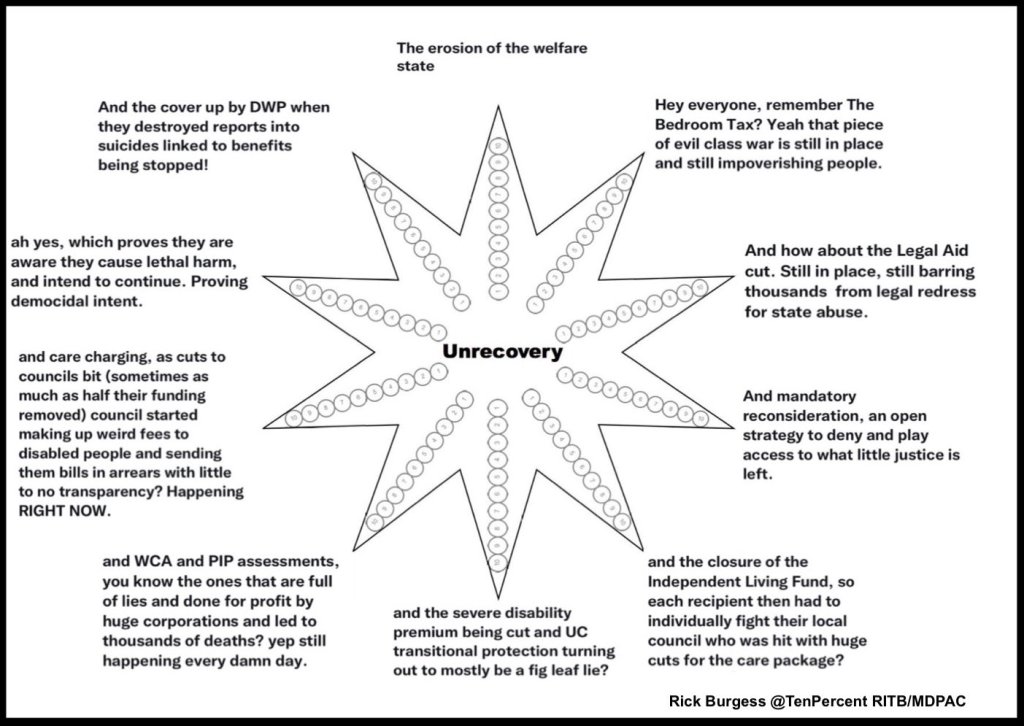
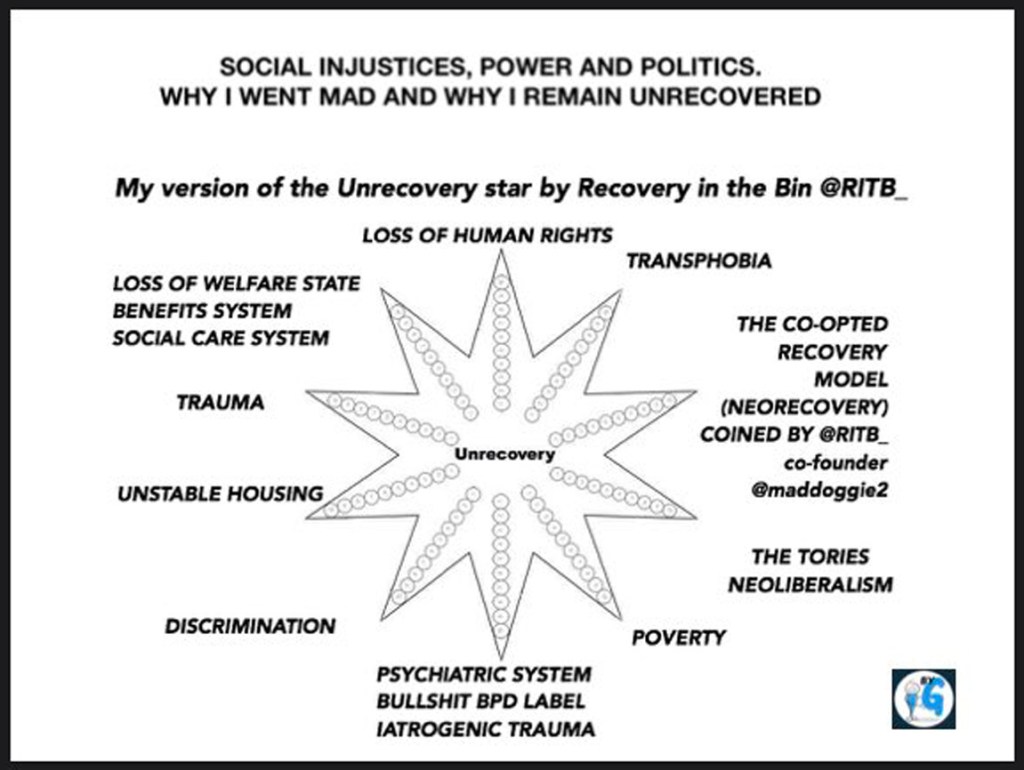

 Recovery in the Bin


