Service User Experience From Mental Health Act Review

thumbnailImage

This is the section of the Mental Health Act (MHA) review final report reflecting the views and input of service users. The MHA review involved, consulted and sought input from service users on an unprecedented scale and whatever happens to the final recommendations the feedback, perspecive and findings from service users should be widely shared not buried on some shelf at the department of health. Also people can link to it when they are getting #notallprofs lines from professionals or ‘that’s just your experience’… Well no, according to the MHA review it isn’t:-

SERVICE USER EXPERIENCE Pages 53-58 MHA Review

Service users have been at the heart of this Review, and we want to make sure their voices are clearly heard in this report. This section pulls together some key themes from the patient experiences that have been shared with us through our service users and carers survey, individual and group submissions, focus groups, engagement events and service user and carer group. We would like to thank those who contributed to debates, shared views and opinions and often revisited difficult or traumatic periods of their lives in order to help us. We should also like to thank any who facilitated feedback or made their own contributions as relatives, carers and friends. And in particular, we would like to thank our Service User and Carer Group which has been invaluable in helping us to shape our recommendations. Patients and carers have told us it is vital that their experiences, and their knowledge of what works best for them, are recognised and acted on, by this Review.

Overall, we have been disturbed and saddened by what we have heard from patients. Only 30% of respondents to our survey of service users and carers felt that they had been treated with dignity and respect, and whilst we accept that surveys like ours can sometimes have a bias towards recording experiences at the extreme ends of the positive/negative scale, this is clearly very worrying. Too many people are detained in wards that are far below the standard anyone would want for themselves or their loved ones. We are also aware that there is sometimes a disconnect between how staff perceive the care they give, and how it is experienced by patients. We agree. Too many have found that when they have previously voiced reasonable concerns or complaints, or spoken of the trauma detention and treatment has caused them, they have been ignored, or their accounts have been dismissed as being due to symptoms of disorder (an example of epistemic injustice, see box).

Epistemic injustice occurs when a person’s capacity as a person with knowledge is wrongfully denied. It is a phrase that some service users feel represents elements of their experiences during the detention process. Epistemic injustice could be when a person’s credibility is challenged for no good reason and their testimony is not believed. An example might be when a person’s treatment preferences are dismissed because the individual’s mental health diagnosis suggests that they are unable to think clearly or rationally about their options.

Some patients have reported neglect, both of physical and psychological health, and the experience of receiving impersonal care, leaving them feeling processed rather than cared for:

  • Many patients report being disparaged, disbelieved or ignored and have been subject to judgemental and paternalistic behaviour from those caring for them.
  • Some patients report coercive mistreatment such as the use of access to leave, or contact with families, as levers in order to achieve compliance, for example making ward leave or access to the telephone dependent on behaviour. Forced compliance can lead to institutionalisation which can delay recovery.
  • Hierarchical ward structures can mirror the negative experiences patients have had with other authority figures.
  • Lack of privacy is a problem – about 1000 inpatient beds are still in multiple bedded rooms. People face arbitrarily imposed restrictions such as being shut out of bedrooms during the daytime, or locked in bedrooms at night. This can increase levels of mental ill-health.
  • Many find it hard to retain links to their social networks and communities whilst detained and many lose contact with family and friends, as well as losing home, employment, or access to education. This can lead to patients being much worse off than before they were detained, for example being unable to work, homeless38 or worse.
  • Parents and carers of children, and those with learning disabilities or autism, told us that professionals do not always take the time to understand how best to communicate with a person with a learning disability, autism or both to try and understand what is causing their distress, or have the necessary skills to do so. We also heard that their attempts to share information and to remain supportive and involved when someone is detained have led them to be ignored or excluded because they are seen as ‘too dominant’, ‘overbearing’ or ‘over-involved’.
  • We have heard repeatedly of the distressing and unacceptable experiences from people from ethnic minority communities and in particular black African Caribbean men. Fear of what may happen if you are detained, how long you may be in hospital and even if you will get out are all widespread in ethnic minority communities. Addressing the issues facing this group of people is a central priority for the Review.
  • Patients detained under the criminal justice system suffer from even longer delays to access the care they need.“A new patient kept ringing the police. They told us that if she didn’t stop then they would take the phone away. It was the only way we could talk to our families.” 39 – Service User“In my Trust they have adopted the tactic of explicitly framing complaint- making by patients against staff and services as an indication that the patient is a risk to others, and formally recording this ‘risk’ in the risk assessments they use to make decisions regarding leave and discharge, etc.” Service user.

Patients also reported harassment and abuse on inpatient wards, both physical and sexual. A CQC review41 reported 1,120 sexual safety reports from Apr-June 2017, of which more than a third of the incidents (457) could be categorised as sexual assault or sexual harassment of patients or staff. Data collection is inconsistent on this, and could be improved as it is for restraint. From the date that is available we know that restraint continues to be a routine occurrence on many wards, affecting disproportionately those from ethnic minority populations, women and girls. Restraint, and particularly pain-based restraint and prone restraint, can be frightening and life threatening. Not surprisingly, sexual assaults and restraint can lead to lasting trauma for those affected.

Ward physical environments have become increasingly cold and unwelcoming with an emphasis on physical safety. A few people have even told us that the way they are treated by staff, the levels of threat and violence, the physical environment and the sound levels make hospitals seem little different to prison.

We are acutely aware that this will be an uncomfortable read. It will be difficult for some of those who provide care, or those reading this report, to comprehend and accept the poor experiences that many patients suffer. But it is essential that they find the courage to acknowledge what patients are saying has been their experience rather than what their care providers believe they provide, if care and treatment are to improve. Many of the issues we cover here have been highlighted repeatedly in CQC reports and by service users and their families. Other problems have slipped below the radar, in some cases because of low expectations of what constitutes good care, and in others because of poor quality assurance of the care provided on wards. The CQC inspection criteria should also be strengthened, for example to have a greater focus on therapeutic environments and person centred care that meets the needs of people with a range of equality characteristics. Day-to-day reporting of incidents is inconsistent and numerous and complex complaints processes prevent patients and relatives from obtaining redress. Those that do complain have told us that care can be negatively affected. All of this has allowed everyone, from local ward staff to national system leaders to overlook or even normalise poor practice.

We are also aware of the huge dedication and compassion of thousands of staff across the NHS, Local Authorities and other agencies, and how services and staff suffer when they are over-stretched, feel overwhelmed and unsupported. High bed occupancy, rapid turnover of patients, higher levels of detention, regulatory pressures, and increased administrative work and inefficient processes can all reduce time spent therapeutically with patients and reduce job satisfaction for staff. Lack of staff and high levels of temporary or ill-equipped staff contribute to wards with high levels of coercion and conflict42. Increasing vacancies (14.3% for MH nursing43, 9% for consultant posts44, 2017) and high turnover suggest the current culture and environment do not support either staff or patients and that this is becoming normalised. Improving ward culture would improve support for staff and help potential problems to be addressed before they escalate. In addition, pressures upon community NHS and social work services can lead to problems in appropriately discharging people.

Solutions to these problems must be multifaceted, addressing the needs of patients and considering how best to encourage and maintain wards that are therapeutic and respect patients’ rights. The Convention on the Rights of Persons with Disabilities (CRPD) 45requires that no decisions about disabled persons should take place without them, so those with relevant lived experience should be involved in decision making across the system, including co-design and production with patients at ward level. Patients should be treated in a way that respects them in the context of their own lives, recognises their strengths, needs, values and experiences and provides equality of outcome regardless of any disabilities or protected characteristics. It is not enough to merely ask that people detained under the Act are listened too, nor can we achieve our goals, of fair treatment for all, if detained patients continue to have so little say in their care and treatment. Many of the legal and regulatory changes recommended in this Review are essential to driving culture change, to ensuring shared decision making becomes routine practice, and that patients’ own expertise is acknowledged and valued.

“ Being sectioned was one of the most traumatic experiences of my life. Sadly, as a result of being sectioned I developed PTSD as the direct result of the way I was treated ” – Service user

“ I did not view the act of sectioning in my case as something that should be avoided, if you are physically exceptionally unwell you are placed in intensive care – the same arrangement applies to your mental health when in crisis ” Service user

Recovery In The Bin (RITB) is covered by a Creative Commons Attribution-NonCommercial-NoDerivatives 4.0 International (CC BY-NC-ND 4.0) License 88x31.png
UPDATE: RITB Position Statement On Personality Disorders (or their euphemisms including Complex Emotional Needs)

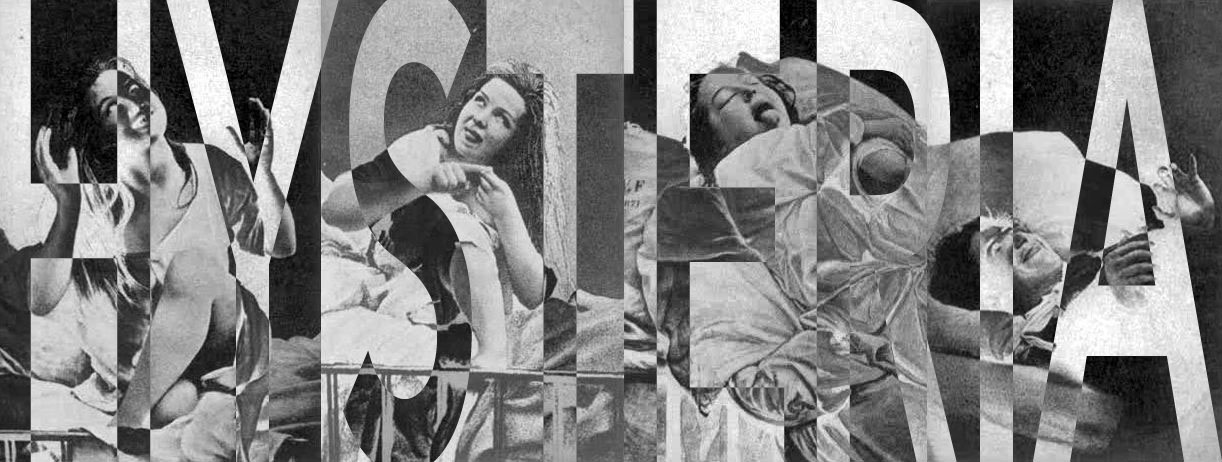
HysteriaBPD

RITB are neutral on diagnosis – we support people to self define in the way they choose that best enables them to live. However we consider Personality Disorders (PD) or their euphemisms including Complex Emotional Needs (CEN), a special case and object to anyone’s personality being diagnosed as disordered.

We respect that some people find the diagnosis useful and would not want to see people not getting good support, but our position is that we do oppose PD/CEN diagnoses.

We view the PD/CEN diagnoses as a special case because of the specific and politicised uses such as;
•a diagnosis of reprisal in response to a complaint or a failure to ‘recover’ or to respond to medication,
•a misogynistic diagnosis given to women, transgender and non binary people mostly due to its links with childhood trauma, childhood sexual abuse or to the sole action of self-harm.
•a diagnostic reclassification to expedite discharge for financial and ideological reasons.

We view it as the worst diagnoses in terms of professional stigma and hateful attitudes and believe it is different to all other diagnoses in its utility so we prefer it was never used unless a service user requested it.

We object to psychological formulation enacting PD/CEN diagnoses in its description but without using the diagnostic words, as this is no different. We also oppose diagnosis creep of Personality Disorder encompassing more and more service users.

We also acknowledge that a diagnosis & deficit based description is still required for in-work and out of work benefits PIP, ESA, & Universal Credit regardless of whatever models are in vogue or preferred.

Update 24.01.24 Recovery In The Bin (RITB) is covered by a Creative Commons Attribution-NonCommercial-NoDerivatives 4.0 International (CC BY-NC-ND 4.0) License 88x31.png

I Have Never Been In A Place More Indifferent To Suffering Than A Psychiatric Ward

I have never been in a place more indifferent to suffering than a psychiatric ward. People walking around in great distress must be so much part of the furniture that mental health nurses can walk past them with barely a glance.

A few nights into my stay a nurse found me crying in my room. “It’s good to cry” she said matter-of-factly, “But sometimes it can go on too long”. She got up and left, promising to return later when I’d calmed down. I wondered what point there would be for her to return when I was no longer in distress, but ultimately it didn’t matter, because she never came back. I had a similar experience a few days later. While I was crying in my room, two health care assistants entered and began to carry out a room search. They didn’t ask if I was OK or acknowledge in any way that I was sobbing. After they finished they smiled and said “Thanks!” brightly, before leaving the room as quickly as possible.

In both these encounters I believe my historical diagnosis of borderline personality disorder (BPD) was at play. My crying was attention seeking, manipulative and proof that I was unable to regulate my emotions. Had they spent time to get to know me, they would understand that I rarely cry, let alone sob in front of people. As someone who OVER regulates their emotions it was upsetting to have my vulnerability responded to in such a callous way.

These experiences reminded me how dangerous the ‘All Nurses Are Heroes’ narrative is. There were some amazing, stand-out individuals working there, whose kindness were the true bright spots of my admission. But there was a culture of indifference which allowed behaviour that was everything from incompetent to genuinely cruel. I saw staff roll their eyes or laugh behind the backs of perceived ‘difficult’ patients. The psychiatrist referred to me in the third person during ward round in a way that should only be reserved for “Does she take sugar?” disability satire. Safety did not seem to be a priority, despite the fact there have been multiple deaths at this hospital. When a patient collapsed in the corridor after taking her nighttime medication, it was other patients who helped carry her to bed. The nurse who’d dispensed it simply shouted after her, “It just means they’re working”.

Two days into the admission I got given somebody else’s medication. I had been given my own meds about an hour before so questioned the nurse whether I really needed them, but she insisted. It turns out they were a different type of benzodiazepine to the one I had just taken and were intended for a woman with a similar name. The last thing I remember clearly from that night is them frantically trying to get a doctor onto the ward when the door to the ward wouldn’t open, but after that is black-out.

The same thing almost happened again two weeks later, but this time I was well enough to refuse and ask them to double check (once again, it was for the woman with the similar name). I was also given the wrong version of my medication on three occasions – an instant release type that left me more sedated and with more side effects. As someone who struggles to take medication, these mistakes left me mistrustful and scared to continue accepting the meds.

It didn’t help that the basic environment was not taken care of. The bathroom was filthy and not cleaned for two weeks, with a blocked drain that meant it flooded every time I took a shower. When I reported these things, the message never seemed to get to the right people. They were unable to find curtains for my room for the first week, and the floodlight outside the window meant I was unable to sleep properly.

To add insult to injury, the hospital I was in has a strong social media presence, where they use buzz words like “quality improvement”, “compassionate care” and talk about being HASHTAG “humbled”. It’s a self-serving denial of reality that’s almost cult-like in nature. It allows them to construct an image of life on the ward that is pure fantasy, all the while keeping genuine conversations about patient’s experiences at bay.

Perhaps most distressing, I was treated as a detained patient throughout the admission, despite being there ‘voluntarily’. This included being prevented from leaving multiple times. On one occasion, I tried to push past a member of staff entering the ward, and a nurse shouted at me, “Hey! You’ll be getting a Mental Health Act Assessment if you’re not careful!”. Her tone was that of a parent threatening a naughty child, not a nurse informing a patient of their rights. Weaponising mental health legislation in this way leaves patients with the experience of being detained without any of the legal safeguards. I was not allowed any ‘leave’ until near the end of my admission and even then, it was hit and miss as to whether the decision to let me out had been handed over. If it hadn’t, I would be left waiting until a member of staff who HAD been informed was on shift, sometimes days.

Despite being ‘de facto detained’ I was told by multiple members of staff that they didn’t think being there would help me. Once again, I’m sure this was related to my historical BPD diagnosis. To tell a patient simultaneously that they aren’t allowed to leave, but that they won’t be helped by staying, is both confusing and cruel. I had lost all hope for myself and saw this hopelessness reflected back at me by the people who were meant to be in a position to help. All of this is contrary to the National Institute for Health and Care Excellence (NICE) guidelines for hospital admission which recommends an “atmosphere of hope and optimism” for service users, with “a clear focus on their emotional and psychological needs”. I was never assigned a primary nurse during my stay and never saw a copy of my care plan, if indeed one existed.

Ultimately, this means I’ve left hospital without a clear plan of care, and with only the side-effects of a traumatic admission. It’s an impossible situation to be in while trying to keep yourself alive through a mental health crisis. The ‘choice’ between being totally unsupported or poorly supported is a catch 22 I’m still scared I might not survive.

Recovery In The Bin (RITB) is covered by a Creative Commons Attribution-NonCommercial-NoDerivatives 4.0 International (CC BY-NC-ND 4.0) License 88x31.png

Words can always break me.

By Maggie Zolobajluk @22magoo, anti-austerity activist. This article first appeared on her blog Telling it as it is

Until two years ago I was a very high functioning Heroin addict and had been self-medicating with heroin since the age of twenty-seven. I had been battling anxiety, depression, anorexia, and addiction from the age of seventeen, all related to physical, psychological and sexual abuse in childhood.

Those of us that function at this level are invisible because from the outside we look like you. Look around you; we could anyone that you see, a friend that you have known for years or a work colleague that you admire and work alongside or the person you chat to at the school gates.

Addiction was not a life style choice; it was a psychological and physical need, like taking a deep breath and exhaling a very long slow deep long sigh of relief, where there is time and space while the drug lasted. The need for these spaces sometimes have lasted for years, other times days, weeks or months and outwardly no-one knew anything was wrong.

After three years of counseling and fast approaching my sixty-seventh birthday, I have been clear of Heroin use for two years.

When I have told people about my past, so far I have come across three different reactions:

One is “Oh wow, that’s amazing. I would never have known, Look at you. Look at what you’ve achieved with your life.

Others unconsciously glance down at my arms to see if I have tract marks, which I don’t. My arms look exactly the same as yours as I have never injected heroin.

And others unconsciously clutch their bags closer to them for a split second, just in case I’m going to snatch it away from them and run off with it.

Words can define how people look and treat us. They create pictures, which are able to shape our beliefs, prejudices and actions.

What picture do you see in your mind’s eye when you hear the words “Dirty Junkie.”

I can guarantee you it won’t be an image of a high functioning addict like me, as I am invisible to you but a stereotype that dehumanises and devalues us, that is very pale looking, often having dark circles around their eyes; they are skinny and always a little bit sweaty. Their clothes look worn-out and unkempt, as if they have not been changed in days.

By judging and reacting to us like this on top of the mountain of pain, fear, isolation and shame we feel already, maybe for things we have done to survive, you give us more shame.  Shame founded on a Puritan belief, where belonging and connectivity comes from hard work and perseverance,

You see us as not deserving, a drain on society, not worthy to be part of your community which reduces your responsibility towards us, as you feel we bought this on ourselves. Your judgement excludes us, when what we need most of all is to feel that we belong and feel connected

This attitude is again reinforced by the media in films like “A street cat called Bob” and “Trainspotting” and perpetrated further by the newspaper in negative reporting.

The media makes a fortune out of it. Its big news, it sells papers, so woe betides a celebrity who falls to pieces due to addiction, as in the recent case of Amy Winehouse.  Images of a public meltdown sell papers. This public scrutiny brings additional pressure at a time where the world was crashing in on her, where she had no space.  Yet we followed and waited for her every move.

The deserving and undeserving is again perpetuated by Government policies of trying to force us into “treatment programs” that we are not ready for, with the threat of sanctions if we don’t or can’t comply.

“DRUG addicts and alcoholics who refuse to have treatment could be stripped of their sickness benefits in a new “tough love” approach to be unveiled by the Government” proclaimed The Express in 2012 It went on to say “From next year in pilot areas, drug addicts will be required to attend discussions about treatment and agree a rehabilitation plan to address their drug problem and other barriers to work that they face, or they risk losing their benefits”

Coercing people into therapy is dangerous as our consent is negated if it is given under duress. Punitive measures have no place in therapy. A safe environment is needed.  Trust needs to be established.  Asking questions about traumatic experiences can be extremely stressful or damaging for us as already traumatized individuals. Subsequent “re-traumatisation” could occur.

Then, when we enter counseling, where words and physical movements, just like music or smells can take us back to a particular event in our past flooding us with the memories and emotions of the trauma we have experienced and suppressed, we are faced with the expression,  “Do you feel dirty?”    A phrase so commonly and thoughtlessly used to describe people that take Heroin. This also perpetuates the stereotype image that’s been around for a long, long time.

These words are also said without thinking by many from the Psychology profession who use them without question. When you stop to think about them they imply that a person who has self medicated with an addictive drug, especially heroin, is dirty.  If you want to use a “d” word think about despair, desperation and dehumanisation.

Yet, after recovery, when we have finished counseling, ready to face the world on our own, we stigmatise ourselves by use the word “clean” to describe our remission. Every time we use the word “clean” to describe our state of health, we reinforce the stigma that once we were “dirty”

Once we stop associating with the word “dirty” we can see ourselves as in the “clear” We have recovered from the trauma of our childhood and are in remission.  We have forged new pathways in our brains that we now follow but just like any remission the old pathways are still there, so relapse is possible.

So finally, I would like you to picture a blank piece of paper. Take a pencil and write the word clean. Then take a rubber and rub away the downward stroke of the letter “n”, the downward stroke that is the stigma that society places upon us.

Many, many thanks to Dr Jay Watts @Shrink_at_Large, jaywatts.co.uk for her support, kind words and comments.


Recovery In The Bin (RITB) is covered by a Creative Commons Attribution-NonCommercial-NoDerivatives 4.0 International (CC BY-NC-ND 4.0) License 88x31.png

Worry Tree in the Bin

The Worry Tree is a complex Psychological Intervention which has led to a paradigm shift® in mental health care.

It works like this:

  1. Write down your worry.
  2. Work out if there is something you can do about your worry.
  3. If there is, then do it and LET WORRY GO, change your focus of attention.
  4. If there isn’t then… just LET WORRY GO, change your  focus of attention.

You can download a free Worry Tree over here.

(This is ACTUALLY USED in IAPT services.)

Case Example 1: Chronic pain and illness

The mindful worry tree cure for all chronic pain and illness, disability and anything non-surgical known to humankind. Basically – DON’T WORRY.

About to die or be killed – LET WORRY GO.

Case Example 2: Imminent austerity death

I am worried I will freeze to death on the street because I have nowhere to live after I was evicted due to Universal Credit… let it go you silly worry head, the nice lady from the government was on TV and said it’s all going really well, Merry Christmas!

Case Example 3: Worrying about worry

I am now worried about whether I worry too much.

Should I let this worry go and refocus my attention?

I am now going to stop worrying about worrying too much, I am going to let that worry go, and refocus my attention on the things I am legitimately worried about.

Case Example 4: Domestic violence

Nearly killed by your husband? All the refuges closing? LET WORRY GO, change your  focus of attention.

Case Example 5: The Worry Tree Worry

I am worried about this Worry Tree™. Is it a hypothetical situation or a current problem? I like that the solution in all cases is change focus of attention. This therefore requires “not thinking about The Worry Tree™”. Problem solved. QED.

Recovery In The Bin (RITB) is covered by a Creative Commons Attribution-NonCommercial-NoDerivatives 4.0 International (CC BY-NC-ND 4.0) License 88x31.png

Mental Health Resistance Network Protest 20th Nov #WeDemand

Screenshot 2018-11-11 21.54.56

#WeDemand
Please share far and wide
Westminster Health Forum Keynote Seminar
20th November 2018
Registration Time: 8:30 am
Start Time: 9:00 am
Venue: Royal Over-Seas League, Over-Seas House, Park Place, St James’s Street, London SW1A 1LR

Meet outside the venue at 8am. Bring whatever banners you want to bring. Be loud and be proud.

The whole thing is rotten to the core, so MHRN will be protesting this event which will bring together some of the people who have had a hand in preventing us from receiving appropriate care and a secure income.

In response to the abusive agenda of this government, MHRN has produced a document that outlines our demands. It is a living document and will be updated from time to time.

PDF MHRN

We will be launching our demands at the protest and presenting it to Claire Murdoch, National Mental Health Director, NHS England and will be sent to Cabinet and Shadow Ministers, MPs and anyone else we see fit to send it to and it will form the basis of our campaigning.

It will be an early start but it is an important protest and we want everyone who can make it to be there. And of course, it’s off to the pub/coffee shop after we have made our point.

Facebook event page

Mental Health Peer Workers: Our lived experience. Part 1

This RITB blog is the first in a series of blogs about the lived experiences of being a Mental Health Peer Worker.  If you are a peer worker (or work in a similar role) and want to share your lived experience, please submit a blog for consideration: recoveryinthebin@gmail.com

peer worker part 1

Lived Experience Working in the NHS

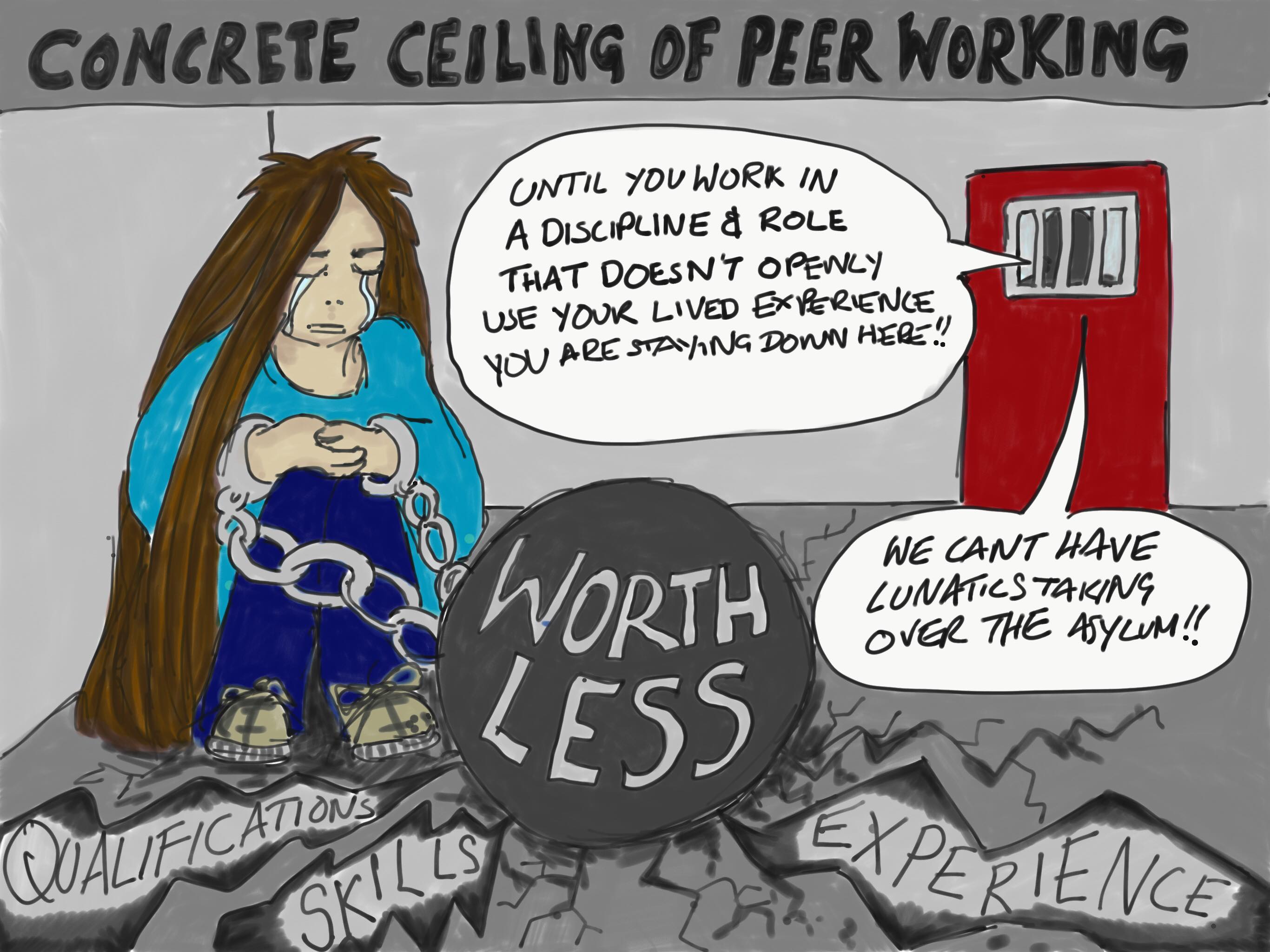
In theory, life should be good at the moment. I’ve finished my Masters. I’ve got a wonderful hubby.  But the other day, I realised that I was taking home pretty much the same pay as I did when I left school to be a carer for my Mum at 16, and was doing a part time cleaning job.  The difference is that now I am 41, with a first class BA Hons, a couple of post graduate certificates, loads of experience working in several different disciplines and now a Masters of Science Degree.  I took the pay cut, a few bands down to my other work, roughly six years ago, with the idea that I could easily work my way up within an organisation that employs 4000 staff.  It struck my like a ton of bricks that in six years I haven’t moved, and despite my experience and specialist training, I have very little worth or value within the system I work in.  Rather than wallow in it, I decided it was the kick in the bum I needed to do something about it.

Sadly, it appears that there are no current or future plans to employ people like me – people who use lived experience of mental health conditions within their work – within specialised roles beyond the lower paid ones.  Even those of us who are more qualified, specialised or experience than our colleagues.  We will continue to be managed and led by people whose job roles do not incorporate Lived Experience.  Even if they are less qualified than we are.

I sobbed deep sobs as I realised that no matter how hard I tried, how much better I am, or how much I achieve, I am worth less than colleagues who are either not open about or do not suffer from mental health conditions.  I am worth less than my colleagues because I actively use my insight into this within my work.  I am worth less despite training for five years and taking a pay cut to do so.

We talk about challenging stigma of mental health.  We first have to do this within the mental health services who claim to support us.  If I am worth less than my colleagues because of my mental health disability, how can my colleagues treat the service users they treat as equal human beings, deserving of dignity, respect and equality?  Our gay colleagues and our black colleagues, our physically disabled colleagues are visibly able to hold positions that match the hard work, the qualifications and the merit they have have.  We want equality for the many NHS staff working in mental health services who are not facing a glass ceiling – they are facing a concrete ceiling – within the work they do.  Let us manage and develop Service User Involvement, Service User Consultancy, Service User research.  It is our discipline, one we have been developing since the 60’s, and now there are many of us who are qualified, skilled and experienced in these areas.

Stop telling us we are not worth anything, that we are worth less, whilst you promote and employ staff to manage and govern us.

This is one story, but it is the experience of many of us, actively held back and discriminated against because of our mental health disability, and our audacity to bring the insight it gives us into a space that feels shame.  We don’t want to retrain as clinicians within other disciplines, we are training in our own, and it is valid, and brings a visibility to mental health that all the other disciplines erase.  It is the missing link in our services.

Please, please start treating us as your equals.  Because we are your equals.  The barriers and discrimination you place before us mean that we will never stand anywhere near you, even if we’ve had to work twenty times harder to stand ten steps behind you.

We are worth just as much as you are.  Maybe if you let us in, the very act of seeing us as equal will improve the care that is given to all people with mental health disabilities when we access services.

Recovery In The Bin (RITB) is covered by a Creative Commons Attribution-NonCommercial-NoDerivatives 4.0 International (CC BY-NC-ND 4.0) License 88x31.png

Toxicity in Mental Health

DISCLAIMER: The Venn diagrams in this refer to voice hearers but the term ‘voice hearer’ here can be applied to people struggling with mental health issues in general. However this was written by a member of RitB who is a voice hearer. The preamble will make the context clear.

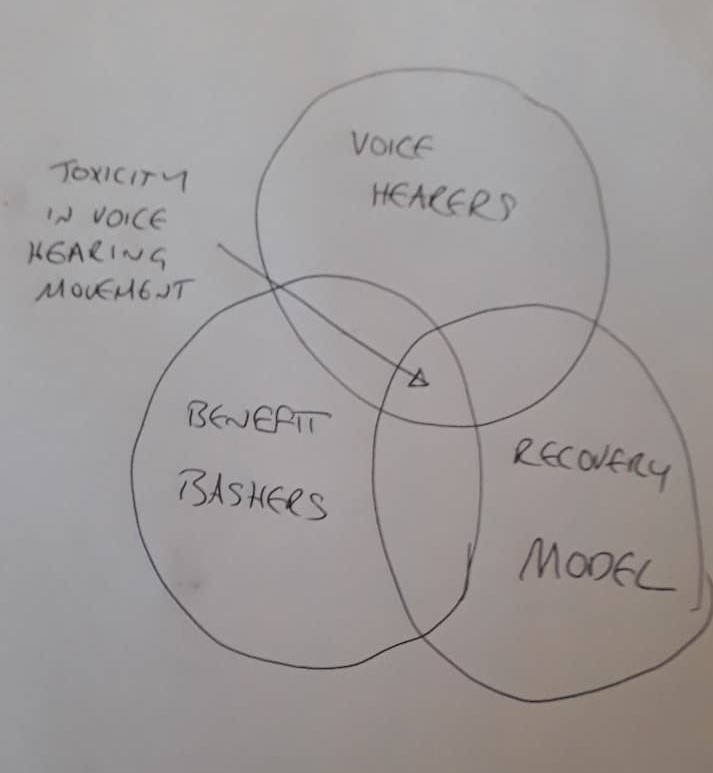
This morning Rita Bins was wondering to herself why she heard so many benefit bashing voices. Was this a projection of the current welfare-hostile ideological zeitgeist, as part of the neoliberal war on the welfare state? Was it a projection of how she felt the terrain of voice hearing activism stood? Or was it her background experience of telepathy, her stance as a mental health activist making her a target for other right-wing voice-hearers, struggling with their cognitive dissonance having internalised an insidious, and pernicious political subjectivity? Who knew? But she needed to work it through? What tools could she use this time? Aha! Venn diagrams!

The first Venn diagram was as so:

RITB AL

Let’s work through the overlaps. First if we look at the overlap between voice hearers and the recovery model, the most benign here. The term recovery model here refers to a particular ‘brand’ of neoliberal, individualistic, technique-driven, outcome measure focused from of ‘recovery’ (as opposed to the more polyvocal term that refers to a more diverse discourse). This group RiTB has no personal animosity to, although a part of our praxis is towards educating the limits of this model in denial of class, economic and structural aspects (the social model of mental health) that critical psychiatry does a better job of recognising.

The second group, benefit bashers overlap with voice hearers on probability are going to be of two possible groups. The first are going to be bio-medical voice hearers (hence no overlap with the medical model) who are of the (according to measures of the efficacy of medication) small group of voice hearers for whom medication works well but who either wilfully or through ignorance, cast aspersions on those who struggle to recover and for whom the medication does not work, but who have also, for whatever reason, internalised the benefit bashing propaganda against their own peers. The other subgroup of this overlap are those still on benefits whose support comes from right wingers (the equivalent of the POC whose racists peers say ‘you’re alright mate, it’s these other lot who are the problem) so to protect their social position attack other people on benefits.

The third overlap is those who support the Recovery Model but who benefit bash, presumably with no lived experience themselves, so on probability mental health professionals. Who have service users and survivors in their charge, but have internalised the anti-benefit media hate-campaigns so much that they are willing to override their own professional knowledge of their clients’ personal circumstances and take a hostile position on their clients’ actual lives and rights. Or they have internalised the individualist aspects of Recovery Model propaganda and blame their clients for not trying ‘hard enough’, no matter how ill their clients may be, treating them as malingerers because of the failure of the techniques of the Recovery Model that they have invested their careers in.

But the most odious and pernicious is the triple overlap, peers willing to sell out their compatriots, internalising their own ‘successful’ recovery as ‘hard work’ and a ‘meritocracy’ in denial of the differences between mental health lived experience, the structural disadvantages the unrecovered struggle with, and the personal advantages the ‘recovered’ have benefited from, that are now ‘all their own work’. The ideology of ‘choice’ over the ‘reality principle’ and its relation austerity that affects and blights so many of the unrecovereds’ lives. These truly are the people Recovery In the Bin are most critical of.

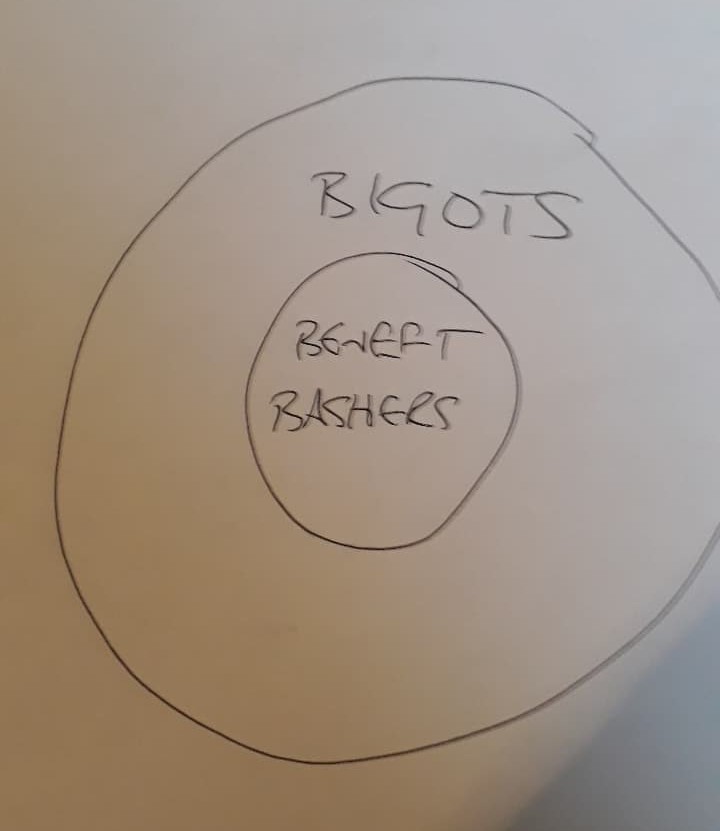
One last Venn diagram though, just in case you were unaware, as there is no excuse, no exception. Venn Diagrams don’t just show ‘overlaps’, some show ‘subsets’.

RITB AL2 (2)

Recovery In The Bin (RITB) is covered by a Creative Commons Attribution-NonCommercial-NoDerivatives 4.0 International (CC BY-NC-ND 4.0) License 88x31.png
Recovery In The Bin Statement Against Racism

AD

Recovery In The Bin stand against racism and acknowledge it is pervasive throughout culture and the systems we are subject to. We acknowledge white privilege and the duty for those with it to recognise and strive to remove it and to challenge the culture of Whiteness. We support an intersectional understanding of how each of us may have privileges and oppressions. We oppose anti-Semitism, Islamophobia, and the State-led policies of hostility toward migrants and asylum seekers. Learning to negotiate with each other respectfully and with humanity is an ongoing process that at times is difficult but to which we should all be committed. We also demand professionals acknowledge the presence of institutional racism and workers who collude with this at an individual and/or collective level are contributing negatively to the mental health of Black, Asian, and Minority Ethnic (BAME) service users. Professionals should join us in learning and changing – to listen to and to give platforms to BAME Service Users, and marginalised groups who are not even visible to services or excluded by hostile environments. We draw particular attention to the appalling higher risk of violent and abusive treatment faced by people of African-Caribbean and African heritage. It is massively under-acknowledged that racism contributes to mental distress and illness; we must recognise and work to change that.

RITB With The T

We wanted to add some specific detail to our previous Statement of Support in respect of the intense activity around the Gender Recognition Act Consultation that is creating upsetting misinformation. You can fill in the consultation with advice here. We oppose Transphobia (definition on wiki) which can be described as ‘any oppression that arises from people being trans, or perceived as trans or as not conforming to gender norms. And the structural oppression of transgender people by cispatriarchal society, and prejudicial and/or ignorant attitudes, narratives and actions which contribute to those structures of oppression’.

Screenshot 2018-10-14 23.22.12

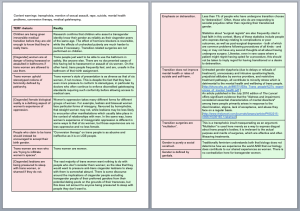
We recommend this great post by Rosie Swayne. And we thank activists for their permission to print here the text of a leaflet which was handed out at an ‘L with the T’ solidarity demonstration recently that deals with common misperceptions. A PDF can be downloaded here > TERF rhetoric vs reality

TERF Rhetoric vs Reality
Content warnings: transphobia, mention of sexual assault, rape, suicide, mental health problems, conversion therapy, medical gatekeeping.

TERF rhetoric
Children are being given irreversible medical transition before they are old enough to know that they’re really trans.

Reality
Research confirms that children who assert a transgender identity know their gender as reliably as their cisgender peers of the same age. The effect of hormone blockers is reversible, while the effects of unchecked puberty are much harder to reverse if necessary. Transition-related surgeries are not performed on children.

TERF rhetoric
[Cisgender] women are at danger of being harassed or assaulted in bathrooms if trans women are allowed to use them.

Reality
Trans people just want to be able to use the bathroom in safety, like anyone else. There are no documented cases of this having led to harassment or assault of cis women. On the other hand, trans people frequently feel, and are, unsafe in the bathroom of their birth assignment.

TERF rhetoric
Trans women uphold stereotyped notions of femininity defined by patriarchy.

Reality
Trans women’s style of presentation is as diverse as that of cis women, if not moreso. This is despite the fact that they face even more pressure to conform to stereotypes, in particular by doctors who often continue to enforce discredited gatekeeping standards requiring such conformity before allowing access to medical care.

TERF rhetoric
[Cisgender] female biological reality is a defining aspect of women’s experience of oppression.

Reality
Women’s oppression takes many different forms for different groups of women. For example, lesbian and bisexual women face particular forms of misogyny, flavoured by homophobia, that straight women may not, while lesbians may be less likely to encounter other manifestations which usually take place in the context of relationships with men. In the same way, trans women’s experience of misogynistic oppression is different in some ways to that of cis women, but those experiences are no less oppressive and no less female.

TERF rhetoric
People who claim to be trans should instead be encouraged to accept their birth gender.

Reality
“Conversion therapy” on trans people is as abusive and ineffective as it is on LGB people.

TERF rhetoric
Trans women are men who are “trying to infiltrate women’s spaces”.

Reality
Trans women are women.

TERF rhetoric
[Cisgender] lesbians are being pressured to sleep with trans women, or shamed if they do not.

Reality
The vast majority of trans women want nothing to do with people who don’t consider them women; so the idea that they would want to pressure anti-trans cisgender lesbians to sleep with them is somewhat absurd. There is some discourse around the implications of cisgender people excluding transgender people of their preferred genders from their potential dating pools on the grounds of their transness, but this does not amount to anyone being pressured to sleep with people they don’t want to.

TERF rhetoric
Emphasis on detransition.

Reality
Less than 1% of people who have undergone transition choose to “detransition”. Often, those who do are responding to societal prejudice rather than rejecting their transitioned gender. Statistics about “surgical regrets” are also frequently cited in bad faith in this context. Many of these statistics include people who express dismay relating to complications or poor outcomes, as well as post-surgical depression – both of which are common problems following procedures of all kinds – and may or may not have any second thoughts at all about having undergone surgery. Likewise, even in rare cases where a patient might regret having opted for a procedure, this should not be taken to imply regret for having transitioned or a desire to detransition.

TERF rhetoric
Transition does not improve mental health or rates of suicide and self-harm.

Reality
Untreated gender dysphoria (due to delays or refusals of treatment), unnecessary and intrusive questioning/tests, prejudicial attitudes by service providers, and restrictive treatment pathways, all contribute to minority stress which is detrimental to the mental health and wellbeing of trans people. [shura.shu.ac.uk/8957/1/Ellis_Trans_people%27s_experiences_of_mental_health.pdf]
An article published in the July 2016 edition of The Lancet offers significant evidence that the “distress and impairment, considered essential characteristics of mental disorders” among trans people primarily arises in response to the discrimination, stigma, lack of acceptance, and abuse they face on a regular basis. [thelancet.com/journals/lanpsy/article/PIIS2215-0366(16)30165-1/abstract]

TERF rhetoric
Transition surgeries are “mutilation”.

Reality
This is a transphobic insult masquerading as an argument.
“Mutilation” is used here merely as a way to express disgust about trans people’s bodies; it is irrelevant to the actual purpose and merits of surgeries, which are effective and often lifesaving treatments.

TERF rhetoric
Gender is purely a social construct. Or Gender is defined by genitals.

Reality
Traditionally feminism understands both that biology does not determine how we experience the world AND that our biology does contribute to our shared experiences as women. There is no contradiction here for transgender women.