Duty, by Dr Avon

One of the responsibilities of doctors (leading to great privilege in the form of good wages and social status) is to act as an informed, accurate and unbiased opinion about people’s access to welfare on the grounds of health problems. Another responsibility of the doctor is to act as an advocate for their patients so that they can access welfare they are entitled to by any reasonable interpretation of the requirements as well as to protect them from any adverse effects of the welfare system that they are vulnerable to. This responsibility can be discharged by communicating with the relevant welfare agencies by various means such as filling out forms, writing letters and direct communications by phone or email. In this blog I tend to use the term “patients” as a generic term used for people consulting a doctor.

Whilst the social model of “disability” is by far the most helpful in order to plan interventions to reduce adverse consequences of mental health problems (my crude understanding of this model is what barriers are there that prevent this person’s desired participation in society including access to their needs for food, shelter and security being met), access to benefits are based on a more medical model of medical condition (identified by diagnosis), associated impairments in functioning and resultant disability (lack of capability or restriction) and social disabling (subsequent disadvantage and lack of fulfilment of social roles such as work or independence without care).

A first point is that the diagnosis is usually insufficient and details need to be given about any resultant impairment. For many diagnostic constructs, the diagnostic criteria are used to identify the best-fitting diagnosis and are not in themselves the whole nature of the condition. To use a general medical example, myocardial infarctions (“heart attacks”) are often identified using a combination of cardiac muscle enzyme results, ECGs, typical descriptions of symptoms and so on but the myocardial infarction itself is a blockage in the blood supply to the heart muscle leading to death of cardiac muscle tissue and resultant complications. It is this blockage and resultant complications that leads to death and impairment in functioning but the diagnostic criteria are used to identify the condition and access to correct treatments and as a first step to other help such as benefits if unable to work afterwards.

Depression is more than just the listing of diagnostic criteria in diagnostic manuals (and in this case the criteria are not as clearly linked to an underlying cause as they are for myocardial infarction). It is this whole nature of depression that is important for the purposes of access to benefits – lethargy, the dread of any change in case it makes things worse, the loss of confidence, the self-doubt, anxiety, avoidance of social contact, poor concentration, thoughts of self-harm etc. The diagnostic construct means the person is more likely to have features associated with that construct that may make them eligible for benefits. It is then up to the doctor to spell out what these features are, what treatment they are receiving, whether they are receiving services such as inpatient or day patient or outpatient, what impairments in functioning result and/or what risks arise to the person or others and what nature of support is needed from others. For example, if someone has agoraphobia they will struggle to leave the house – one consequence is they will find it hard to keep a job. Someone with dementia may wander and get lost so need somebody supervising them. Somebody who is suicidal is a risk of death so will need support and watchful care.

There several papers I use to help me fill out these forms (see references, all open access but all last millennium) but care coordinators such as CPNs and social workers are much more aware of the intricacies and requirements of the system. CAB and welfare rights organisations can provide helpful guides to completing form.

The second point and one frequently made is that the benefits system suits physical health conditions better. It is much harder in mental health to demonstrate that the impairment in functioning is due to the condition – for the myocardial infarction there are tests both associated with diagnosing the condition as well as associated impairments in functioning. In mental health apart from some exemptions such as dementia the demonstration of impairment in functioning is often reliant on the “word” of a mental health professional – it is therefore necessary to fill in the forms requested by benefits agencies so that the doctor’s patient can prove their eligibility. The benefits agencies will weigh up the reports of impairments in functioning, the risks and need for support and care.

The third point is that the benefits system can cause distress to people who are most vulnerable to this problems and increase their mental health problems and risks. Waiting for benefits with no income or savings leads to practical problems as lack of access to food and how to pay the rent multiplied many-fold if the patient has dependents like children. Assessments including reviews of eligibility are major existential threats to many patients on benefits. The lack of tests in mental health mean patients fear they will be disbelieved and the stress caused by these procedures can lead to relapses of mental health conditions and increased risks such as suicide. It is important that mental health services support their patients by completing these forms and if necessary direct contact with benefits agencies – by phone, letter or email – to point out these adverse and counter-productive effects so that patients are protected from these effects.

It is the duty of doctors to help their patients access benefits to which they are eligible, to provide accurate unbiased information as needed to benefits agencies and to help patients by interceding if they are suffering adverse effects from the procedures of the benefits agencies.

References

Disability and Incapacity Benefits – the role that doctors play. Maura Killoughery
https://www.cambridge.org/core/journals/psychiatric-bulletin/article/disability-and-incapacity-benefits/5F3F034CF0D64DC4A6117255701D7465

Incapacity Benefit. Phillip D. Marshall
https://www.cambridge.org/core/journals/psychiatric-bulletin/article/incapacity-benefit/EBD5705BFF05F942B59E69391601B5DA

Mental Health aspects of Incapacity Benefit. Laurence G. Measey
https://www.cambridge.org/core/journals/psychiatric-bulletin/article/mental-health-aspects-of-incapacity-benefit/81D0E6F7D6E4ECAC35E75F26F4ADD248


RITB recommends these essential resources for mental health
professionals:

Click to access benefit-assessments-e28093-exemption-to-protect-vulnerable-patients.pdf

https://www.shop.cpag.org.uk/big-book-of-benefits-and-mental-health-2017-18

https://www.benefitsandwork.co.uk

https://www.shop.cpag.org.uk/welfare-rights-books

http://pipinfo.net

This is covered by a Creative Commons Attribution-NonCommercial-NoDerivatives 4.0 International (CC BY-NC-ND 4.0) License 88x31.png

Using power wisely: why psychologists must engage with the DWP

In response to RITB’s request for professionals to get in touch, a clinical psychologist explains why they think it is vital for the profession to speak up and to get involved when it comes to dealing with the Department of Work and Pensions. They have chosen to remain anonymous to protect patient confidentiality.

Psychologists in the UK have been talking a lot about power of late. Here’s a statement that presumably we’ll all agree with: the Department of Work and Pensions (DWP) exerts a vast amount of power over people.

Many people who are engaged in therapy with a psychologist or other mental-health professional might be caught up in the DWP power dynamic. You might therefore expect those of us working in health and social care to be keenly aware of exactly what that means – just as, for instance, you’d expect us to be aware of comorbid health conditions, or of difficulties in someone’s social or relational context.

So here’s a question for my fellow professionals: are we aware? When someone sits in our clinic room and explains that they’re completely dependent on the DWP for ESA or PIP or Universal Credit – for every penny they get – do we take time to consider what that means for them? Do we include it in our carefully crafted, collaborative formulation? Or do we file it away, to be forgotten until the session that gets missed because even the bus fare that week proved too much? Do we understand what those different benefits are; how they work; what the complicated rules are around them; how those rules are imposed by the DWP and their appointed assessors?

Straight away as I write, examples from my own practice come to mind. The person struggling to recover from unimaginable trauma, terrified to visit the gym lest ‘fit to walk on a treadmill’ somehow equates to ‘fit to work’. The person living in a tiny rural village, summoned to a benefits review by way of a curt letter that showed no inkling at all that a journey to the city may be expensive, time-consuming and challenging to the point of being impossible (especially in the middle of winter). The person who told me they’d simply given up on the idea of claiming the benefits to which they were entitled, so crushing had they found the experience of being threatened with sanction for some minor transgression. There are many, many darker stories elsewhere [1].

This is not a benign system. It’s not even a neutral one. It might be argued that it is in fact a structurally violent one [2].

As a psychologist working in the UK, I am a member of a professional body which has – as is its wont – tiptoed gently around these issues [3]. Some individual psychologists have done much, much more [4, 5]. So what else can applied psychologists do, day to day, in our routine practice?

I would suggest that the answer involves doing exactly what we’re trained to do. We listen, we formulate, and we engage – gradually, persistently – to try to bring about positive, enduring change for the people with whom we are working. And if that means engaging with the DWP on their behalf, then let’s do it.

Listening, then, involves attending to exactly what people are telling us when they talk about benefits or the DWP. What position are they finding themselves in? What are they doing to cope with that? Are they asking for help; have they considered asking for help? Formulating includes – as always – considering people’s subjective experiences, not merely imposing our own understanding, which is sometimes vague and ill-informed. (This cuts both ways, of course: I’d never want to impose my own concerns about the system upon someone! But I’ll admit I’m struggling to think of a single person I’ve ever worked with who’s said: ‘I’m in receipt of benefits, and I have absolutely no concerns about my future financial security or dealings with DWP assessors.’)

As for engagement: that doesn’t have to be oppositional. As is so often the case, an open, curious stance is a good place to begin. If people are struggling with their dealings with the DWP – if they feel unsupported and afraid – how might we help with that struggle? Are we aware of local money-support services to whom we can signpost? Can we provide information to help people complete those uninviting forms? Can we put aside some time in a session to actually do the forms with them?

More pertinently, might we write a formal letter of support on their behalf? (The Westcountry Community Psychology guidance on letter-writing is invaluable here, and I am indebted to its authors [5].) Might we pick up the phone and make a call … or, as I still find anachronistically amusing, fax a copy of a letter, as the DWP sometimes request? (That has involved not just locating a fax machine but learning how to work it. Every day’s a school day.) Once we’ve done that, could we spare five minutes of our time to make another call and check the fax has been received? Yes, we can. All these little acts add up; all that persistence can pay off. Our engagement might be the thing that makes all the difference to what someone receives.

Of course, it’s easy to be put off. It’s incredibly easy to tell ourselves ‘this isn’t my job’ or ‘I haven’t got time’. But whose job is it? Every single time I engage with the DWP, on any level, there’s a point at which I feel my frustration rising in my throat; a point at which I find myself almost marvelling at the mercurial mechanisms of the system; a point at which I consider giving up. But if I’m experiencing all that – me, the empowered professional – then what on earth is someone who is suffering, struggling and distressed going to make of it all? So yes, of course I can make the time to make a call to pursue something that is potentially going to have a profound impact on a person’s psychological wellbeing.

As a clinical psychologist, I am operating in a highly privileged position. For better or for worse, I can persuade people to listen to me much more easily than I could when I didn’t have ‘Doctor’ in front of my name. To what end, then, do I want to use that power? If I can share it – use it to empower others, who don’t have the same privilege – that strikes me as a very worthwhile endeavour. On an individual level, that letter, that call – that fax! – from you as an empowered professional, one who is willing to take a stand on behalf of your patient, might be the intervention that changes everything.

I might also add that every single human being I’ve spoken to at the DWP has been decent and helpful – in surprising contrast to the tone of the brutal written communications that get sent out every day. Perhaps I’m being overly idealistic, but I do believe there’s a common humanity here, to which we might appeal.

And on a wider level, let’s engage too. Let’s get involved with policy. Let’s consider how we can use our collective voice. I imagine that if you’ve read this far you’re already aware of Psychologists for Social Change [6], but if not: well, you are now.

If we walk away from engagement with the DWP – if we hide behind woolly ideas of what’s our job and what’s someone else’s – I believe that we are failing the people with whom we work.

This matters. So let’s do what it takes.

Links
[1] https://www.theguardian.com/society/2016/may/13/suicides-of-benefit-claimants-reveal-dwp-flaws-says-inquiry
[2] https://en.wikipedia.org/wiki/Structural_violence
[3] https://www.bps.org.uk/news-and-policy/bps-calls-government-suspend-its-benefits-sanctions-system
[4] https://www.bps.org.uk/blogs/stephen-weatherhead/your-brain-benefits
[5] https://lindagask.files.wordpress.com/2018/01/med_evidence_wcp_guidance_final_14dec.pdf
[6] http://www.psychchange.org

RITB welfare resource listing:

Click to access benefit-assessments-e28093-exemption-to-protect-vulnerable-patients.pdf

Click to access Med_Evidence_WCP_Guidance_final_14dec.pdf

http://pipinfo.net

https://www.citizensadvice.org.uk/benefits/sick-or-disabled-people-and-carers/pip/

http://www.benefitsandwork.co.uk

http://www.fightback4justice.co.uk

http://www.shop.cpag.org.uk/big-book-of-benefits-and-mental-health-2017-18

https://www.shop.cpag.org.uk/welfare-rights-books

https://www.disabilityrightsuk.org/shop/disability-rights-handbook-2017-2018

http://www.lawcentres.org.uk/about-law-centres/law-centres-on-google-maps/alphabetically

This is covered by a Creative Commons Attribution-NonCommercial-NoDerivatives 4.0 International (CC BY-NC-ND 4.0) License 88x31.png

Universal Basic Income, a neoliberal scam: discussion

A: Some of you know that the idea of a Guaranteed Basic Income is being mooted.

When I say I don’t support ‘it’, I have to be careful what I said. There are plenty of Marxists and others (Kathi Weeks, David Frayne, David Graeber, Thomas Piketty etc) who support a ‘wealth tax’ based Basic Income, that is a response to increasing automation replacing people’s work, and part of the move to have a decent wages (better than we have now), less hours, better employment rights etc. That is fine. This has my support, especially in ADDITION to the welfare state
But we are not being sold this. What we are being offered is a negative tax (Milton Friedmannesque) based Basic Income (not that dissimilar to Tax Credits, and bear in mind Universal Credit will be a similar version – don’t forget when the Tories backtracked on reducing Tax Credits it was because it was already passed in the House of commons as being cut in the introduction of Universal Credit). It will be less and cover for less accidental contingencies than the welfare state, it won’t be much more than JSA.
So in many ways the travesty that is being sold as Basic Income today is the equivalent of the Tories undermining Labour’s Living Wage pledge by renaming the Minimum Wage as a Living wage after keeping it low for five years and returning it to what it would have been had it risen with inflation, and called it a generous increase. It’s a pup!

One argument that I am looking at is the Job seeker’s Allowance thing. I know a fair few disabled people who fear losing their income due to this, but truth be told their ‘top up’ would most likely be replaced by a personalised agenda, like direct Payments, sounds good in theory, but actually is more focused and controlling and has greater possibility of sanction for not meeting audited outcomes and procrustean criteria.

But the one those who swallow the ‘hard working families’ propaganda agenda may find harder to swallow is the socialised unemployment insurance thing. Basically ‘waged’ and ‘salaried’ worker’s pay their NI because they have very little control over the eventualities of losing their jobs. A Basic Income would be in-work. Many families (at least) get tax credits already to top up their low wages, should they lose their job if BI replaces JSA they would be in the equivalent position of being without work just on tax credits, without JSA, that they pay NI for such an eventuality.

So it’s a way of explaining that people lose the ‘unemployment’ contingency aspect of NI, given that wages will adjust around whatever figure BI would be.

B: So it’s perhaps not surprising that a section of the super wealthy elite favour reducing the problem created by the escalating wealth divide, as Dugger says “It’s a reason most of them give money to good causes”. This future is the warehousing strategy of introducing a Universal Basic Income (UBI) for those lucky enough to be born in the already industrialised zones where most of the super rich live. When the need for our labour ends rather than leaving us to starve (and perhaps rob them if not revolt) the elite want to give us enough of an income to survive on. UBI would involve every citizen or resident (and that distinction is important) being given a regular unconditional sum of money in addition to any income received from elsewhere. In most forms of UBI this is enough money to look after essential needs including housing and healthcare.

This warehousing may appear more attractive to some of us but it also moves us inside the borders of fear. It inevitably involves escalating the slamming of the door on those trapped outside because of where they happened to be born. Thousands of people have died trying to cross the EU borders this year without the magic of the right passport. Even as I type this I’ve received a new notification that dozens of bodies of the drowned have just been found along the coast of Libya, another ship must have gone down.

UBI would also do little against the other looming disasters related to growth and pollution, in particular climate change. It would have some impact as the super wealthy would be slightly less powerful so environmental protection laws would be stronger but capitalism and its need for incessant growth would survive and continue to deepen that crisis. UBI has also become a cover in many countries for the final abolition of the welfare state as parties say they will fund it by abolishing entitlement to services which people will then have to buy.

In countries like Ireland where a welfare system exists mainstream parties have started to talk about UBI as a way of eliminating bureaucracy and introducing market competition. In practise that translated into eliminating yet more jobs – in the public sector – and replacing only some of them with what would be much more insecure private sector jobs. UBI was even favourably put forward – as ‘negative taxation’ – by Milton Friedman, the chief economist promoting neoliberalism who also advised Pinochet on the post-coup destruction of workers’ gains in Chile.

http://anarchism.pageabode.com/andrewnflood/three-futures-barbarism-ubi-warehousing-anarchism

C: I’m always suspicious now when things are mooted as ways to reduce or eliminate bureaucracy. Personal budgets/direct payments/UC were all trumpeted as reducing bureaucracy, simplifying the process, giving service users more choice and more control over their lives. More like a sneaky way to strengthen the independence is everything narrative while simultaneously cutting costs and therefore the necessary funding for everyone to be able to live independently.


UBI references:

UBI (Universal Basic Income): The Good, The Bad, and The Ugly.

The neoliberal writing on the wall: Ontario’s Basic Income Experiment

What Basic Income Means for Disabled People

http://www.telesurtv.net/english/opinion/Basic-Income-as-a-Neoliberal-Weapon-20170217-0009.html

http://www.socialistproject.ca/bullet/1350.php#continue

https://www.jacobinmag.com/2017/01/ubi-finland-centre-party-unemployment-jobs/

https://www.opendemocracy.net/neweconomics/universal-basic-income-is-a-neoliberal-plot-to-make-you-poorer/

https://www.jacobinmag.com/2016/01/universal-basic-income-switzerland-finland-milton-friedman-kathi-weeks/

https://jacobinmag.com/2017/12/universal-basic-income-inequality-work

https://londongreenleft.blogspot.co.uk/2017/11/universal-basic-income-too-basic-not.html

https://www.policyalternatives.ca/publications/monitor/redistribution-through-basic-income

https://dpac.uk.net/2017/09/why-dpac-has-concerns-about-a-neo-liberal-basic-income/

https://www.jrf.org.uk/blog/universal-basic-income-not-answer-poverty

This is covered by a Creative Commons Attribution-NonCommercial-NoDerivatives 4.0 International (CC BY-NC-ND 4.0) License 88x31.png

When Staff Train Each Other: What Can Go Wrong?

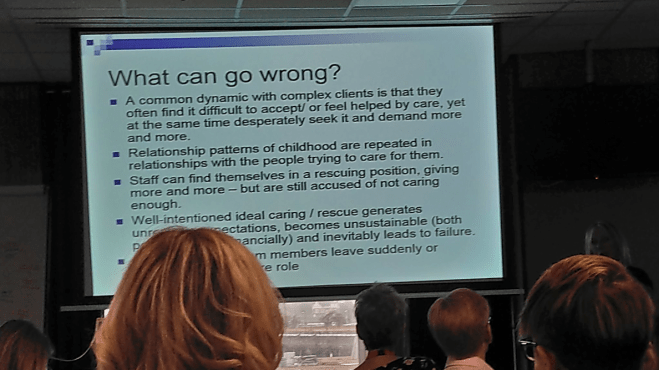
There are myths presented at a Tees, Esk and Wear training session for a mixed group of staff. We have tried to provide some insight into the reality behind the myths.

Screenshot 2018-05-03 22.38.46

MYTH: A common dynamic with complex clients is that they often find it difficult to accept or feel helped by care yet at the same time desperately seek it and demand more and more.
REALITY: So-called ‘complex’ clients are often clients who correctly identify poor quality care and speak up about it. They are not helped by poor care and rightly refuse to accept it. A common scenario is a client repeatedly mistreated by crisis team staff who then refuses to have further contact. Instead, the client demands adequate care becoming increasingly desperate as concerns about care standards are not addressed. Meanwhile the client is labelled ‘complex’ and seeking a reasonable standard of care is framed as pathological.

MYTH: Relationship patterns of childhood are repeated in relationship with the people trying to care for them
REALITY: Even the most mature person will apply previous relationship learning to new relationships. This applies to MH professionals and clients. Many MH professionals have their own problems and may be replaying dynamics where they were carers for parents or relatives. Clients who don’t provide staff with admiration, comfort reassurance and a sense of control can experience hostile and retaliatory reactions. This is why clients with an attitude of ‘doctor knows best’ tend to be so popular with health professionals.

MYTH: Staff can find themselves in a rescuing position, giving more and more – but are still accused of not caring enough.
REALITY: MH services are underfunded and under resourced. People with severe illnesses that should have intense community support are considered to receive a lot of support if they see a key worker for 1 hour a week – that’s 1/168 hours. Most clients have even less input. Rather than owning this many staff accuse patients of being overly demanding and perceive them as taking up their time. When staff position themselves as victims doing all they can to rescue and care for an accusatory client they really are losing the plot and failing to see the situation objectively: they feel overworked and patients are rightly identifying insufficient services.

MYTH: Well-intention ideal caring/rescue generates unrealistic expectations, becomes unsustainable (both personally and financially) and inevitably leads to failure
REALITY: Ideal caring is a fiction in current MH services and austerity UK. There is no possibility that staff will be providing this. Describing optimal care as ‘rescue’ is demeaning towards clients and insulting to those staff who are kind and deliver high standards. Research shows that good quality care is the type of care most likely to result in positive outcomes. Ineffective care from poorly trained staff with weak personal attributes who believe they are providing good care but lack the self-awareness to identify their personal, and training, needs and subsequently feel overwhelmed, burnt-out and then seek to blame clients, never helped anyone.

Screenshot 2018-05-03 22.38.26

MYTH: Some staff can feel caught in a dilemma – whether to be “abused” or reject the client.
REALITY: Some staff are caught in a situation where they lack skills and personal insight and their managers and Trust leadership provide poor role models, support and supervision. Some staff, due to their inability to recognise their own skills gaps perceive clients accurate identification of care failings as personal criticism. Lacking any self-awareness and not open to accept the clients feedback about the standard of care they deliver, they experience the feedback as abusive. Blaming someone else rather than accepting one’s own failings is not restricted to psychiatric nurses but due to MH professionals role and power it is particularly harmful.

MYTH: Attempts to help are apparently sabotaged by the client leaving workers feeling worthless, neglected or victimised
REALITY: Workers impose tick box solutions on clients that are totally unsuitable. They will also claim they’ve involved a client when they may have not listened well to a client at all. When a worker imposes an inappropriate solution on a client it isn’t likely to work. Anger and resentment by NHS professionals toward patients who don’t respond gratefully to ineffective advice and solutions imposed on them is inappropriate. It is also important workers don’t respond with dramatic accusations of ‘sabotage’ when an intervention is ineffective – maybe the clients needs and barriers have not been addressed, or have been discounted.

MYTH: Splitting and interdisciplinary conflict, failure to support each other within the ‘team’. Stress. Burn-out.
REALITY: The concept of splitting was originally about how the most vulnerable patients could be caught up in the dynamics of weak, fractious teams. Overtime, and unsurprisingly given the problematic staff in such teams, splitting has come to be a phenomena blamed on the patient. In family therapy dynamics like this where dysfunctional parents blame the child would be called ‘scapegoating’.

MYTH: Use of language such as ‘it’s just behaviour’ or ‘it’s manipulative’ (experienced as blaming or abusive)
REALITY: Use of language like this by NHS professionals toward the patients they have a duty of care toward IS abusive. Such beliefs about patients are the result of ignorance, prejudice and stigma.

This is covered by a Creative Commons Attribution-NonCommercial-NoDerivatives 4.0 International (CC BY-NC-ND 4.0) License 88x31.png

In the shadows of diagnosis

Diagnostic overshadowing is when physical health problems, pain, or not yet diagnosed health conditions are not taken seriously, or are seen as delusional, attention-seeking, or made up because someone has a mental health diagnosis and/or self-injury scarring.

*Invalidation

Invalidating someone else is not merely disagreeing with something that the other person said.
It is a process in which individuals communicate to the other that the opinions and emotions of the target invalid, irrational, selfish, uncaring, stupid, most likely insane, and wrong, wrong, wrong.
Invalidators let it be known directly that their target’s views and feelings, do not count for anything to anybody at any time or in any way.

David M. Allen. MD

*(slide used by Sue Phillips Survivor Activist, ‘Much More Than a Label, CAPS Advocacy, with thanks by RITB)

One of our members ended up in ITU recently because of diagnostic overshadowing as her diagnosis of BPD, makes her especially vulnerable to diagnostic overshadowing. It can be a life threatening norm for service users with that diagnosis. She had spent a year suffering with physical ill health being disbelieved until she became critically ill.

These are other examples from members of their experiences of diagnostic overshadowing;

“I went to a GP twice a few years ago in agony. For two days she explained away every symptom & told me to go & tell CMHT about the pain. Told me no need to go to A&E it would pass, left me in worst pain imaginable.
Family member found me on day 3 & got me to hospital. I had a hole in my stomach from a perforated ulcer & had septicaemia. Literally hours to live as organs were shutting down. Now left with hefty surgical scar & developed epilepsy & have kidney damage because of the amount of time I had septicaemia for. All because a GP refused to look beyond PD label & consider that I may actually have been ill”.

“I’ve had similar it was an embolism, the terror of not being able to breathe and being told you’re basically making it up will never leave me”.

“Around 10 years ago I went to the GPs stating my asthma had got worse. I was put on a course of steroids and I have a nebuliser at home. Months and months went by and my breathing got worse. I continued going to the surgery but saw many different doctors. They ALL told me that it was anxiety due to my mental ‘illness’. I tried to disagree.
Approximately 4 months later I collapsed in the street. Was rushed to A&E. Don’t remember much for weeks after that. Apparently I had pneumonia and suspected pulmonary embolism was in ICU on a ventilator”.

“I have had two major experiences of diagnostic overshadowing. My symptoms of thyrotoxicosis were said to be panic attacks. To make it worse the thyroid issues were a side effect of lithium. Some years later my abdominal pain was thought to be psychosomatic when I actually had appendicitis. My GP was my hero on that occasion for insisting they operate”.

“various things being put down to be me being over-anxious. I used to use a stick because of pain in feet and knees but a SHO was adamant that I was using the stick in a pathological way and wanted me to stop using it. Not sure if he thought my pain wasn’t real or I was using the stick for attention or I was in the sick role… (Pain is mostly sorted through podiatry diagnosing it properly and giving me orthotics and physio exercises.)”

“Told that being transgender is just a phase and due to my mh ‘illness’. Arguing that my voices are real. Stating that some of my medication gives me suicidal side effects and makes voices worse. Physical illnesses being put down to mh difficulties”

“I was first given a MH dx age 12 which coincided with my mother convincing doctors I was a not to be trusted and was attention seeking as usual when in fact I had developed septicaemia from a burst appendix. I almost died and was in PICU for 6 weeks. I can still remember my mum standing at the end of my hospital bed post op calling me a liar.
There are many other examples from my childhood and I believe that abusive care givers are often complicit with medics re dx overshadowing. After all a dead child can’t tell…”

“The whole Venlafaxine withdrawal process was a nightmare of diagnostic overshadowing. GPs and MH workers don’t acknowledge it exists. Physical and mental symptoms attributed to pre-existing MH diagnoses or not existing at all”.

“I needed cornea transplants, there’s a strict criteria for eligibility which I fitted but the ophthalmologist had a problem with loonies. It took staff a year of persuasion to see me in clinic. He referred to me as “that girl” and assumed that history of self-harm meant I would bang my head against the wall after surgery. I had no history of head banging. He didn’t speak to me, my GP, or a psychiatrist. He made a clinical judgement based on his prejudice and I was partially sighted. I was deeply depressed because of my sight.
He also interfered with optometry when I had substantial difficulties with medical lenses. They came up with a novel method of assisting me and he vetoed it, threatening them that he would not see me”.

“I tend to let my peak flow get lower before seeking help because I worry they will think I’ve not blown hard enough into the peak flow meter or not used my inhalers.
I agonise over seeing GP unless I can justify it, it must be ‘bad enough’ and couldn’t be construed as in my imagination”.

“I have known of service users to receive late cancer diagnoses because of diagnostic overshadowing and one woman’s husband was asked when she was in labour, “is she sure?” as her baby’s head started crowning”.
“I collapsed on a MH ward and when the paramedics arrived the staff nurse said ‘she’s PD’ as if to suggest ‘don’t bother, she’s faking’. My BP was critically low and they found I had heart problems that were causing the sudden drop”.

From hypermobility, to autism, any physical illness or pain which causes anxiety, drug withdrawal symptoms, bowel impaction through psychiatric medication being left to the point of obstruction and rupture, to poor management of long term physical conditions, to late cancer diagnoses – diagnostic overshadowing can kill.

This is covered by a Creative Commons Attribution-NonCommercial-NoDerivatives 4.0 International (CC BY-NC-ND 4.0) License 88x31.png

What a criticism of recovery is – a discussion

A: Sometimes it concerns me that there is a straw man about what a criticism of recovery is.

If we take the biomedical model view (that is not actually that widespread but is definitely a bugbear of the ‘recovery movement’) that, I suppose going back to Dementia Praecox, there was little likelihood of ‘recovering’ from mental health issues, then I for one can acknowledge that the ‘recovery movement’ pushed the possibility of ‘recovering’ out of that belief.

I would argue, as I said above, that this ‘never recover’ model was less wide spread than the myth would have, but it did exist. I was told by at least one person in the early nineties after being diagnosed that my life was over take my pills and sign on, but many others were very encouraging right from the start.

However, thinking of talking to founders of this group, my criticism was that austerity would make recovery harder.

But it’s not rocket science. This knowledge base goes back to Durkheim and his research in changes in suicide rates. And as such given the time it takes to gather data, there will be evidence to either condemn or vindicate us on changes in recovery rates in five years or so. Obviously the data will be scattered, open to interpretation, there will be methodological differences and ideological spin. But I am willing to state here and now my money will be that there will be sufficient evidence (if there isn’t already) that austerity has worsened recovery rates.

I would also argue that there is room for a discourse analysis that looks at how ‘metalanguage’ of recovery policy after acknowledging people can recover but then denying the effects of the economy and austerity policy then becomes more punitive, which personal testament in this group has borne witness to.

B: My perception is that ‘never recover’ was not as widespread as sometimes promoted by certain factions.
Now that’s swung to the polar opposite, no one is permitted to have long term issues or refer to them as probably permanent.
Now you will & must recover, you are obligated to and regardless of context and the political operating system we live in.
Austerity, neonormative neorecovery with fixed outcomes as we have does make whatever we view as ‘recovery’ (if it’s a concept you subscribe to) impossible for some folk.

I never subscribed to recovery at any point before austerity, for me there was something malleable about it which would always fit a self-serving agenda regardless. It always felt like a dodgy car to me. I’m aware that’s probably a minority perception, that more of us saw something good it which changed over time. #ideologydar

A: I suppose for me, I hate being ‘unwell’ (obviously), so the idea that I could recover was for me a massive a driving factor, and indeed I have been a ‘lot’ weller than now. My breakdown in 2011 was devastating for me, due to having got so much better before.

But I do agree, especially in hindsight, that the idea of recovery is somewhat malleable, and now I am 9 years into what was originally a PhD level research project, I can recognise it is an issue of what is called subjectivity too. I was obviously aware of that before 2009 or I wouldn’t have come up with the research!

And I do still so much want to live without ‘voices’. But I am more sanguine now.

B: For me I looked up to activists who were out there and living but still at times really going through it. None of them made any reference to ‘recovery’. If anything I felt greater acceptance of the ebb & flow.
How do recovery poster boys & girls come back from a major hitting of the deck now?
Public speakers didn’t have to have recovery stories then so we could rise & fall.
I found living with voices easier by accepting them as a permanent feature. The depressive sludge’s and psychotic anxiety (I’d find that useful as a diagnosis!)and paranoia are much harder to deal with.

A: I have (ironically) been arguing with my voices that whilst I would rather not have voices, they are not my ‘mental health’ issue, it is as you say all the other stuff. I am fully aware from past experience that when I deal with the other stuff the ‘voices’ lessen as a consequence anyway.

Another issue I would say is the difference in focus of whatever ‘recovery’ version people subscribe to is an issue I was reading earlier about in Gregory Bateson on epistemology problems in therapy, where focusing on ‘saving’ individuals is kind of invalidating in itself (and given psychosis is often related to ‘being invalidated’ kinda exploitative and dodgy), what is needed, that we do in this group, is to look at the conditions of ‘possibility’ of at least living a more ‘meaningful’ life, which of course is a political project, going back to Aristotle and the relation of the ethical life to the ‘polis’.

B: ‘Meaningful’ has changed now, it’s productivity.

Just been discussing how the current austerity violence can be so damaging that with each punch there’s lasting damage we don’t all recover from, like incremental losses, where your revised 100% drops to 80, then 60 and so on.

A: Definitely ‘violence’ is an accurate word.

See that’s it for me now. I am no longer looking at what I can get ‘back’ to, that ‘me’ is gone for good, but what else I can become. For that reason I have no interest in ‘recovery’. But I do want to feel ‘better’ than I do now.

B: Yes I know I can’t regain the former me and the precarity I live within means I can’t feel ‘better’.

Regarding austerity violence there’s a clear ‘before and after 2010’ difference and in profound ways.
The stasi-like culture of fear, threat. The fact that people are paranoid for feeling potential targets. Precarity with threat erodes sense of self and agency in a particular way.

B: Very much have experienced the same.

C: The hurdle to achieve the idea of recovery seems ridiculously high now the loose definition of it equates with work and a very superficial idea of economic independence.

Many I know went through ups and downs, hell and back as a personal, emotional journey, with stigma of course but not quite as much threat of destitution over them. It wasn’t a complete social duty to ‘recover’ as now.

Fear as a motivator is a huge driver in this culture. That many of us live with more than enough fear anyway seems crazy; that the imposition of recovery for fear of being destroyed is how it is.

What is recovery anyway? Life by its very inevitable shuffle to the grave is killing me, how do I ‘recover’ from that?

D: I have been rereading ‘Recovering Sanity’ by Edward Podvall and his ideas about madness/psychosis and recovery are very relevant and in opposition to the social duty to ‘recover’. Thank you for helping to clarify what is currently happening in the extremely harsh world of mental health services today.

I’m all for taking stuff back a step and highlighting the fundamental misuse of a decent enough idea of helping those that can to do……just wish those of us who can’t were not nailed up as ‘not trying’

B: Or ‘clinging to diagnosis’, ‘sick role’, bio orientated, extreme leftist.

This is covered by a Creative Commons Attribution-NonCommercial-NoDerivatives 4.0 International (CC BY-NC-ND 4.0) License 88x31.png

Are smoke free hospitals allowed to take and destroy inpatients cigarettes and lighters?

[Click on the above embedded tweet to view Twitter]

Here are the attachments sent by the medical director of Barnet, Enfield and Haringey Mental Health NHS Trust following our twitter conversation regarding the destruction of patients property as part of their smoke free practices>

CQC_briefguide-smoke free jun17

Protocol on the use of e-cigarettes and vaporisers circulated

Smoke Free Policy final

Smoke free report june17 sent

WARD NOTICE example

Kindred Minds, BME Service User Led Manifesto

“Racism is a political issue. Inequality is a political issue. Mental health is a political issue. We should hold politicians to account.”

“It’s not just about looking at improving services that fix us; it’s also about looking at what broke us in the first place.”

“There is a Bermuda Triangle in society for Black people. At one corner of the triangle is education, at another, the police and in the third corner are mental health services. Far too many Black people simply disappear into this triangle, many of them only to be seen decades later – some, tragically, never again.”

Executive summary in case you are time poor and still want to have an overview at a glance! > Kindred Minds Executive Summary

Author, Raza Griffiths, writes –  The Kindred Minds Manifesto! I believe it’s pretty unique in being BME service user led and having such a “bigger picture” view of the changes needed to improve the lives of BME mental health service users.

I’ve been working on this for 2.5 years with input from hundreds of BME service users at 18 consultation events, mainly in Southwark borough, London, and an extensive review of the literature. The manifesto has national relevance, I believe.


Slides provide an overview of the process of how the Kindred Minds BME mental health service user led manifesto was written, over the course of 2.5 years, using apposite words and pictures for people who hate long text heavy documents! Click thumbnails above to open them or Download HERE> Kindred Minds powerpoint

The priority now is to ensure we galvanise BME service users and allies to take the recommendations forward. For this we need a stimulus like a launch event. We have already secured a free venue this summer and MPs, campaigners, SLaM Trustees and other VIPs have expressed an interest in attending. The Voice newspaper expressed interest in covering a launch, particularly if we organise a public debate around the Manifesto and the BBC has expressed an interest in me talking about the launch as part of a series on mental health.

For the launch event, we urgently need £6,000 to pay for design and publication of the Manifesto (we intend to disseminate this at the launch and later to other key players not able to make the launch) and also for refreshments and entertainment. Know of anyone who could fund this? I’m approaching various funders.

The newsworthiness and relevance of the Manifesto is greater now than ever. This is due to the race inequality audit Theresa May ordered that was published earlier this year, and the Mental Health Act Review currently under way. These developments put race based mental health inequality and the use of force and restraint that is disproportionately used against BME communities firmly under the spotlight – whatever the Govt’s motivations.

Screenshot 2018-03-02 13.00.36

There are also new BME mental health initiatives challenging BME mental health inequalities, including Synergi, an academic led national programme, and Black Thrive based in Lambeth, both of which seek to challenge BME mental health inequalities. I believe we should use the Manifesto, which is BME service user led, to influence all these other initiatives and the Review, to help ensure the BME service user voice is heard.

In PDF format download HEREKindred Minds Manifesto A Call for Social Justice

If you can help raise the necessary funds or other ideas to help the manifesto gain prominence please contribute here gofundme.com/racial-justice-in-mental-health


email  recoveryinthebin@gmail.com

Or say hello to us on Twitter @RITB_

Demo at New Savoy conference: 8.15am Wednesday 21st March 2018

The Alliance for Counselling and Psychotherapy has organised a demo at the New Savoy conference again this year: 8.15am Wednesday 21st March 2018.

Paul Atkinson writes> Some context:

• The hierarchy of IAPT and psychological services in the NHS who gather at these conferences continue to offer liberal mouthings about DWP welfare reform policies, WCA and PIP, sanctions, coercion around Work and Health. But they’ve actually taken no real action to boycott DWP/Health collaboration, despite all the developments re judicial reviews, UN condemnations, the recent Parl Committee report, and the UC debacle.

(luxury Hotel details https://www.millenniumhotels.com/en/meetings-events/europe/united-kingdom/london/millennium-gloucester-hotel-london-kensington/)

In his intro to the conference in the programme http://www.healthcareconferencesuk.co.uk/conf/uploads/brochures/1210_20180214-104528_Psychological_Therapies_2018_Brochure.pdf Jeremy Clarke (NS chair) says:

“The second issue is the running sore of welfare benefit reform, and its negative impact on mental health, that undermines whatever benefit we make to population wellbeing. Have we reached a consensus now for how we can turn the tide? The BBC’s Mark Easton will find out”

Screenshot 2018-02-25 13.21.52.png

• The overall theme is depression; there are sessions on the crisis in the IAPT workforce, latest staff survey, impact of targets; session on Work and Health Unit; Wessely’s review of human rights and compulsory treatment; session on Employee Assistant Programmes (often run by people like Maximus https://www.maximusuk.co.uk/health-programmes/health-promotion-and-wellbeing/employee-assistance-programmes); familiar faces in the list of speakers

• I’m working on the scam of IAPT as a service in local communities. It has a massive evidence base, tons of statistics for every CCG in England including “recovery” rates; ethnicity stats; deprivation stats; etc etc No-one really analyses the figures. For IAPT it seems just collecting the stats is their claim to being evidence based and therefore their claim for funding from the Government. In fact, their stats reveal a shockingly failing provision.

For example, out of 1,350,000 referrals a year 85% either never enter any kind of therapy, or never finish a course of treatment, or don’t “move to recovery” (as IAPT jargon has it). In my CCG (Tower Hamlets) only 6.6% of referrals to IAPT “recovered” and among the Bangladeshi community who make up over 30% on TH population only 3% “recovered”. Farmer’s Taskforce target for % of population who “need IAPT therapy” is 15%, rising to 25% by 2021. In TH about 2% of the pop were referred/referred themselves to IAPT, of whom as I say 6.6% “recovered”.

IAPT will be a major part of the propaganda around the NHS reorganisation now in progress, via the STPs and the ACOs they are developing (link here for more info on this https://keepournhspublic.com/campaigns/accountable-care/). STP management have “the mental health crisis” high on their agenda – certainly their PR agenda – and selling more provision for IAPT services will be a major plank of the campaign. See Hunt on this role for IAPT here https://www.newstatesman.com/microsites/healthcare/2017/10/planning-new-mental-health-paradigm

IAPT is rarely taken to task as a service that is massively failing communities all over England. This is true in the Labour Party as much as any where ekse. This has to stop. It is a propaganda service for neoliberal capitalism and its dissemination of psychological scapegoating and coercion across society

Hope to see some of you on the 21st!<

Flyer as PDF here New Savoy 2018