The RITAs Awards #RITASawards

The full list of The RITAs Awards for Excellence in Awfulness 2025!

The RITA Awards for Excellence in Awfulness (Brown)

Alt Text description of Award certificate: 
A rectangular award notice in white with a bronze brown segment on the left saying the Rita awards and the the name of the winner with a stick figure from the recovery in the bin logo throwing the award in the bin.
Patronising Interventions Award sponsored by having a cup of tea in a warm bath CIC (we’re Disability Confident™): The Decider life skills program for those for whom DBT has been deemed too expensive.

Patronising Interventions Award sponsored by having a cup of tea in a warm bath CIC (we’re Disability Confident™): The Decider life skills program for those for whom DBT has been deemed too expensive.

The RITA Awards for Excellence in Awfulness (Brown)

Alt Text description of Award certificate: 
A rectangular award notice in white with a bronze brown segment on the left saying the Rita awards and the the name of the winner with a stick figure from the recovery in the bin logo throwing the award in the bin.

Bad Samaritan Award: The Samaritans (for rationing calltime)

Bad Samaritan Award: The Samaritans (for rationing calltime)

The RITA Awards for Excellence in Awfulness (Brown)

Alt Text description of Award certificate: 
A rectangular award notice in white with a bronze brown segment on the left saying the Rita awards and the the name of the winner with a stick figure from the recovery in the bin logo throwing the award in the bin.

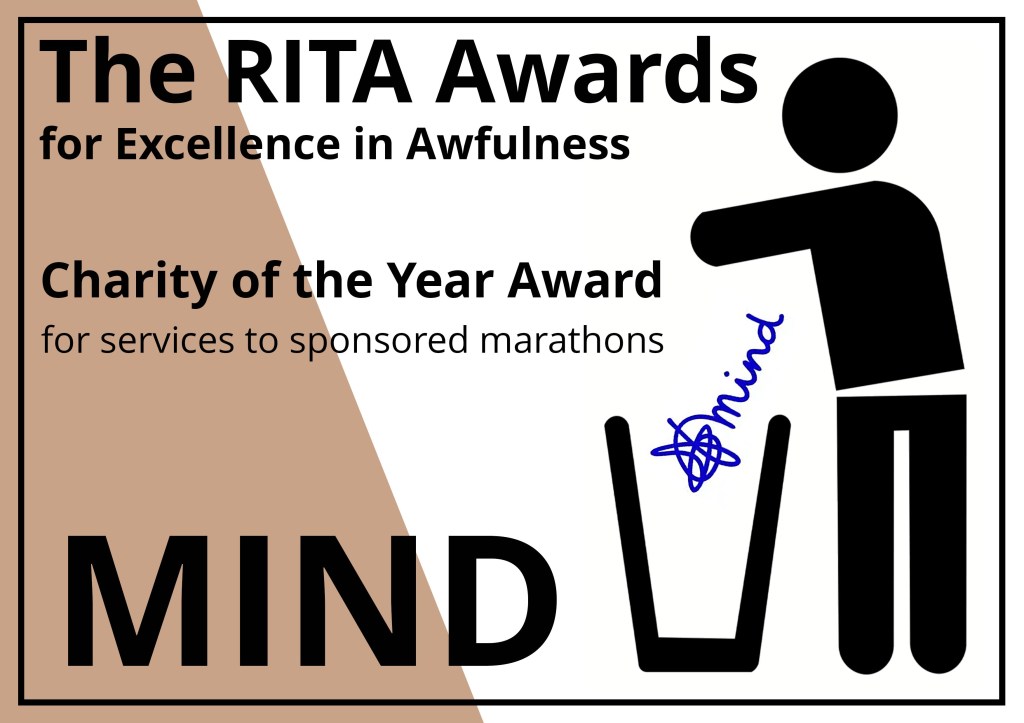
Charity of the Year award for services to sponsored marathons: MIND 

Charity of the Year award for services to sponsored marathons: MIND 

The RITA Awards for Excellence in Awfulness (Brown)

Alt Text description of Award certificate: 
A rectangular award notice in white with a bronze brown segment on the left saying the Rita awards and the the name of the winner with a stick figure from the recovery in the bin logo throwing the award in the bin.
Professional Tosser Award (Joint): Jonathon Shedler and Mark Ruffalo (not the actor) For their verbal diarrhoea on X/Twitter

Professional Tosser Award (Joint): Jonathon Shedler and Mark Ruffalo (not the actor) For their verbal diarrhoea on X/Twitter

The RITA Awards for Excellence in Awfulness (Brown)

Alt Text description of Award certificate: 
A rectangular award notice in white with a bronze brown segment on the left saying the Rita awards and the the name of the winner with a stick figure from the recovery in the bin logo throwing the award in the bin.
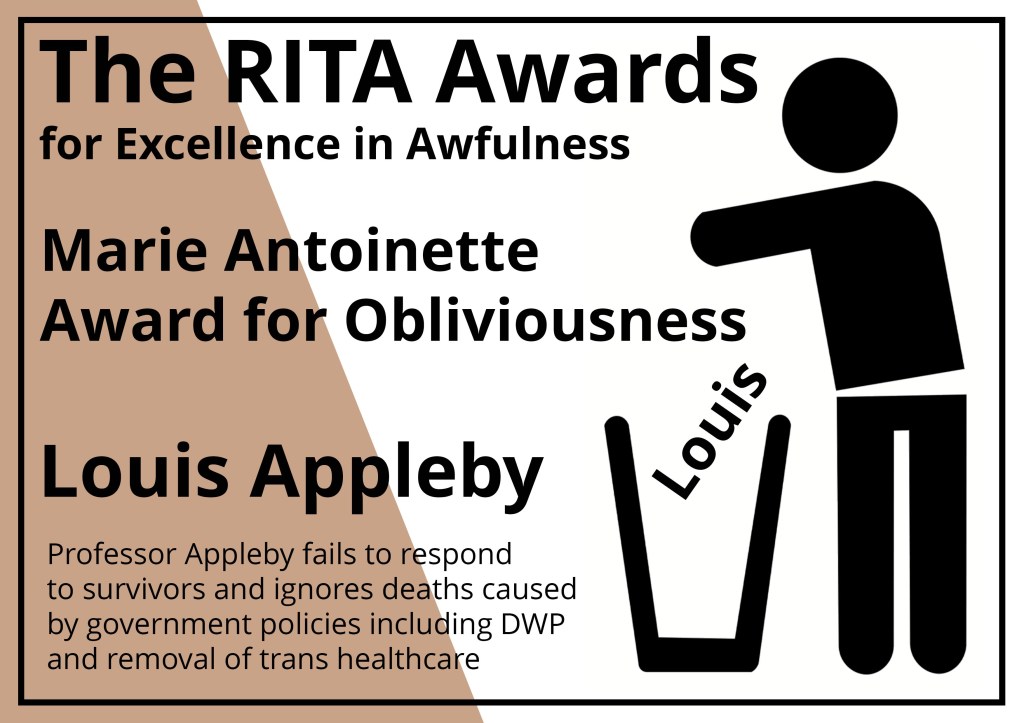
Marie Antoinette Award for Obliviousness: Prof Appleby fails to respond to survivors and ignores deaths caused by government policies including DWP and removal of Trans healthcare.

Marie Antoinette Award for Obliviousness: Prof Appleby fails to respond to survivors and ignores deaths caused by government policies including DWP and removal of Trans healthcare.

The RITA Awards for Excellence in Awfulness (Brown)

Alt Text description of Award certificate: 
A rectangular award notice in white with a bronze brown segment on the left saying the Rita awards and the the name of the winner with a stick figure from the recovery in the bin logo throwing the award in the bin.
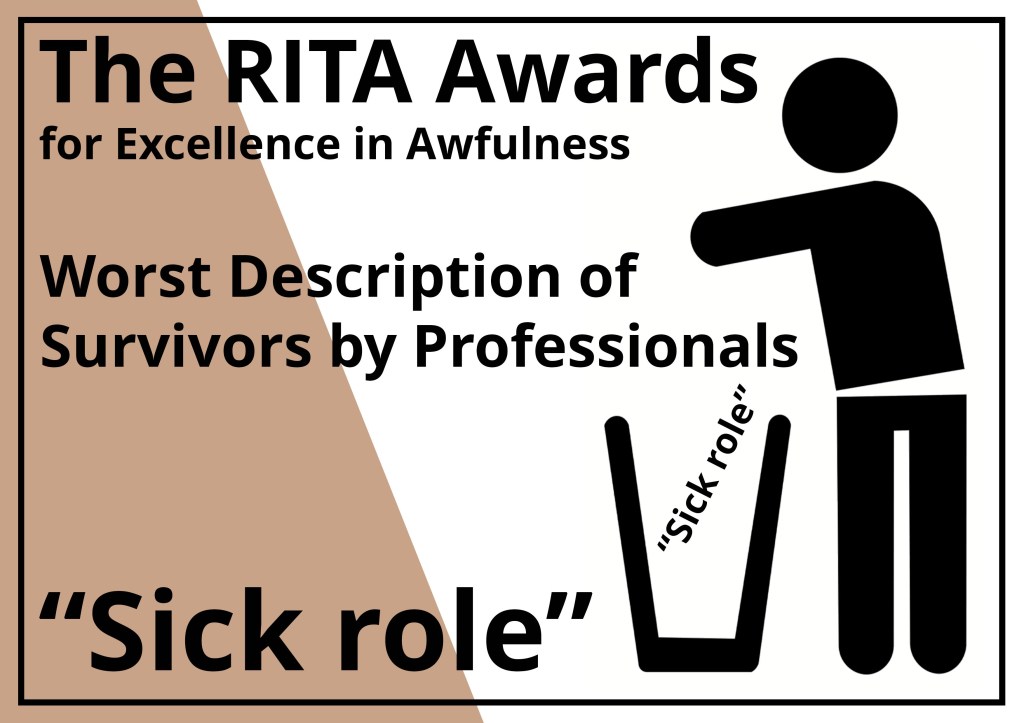
Worst description of survivors by professionals Award: "Sick role"

Worst description of survivors by professionals Award: “Sick role” 

The RITA Awards for Excellence in Awfulness (Brown)

Alt Text description of Award certificate: 
A rectangular award notice in white with a bronze brown segment on the left saying the Rita awards and the the name of the winner with a stick figure from the recovery in the bin logo throwing the award in the bin.
We are so rebellious that conservatives agree with us and we have book deals, and appear on TV: The Criticals - The nickname for professionals viewed as radical/critical thinking about MH services and disciplines yet aren’t revolutionary but are just seeking to  replace one hierarchy with theirs.

We are so rebellious that conservatives agree with us and we have book deals, and appear on TV: The Criticals – The nickname for professionals viewed as radical/critical thinking about MH services and disciplines yet aren’t revolutionary but are just seeking to  replace one hierarchy with theirs.

The RITA Awards for Excellence in Awfulness (Brown)

Alt Text description of Award certificate: 
A rectangular award notice in white with a bronze brown segment on the left saying the Rita awards and the the name of the winner with a stick figure from the recovery in the bin logo throwing the award in the bin.
Lifetime Achievement for Total Bollocks Award: Peter Tyrer - For his endless judgemental and stigmatising promotion of “Personality Disorder”. Runner up: Rachel Perkins

Lifetime Achievement for Total Bollocks Award: Peter Tyrer – For his endless judgemental and stigmatising promotion of “Personality Disorder”. Runner up: Rachel Perkins

The RITA Awards for Excellence in Awfulness (Brown)

Alt Text description of Award certificate: 
A rectangular award notice in white with a bronze brown segment on the left saying the Rita awards and the the name of the winner with a stick figure from the recovery in the bin logo throwing the award in the bin.
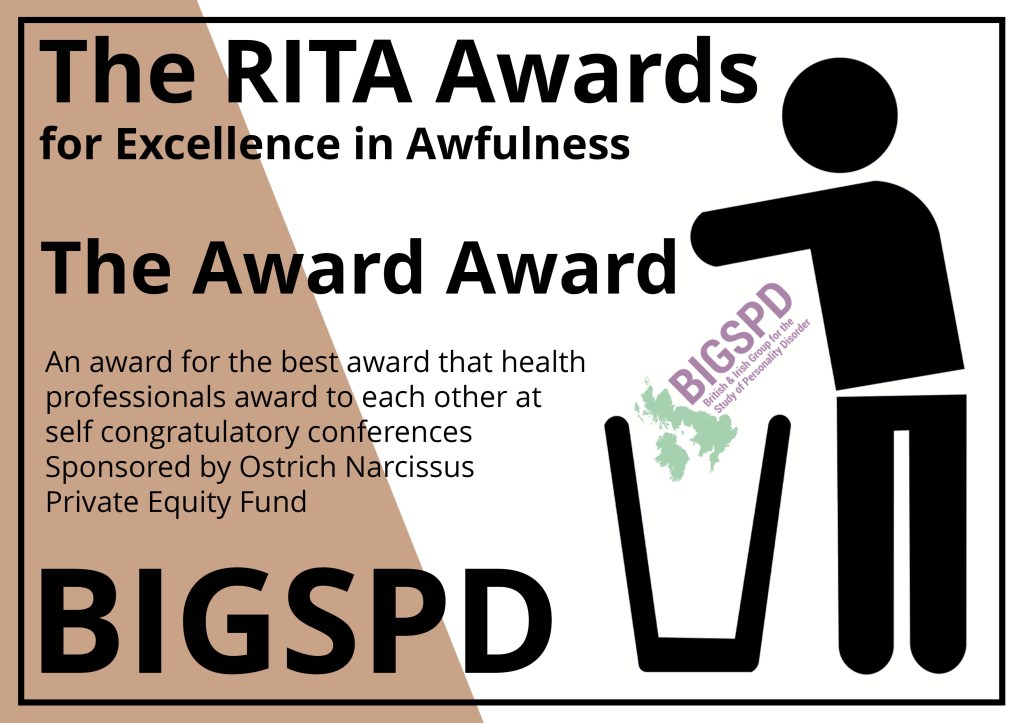
The Award Award, an award for the best award that health professionals award to each other at self congratulatory conferences. Sponsored by Ostrich Narcissus Private Equity Fund: BIGSPD - the annual party for personality disorder professionals to congratulate themselves.

The Award Award, an award for the best award that health professionals award to each other at self congratulatory conferences. Sponsored by Ostrich Narcissus Private Equity Fund: BIGSPD – the annual party for personality disorder professionals to congratulate themselves.

The RITA Awards for Excellence in Awfulness (Brown)

Alt Text description of Award certificate: 
A rectangular award notice in white with a bronze brown segment on the left saying the Rita awards and the the name of the winner with a stick figure from the recovery in the bin logo throwing the award in the bin.
Most extractive and exploitative false co-production award, sponsored by NHS England: Tim Kendall, for SIM 

Most extractive and exploitative false co-production award, sponsored by NHS England: Tim Kendall, for SIM 

The RITA Awards for Excellence in Awfulness (Brown)

Alt Text description of Award certificate: 
A rectangular award notice in white with a bronze brown segment on the left saying the Rita awards and the the name of the winner with a stick figure from the recovery in the bin logo throwing the award in the bin.
Worst Trust of the Year Winner: Norfolk and Suffolk NHS Foundation Trust (NSFT)

Nominated:

Cambridgeshire and Peterborough NHS Foundation Trust (CPFT)

Essex Partnership University NHS Foundation Trust (EPUT)

Greater Manchester Mental Health NHS Foundation Trust (GMMH)

Kent and Medway NHS and Social Care Partnership Trust (KMPT)

Lancashire and South Cumbria NHS Foundation Trust (LSCFT)

Norfolk and Suffolk NHS Foundation Trust (NSFT)

Surrey and Borders Partnership NHS Foundation Trust (SABP)

Tees, Esk and Wear Valleys NHS Foundation Trust (TEWV)

Worst Trust of the Year Winner: Norfolk and Suffolk NHS Foundation Trust (NSFT)

Nominated:

Cambridgeshire and Peterborough NHS Foundation Trust (CPFT)

Essex Partnership University NHS Foundation Trust (EPUT)

Greater Manchester Mental Health NHS Foundation Trust (GMMH)

Kent and Medway NHS and Social Care Partnership Trust (KMPT)

Lancashire and South Cumbria NHS Foundation Trust (LSCFT)

Norfolk and Suffolk NHS Foundation Trust (NSFT)

Surrey and Borders Partnership NHS Foundation Trust (SABP)

Tees, Esk and Wear Valleys NHS Foundation Trust (TEWV) 

The RITA Awards for Excellence in Awfulness (Brown)

Alt Text description of Award certificate: 
A rectangular award notice in white with a bronze brown segment on the left saying the Rita awards and the the name of the winner with a stick figure from the recovery in the bin logo throwing the award in the bin.
Worst Ward Award: Roseacre (Cygnet Maidstone)

Runner up: Moredun ward, NHS Tayside.

Worst Ward Award: Roseacre (Cygnet Maidstone)

Runner up: Moredun ward, NHS Tayside.

The RITA Awards for Excellence in Awfulness (Brown)

Alt Text description of Award certificate: 
A rectangular award notice in white with a bronze brown segment on the left saying the Rita awards and the the name of the winner with a stick figure from the recovery in the bin logo throwing the award in the bin.
Worst Community Health Award: Pendle CMHT 

Worst Community Health Award: Pendle CMHT 

The RITA Awards for Excellence in Awfulness (Brown)

Alt Text description of Award certificate: 
A rectangular award notice in white with a bronze brown segment on the left saying the Rita awards and the the name of the winner with a stick figure from the recovery in the bin logo throwing the award in the bin.

Worst Intervention Award: Oxevision

Runners up: CBT / IAPT & IPS (Individual Placement & Support)

Worst Intervention Award: Oxevision

Runners up: CBT / IAPT & IPS (Individual Placement & Support)

The RITA Awards for Excellence in Awfulness (Brown)

Alt Text description of Award certificate: 
A rectangular award notice in white with a bronze brown segment on the left saying the Rita awards and the the name of the winner with a stick figure from the recovery in the bin logo throwing the award in the bin.
Worst MH Trust CEO: Brent Kilmurray for TEWV.

Runner up: Claire Murdoch.

Worst MH Trust CEO: Brent Kilmurray for TEWV.

Runner up: Claire Murdoch.

The RITA Awards for Excellence in Awfulness (Brown)

Alt Text description of Award certificate: 
A rectangular award notice in white with a bronze brown segment on the left saying the Rita awards and the the name of the winner with a stick figure from the recovery in the bin logo throwing the award in the bin.
The Chocolate fireguard achievement in creative report writing award: Care Quality Commission CQC

The Chocolate fireguard achievement in creative report writing award: Care Quality Commission CQC

The RITA Awards for Excellence in Awfulness (Brown)

Alt Text description of Award certificate: 
A rectangular award notice in white with a bronze brown segment on the left saying the Rita awards and the the name of the winner with a stick figure from the recovery in the bin logo throwing the award in the bin.
Worst thing said to you by a health professional, Award sponsored by ‘its your choice, you have capacity to kill yourself' (Joint):

"You do know that you have a Black gene that is causing you to be mentally ill"

"Your brain lacks the foundations of an ordinary building which is why you should take Sodium Valproate"

"Katy has a different kind of brain " 

“The thing about Sophie is, there’s nothing you can do to help her.” 

“well you’re quite the prolific self harmer anyway. we’ve already decided you don’t need a bed, we just need to tick you off” (said to me as soon as they met me, before they even said hello).

"I ain't going to coroner's court for you & neither will your private therapist, the trust, or the ambulance service. You have capacity". Then she (NHS rapid response service) hung up the phone on me. This was seconds after a suicide attempt when I was home alone.

"You can't have autism, you don't like trains", said by an NHS psychiatrist medical director who had "worked with autistic people for many years”. (later diagnosed with autism).

“Nurse telling me to try losing weight with keto to cure anorexia has to be up there right? Apparently I'd lose ten kilos a month if I just ate as much meat as possible and nothing else. Impressive double whammy of 'not how to help an anorexic' and 'not physiologically possible'.”

Refused help because you won't meet services "recovery targets"

Award Goes to ‘The unknown professional’ for all these things that are said. You know who you are!

Worst thing said to you by a health professional, Award sponsored by ‘its your choice, you have capacity to kill yourself’ (Joint):

“You do know that you have a Black gene that is causing you to be mentally ill”

“Your brain lacks the foundations of an ordinary building which is why you should take Sodium Valproate”

“Katy has a different kind of brain ” 

“The thing about Sophie is, there’s nothing you can do to help her.” 

“well you’re quite the prolific self harmer anyway. we’ve already decided you don’t need a bed, we just need to tick you off” (said to me as soon as they met me, before they even said hello).

“I ain’t going to coroner’s court for you & neither will your private therapist, the trust, or the ambulance service. You have capacity”. Then she (NHS rapid response service) hung up the phone on me. This was seconds after a suicide attempt when I was home alone.

“You can’t have autism, you don’t like trains”, said by an NHS psychiatrist medical director who had “worked with autistic people for many years”. (later diagnosed with autism).

“Nurse telling me to try losing weight with keto to cure anorexia has to be up there right? Apparently I’d lose ten kilos a month if I just ate as much meat as possible and nothing else. Impressive double whammy of ‘not how to help an anorexic’ and ‘not physiologically possible’.”

Refused help because you won’t meet services “recovery targets”

Award Goes to ‘The unknown professional’ for all these things that are said. You know who you are!

The RITA Awards for Excellence in Awfulness (Brown)

Alt Text description of Award certificate: 
A rectangular award notice in white with a bronze brown segment on the left saying the Rita awards and the the name of the winner with a stick figure from the recovery in the bin logo throwing the award in the bin.
Worst Broadcaster: Channel 4, Fraser Nelson (Dispatches: Inside Britain’s £48 Billion Benefits Scandal). This was journalistic malpractice by Dispatches, Fraser Nelson has a well documented bias against social security and advocates for far right positions (noticeably he edited The Spectator, a magazine that has posted defences of Nazis -who under Aktion T4 exterminated 250,000 disabled people as a precursor to the Holocaust), this cherry picked meritless hit piece is beneath acceptable standards. The real story is the thousands of deaths caused by the DWP.  deathsbywelfare.org

Worst Broadcaster: Channel 4, Fraser Nelson (Dispatches: Inside Britain’s £48 Billion Benefits Scandal). This was journalistic malpractice by Dispatches, Fraser Nelson has a well documented bias against social security and advocates for far right positions (noticeably he edited The Spectator, a magazine that has posted defences of Nazis -who under Aktion T4 exterminated 250,000 disabled people as a precursor to the Holocaust), this cherry picked meritless hit piece is beneath acceptable standards. The real story is the thousands of deaths caused by the DWP.  deathsbywelfare.org

The RITA Awards for Excellence in Awfulness (Brown)

Alt Text description of Award certificate: 
A rectangular award notice in white with a bronze brown segment on the left saying the Rita awards and the the name of the winner with a stick figure from the recovery in the bin logo throwing the award in the bin.
Most repulsive think tank: Centre for Social Justice

Most repulsive think tank: Centre for Social Justice

The RITA Awards for Excellence in Awfulness (Brown)

Alt Text description of Award certificate: 
A rectangular award notice in white with a bronze brown segment on the left saying the Rita awards and the the name of the winner with a stick figure from the recovery in the bin logo throwing the award in the bin.
Political gaslighter of the Year Award: The government front bench & the Westminster media lobby.

Political gaslighter of the Year Award: The government front bench & the Westminster media lobby.

The RITA Awards for Excellence in Awfulness (Brown)

Alt Text description of Award certificate: 
A rectangular award notice in white with a bronze brown segment on the left saying the Rita awards and the the name of the winner with a stick figure from the recovery in the bin logo throwing the award in the bin.
You can’t call someone a liar in parliament, but we’re not in parliament, so LIAR! Award: Keir Starmer

You can’t call someone a liar in parliament, but we’re not in parliament, so LIAR! Award: Keir Starmer

The RITA Awards for Excellence in Awfulness (Brown)

Alt Text description of Award certificate: 
A rectangular award notice in white with a bronze brown segment on the left saying the Rita awards and the the name of the winner with a stick figure from the recovery in the bin logo throwing the award in the bin.
Cuts will set you free, Fiscal Incompetence Award: Rachel Reeves

Cuts will set you free, Fiscal Incompetence Award: Rachel Reeves

The RITA Awards for Excellence in Awfulness (Brown)

Alt Text description of Award certificate: 
A rectangular award notice in white with a bronze brown segment on the left saying the Rita awards and the the name of the winner with a stick figure from the recovery in the bin logo throwing the award in the bin.
Worst co-production Award: Timms PIP Review

Runners Up:  Knowledge and Understanding Framework (KUF) training programme.

A provider who churns out "co-produced patient lounges" in inpatient wards like there's no tomorrow... because patients would all rather choose the colour of a gaming chair than have strategic influence.

Worst co-production Award: Timms PIP Review

Runners Up:  Knowledge and Understanding Framework (KUF) training programme.

A provider who churns out “co-produced patient lounges” in inpatient wards like there’s no tomorrow… because patients would all rather choose the colour of a gaming chair than have strategic influence. 

The RITA Awards for Excellence in Awfulness (Brown)

Alt Text description of Award certificate: 
A rectangular award notice in white with a bronze brown segment on the left saying the Rita awards and the the name of the winner with a stick figure from the recovery in the bin logo throwing the award in the bin.

Lifetime Achievement Award for Democidal Policies: Iain Duncan Smith

Lifetime Achievement Award for Democidal Policies: Iain Duncan Smith

The RITA Awards for Excellence in Awfulness (Brown)

Alt Text description of Award certificate: 
A rectangular award notice in white with a bronze brown segment on the left saying the Rita awards and the the name of the winner with a stick figure from the recovery in the bin logo throwing the award in the bin.

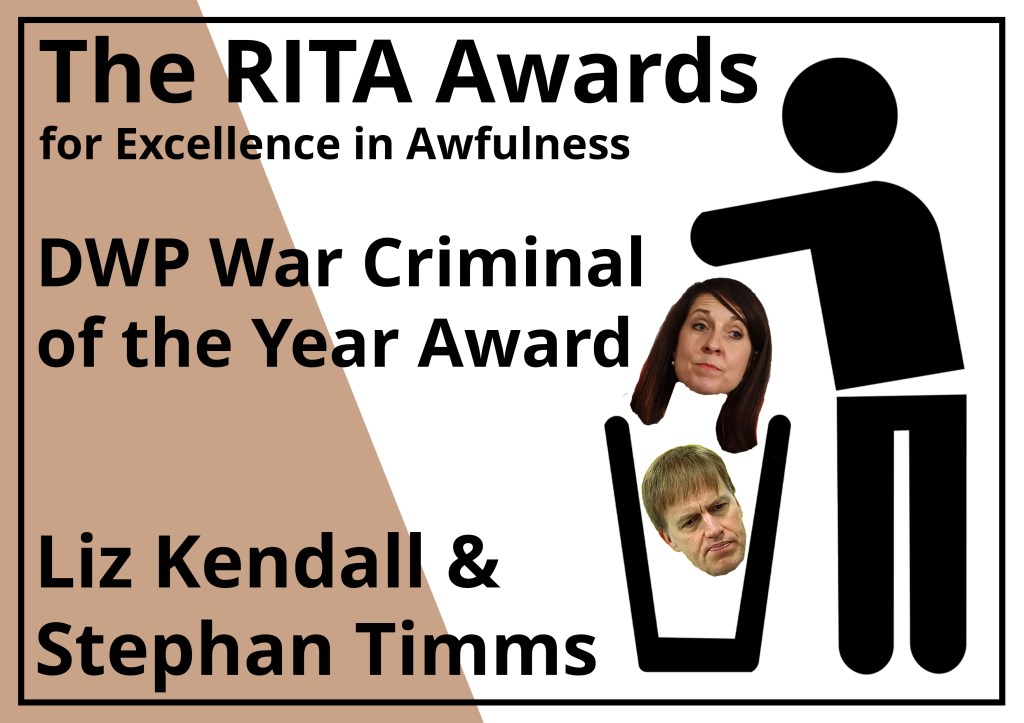
DWP War Criminal of the Year: Joint award to Liz Kendall and Stephen Timms.

DWP War Criminal of the Year: Joint award to Liz Kendall and Stephen Timms.

RITB Honours #RITBhonours

The full list of (Binners are) Winners of Recovery in the Bin Honours.

Alt Text description of Honour certificates:
A rectangular Honour Certificate of Appreciation in luxurious cream and gold with a gold seal on the top left with the Recovery in the Bin logo of stick figure, star, and bin. Honouring the winner with the date and signed Rita Bins. 
Innovative activist Honour: Dolly Sen

For her innovative art, activism, and films, including ‘sectioning’ the DWP for being a danger to claimants.

Innovative activist Honour: Dolly Sen

For her innovative art, activism, and films, including ‘sectioning’ the DWP for being a danger to claimants.

Alt Text description of Honour certificates:
A rectangular Honour Certificate of Appreciation in luxurious cream and gold with a gold seal on the top left with the Recovery in the Bin logo of stick figure, star, and bin. Honouring the winner with the date and signed Rita Bins. 
Legal win of the year Honour: Ellen Clifford DPAC

For winning a judicial review against the DWP

Legal win of the year Honour: Ellen Clifford DPAC

For winning a judicial review against the DWP 

Alt Text description of Honour certificates:
A rectangular Honour Certificate of Appreciation in luxurious cream and gold with a gold seal on the top left with the Recovery in the Bin logo of stick figure, star, and bin. Honouring the winner with the date and signed Rita Bins. 
Loony/Allie of the Year Honour: Jay Watts

A survivor and professional who has tirelessly, consistently, supported and amplified fellow survivors' work and needs.

Loony/Allie of the Year Honour: Jay Watts

A survivor and professional who has tirelessly, consistently, supported and amplified fellow survivors’ work and needs.

Alt Text description of Honour certificates:
A rectangular Honour Certificate of Appreciation in luxurious cream and gold with a gold seal on the top left with the Recovery in the Bin logo of stick figure, star, and bin. Honouring the winner with the date and signed Rita Bins. 
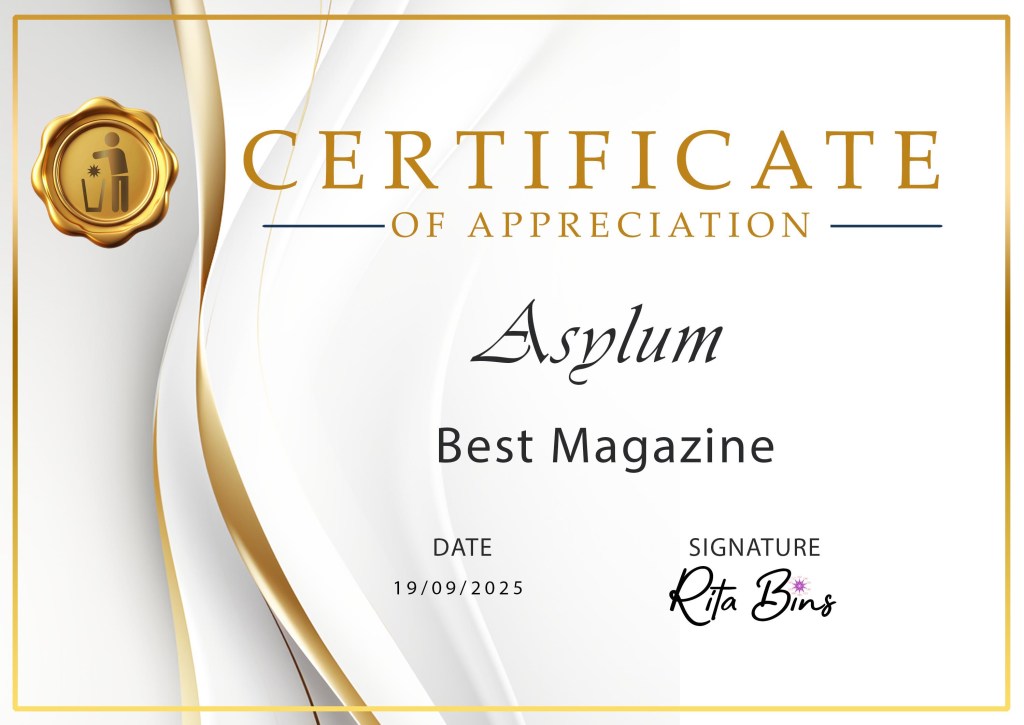
Best Magazine Honour: Asylum

What more can we say! Asylum continues to be a fab radical magazine for 40 years

Best Magazine Honour: Asylum

What more can we say! Asylum continues to be a fab radical magazine for 40 years

Alt Text description of Honour certificates:
A rectangular Honour Certificate of Appreciation in luxurious cream and gold with a gold seal on the top left with the Recovery in the Bin logo of stick figure, star, and bin. Honouring the winner with the date and signed Rita Bins. 
Best Journalist Honour: John Pring Disability News Service.

Author of ‘The Department’, disabled journalist John has been holding the DWP and others to account for 25 years as the only news agency specialising in disability issues.

Best Journalist Honour: John Pring Disability News Service.

Author of ‘The Department’, disabled journalist John has been holding the DWP and others to account for 25 years as the only news agency specialising in disability issues.

Alt Text description of Honour certificates:
A rectangular Honour Certificate of Appreciation in luxurious cream and gold with a gold seal on the top left with the Recovery in the Bin logo of stick figure, star, and bin. Honouring the winner with the date and signed Rita Bins. 
Fab activism Honour: Stop Oxevision

Stop Oxevision is a brilliant, thorough, well researched campaign to highlight the use of Oxevision, a patient monitoring system consisting of an infrared sensor and camera, which can be used to observe patients remotely.

Fab activism Honour: Stop Oxevision

Stop Oxevision is a brilliant, thorough, well researched campaign to highlight the use of Oxevision, a patient monitoring system consisting of an infrared sensor and camera, which can be used to observe patients remotely. 

Alt Text description of Honour certificates:
A rectangular Honour Certificate of Appreciation in luxurious cream and gold with a gold seal on the top left with the Recovery in the Bin logo of stick figure, star, and bin. Honouring the winner with the date and signed Rita Bins. 
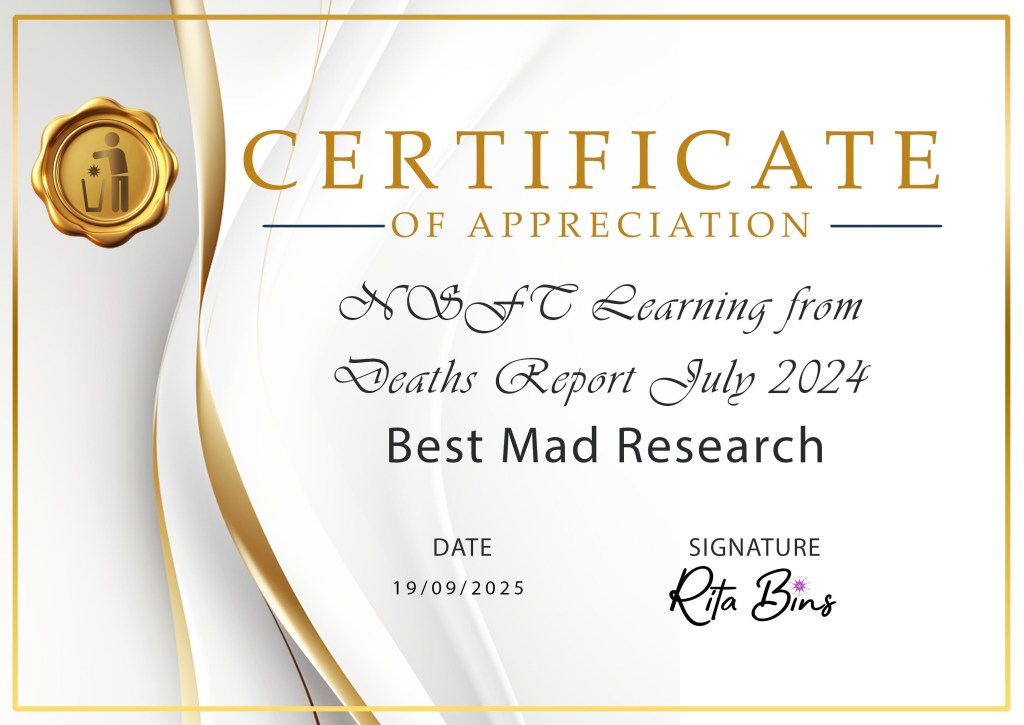
Best mad research Honour:

NSTF Crisis Learning From Deaths report July 2024

Mental health campaigners held Norfolk and Suffolk NHS Foundation Trust to account for thousands of patient deaths.

Runners up Menstrual health in psychiatric inpatient settings - Hat Porter et al

Wren Aves - self-harm research, Escaping iatrogenic harm: A journey into mental health service avoidance

Best mad research Honour:

NSFT Crisis Learning From Deaths report July 2024

Mental health campaigners held Norfolk and Suffolk NHS Foundation Trust to account for thousands of patient deaths.

Runners up Menstrual health in psychiatric inpatient settings – Hat Porter et al

Wren Aves – self-harm research, Escaping iatrogenic harm: A journey into mental health service avoidance

Alt Text description of Honour certificates:
A rectangular Honour Certificate of Appreciation in luxurious cream and gold with a gold seal on the top left with the Recovery in the Bin logo of stick figure, star, and bin. Honouring the winner with the date and signed Rita Bins. 
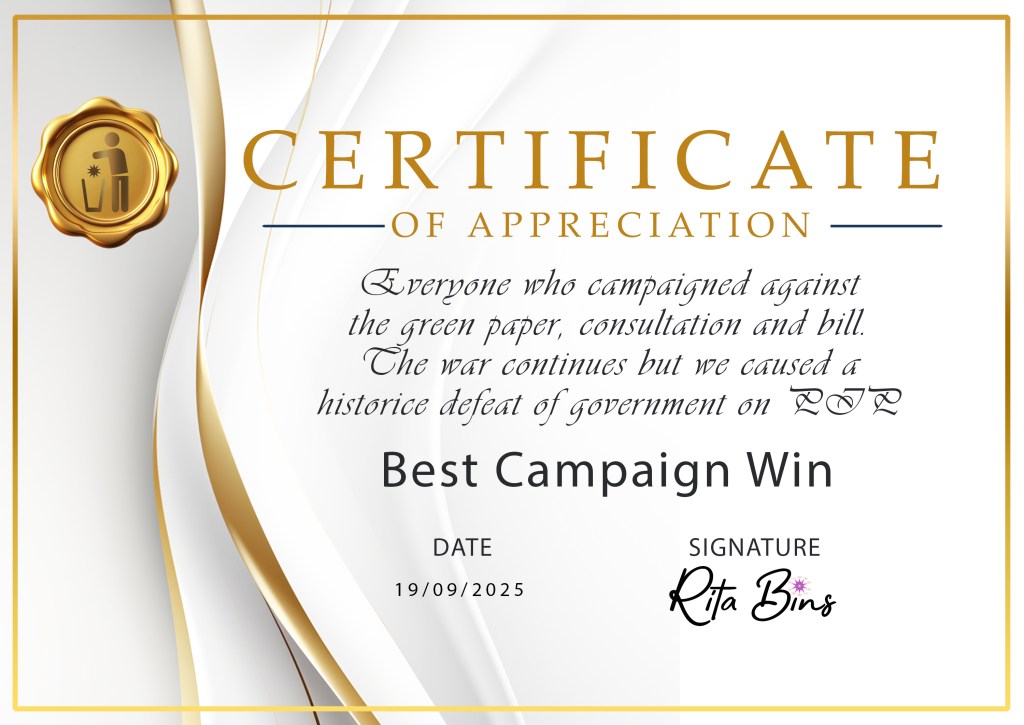
Best Campaign Win

Everyone who fought against the Pathways to Work Green Paper and the PIP & UC Bill.

Best Campaign Win

Everyone who fought against the Pathways to Work Green Paper and the PIP & UC Bill.

Alt Text description of Honour certificates:
A rectangular Honour Certificate of Appreciation in luxurious cream and gold with a gold seal on the top left with the Recovery in the Bin logo of stick figure, star, and bin. Honouring the winner with the date and signed Rita Bins. 
Our Highest Honour:

Lifetime Fellowship Of The Unknown Survivor - to everyone living with mental distress and illness who has lived through another year, we persist. 

Love, Rita ❤️ xoxo

Our Highest Honour:

Lifetime Fellowship Of The Unknown Survivor – to everyone living with mental distress and illness who has lived through another year, we persist.

Love, Rita ❤️ xoxo

DWP’s Nation of Snitches

a glass faced office building of many floors, in many windows are giant eyeballs watching you, in one dark window two red eyes glare out.

One day a woman was admiring my new outfit and smiling, casually said “careful someone might phone the DWP” making a phone call gesture (because of course that someone might be her).

My blood ran cold, in that moment I really disliked that person and will think they’re scum forever. This is not the first or last time this has happened, that people jump to this response in relation to something like nice clothes is disturbing to me but apparently acceptable to others. The fact that I’m on disability benefits is clearly never far from their minds and weaponising it against me isn’t either.

Another time a friend queried whether I should be spending my benefits money (£25) on a massage, y’know shouldn’t it be for things like food and leccy? She didn’t know anything about benefits, my benefits, why I get them or anything else but thats ok she entitled to question me about it.

The idea that they are paying for you so they have the right to police you, that “taxpayers” rhetoric has really worked in a very deep rooted way. Its not my money, its theirs.

Every time this happens I find myself justifying to myself why I bought new clothes, why I bought a massage, why I needed them, because I’m doing it too.

I’ve been investigated for fraud twice, once in the 90s when legislation changed in April and suddenly lots of people where committing fraud so we had to report en masse to the fraud dept. And a second time around 2010, I say second time but it actually lasted for 6 yrs. I was summoned to the fraud dept, was questioned and had to give a statement, I was told “90% of people who come into this room end up in court”. I didn’t, I still have no idea what fraud I was accused of, why and more importantly who reported me. For 6yrs I received constant forms to fill in and random phone calls; someone would say their name really fast, so I couldn’t catch it and then bark questions at me “how much money did I have in my account? How many times I had I been abroad in the past ten years (with outgoing/incoming dates). They always refused to repeat their name or give me any details such as a phone number.

Could you do that? Tell someone how much money you have down to the last penny on demand? Do you have the dates of all your travel over the past decade memorised? Tell a stranger that phoned you without warning?. I had to. This was also information I already provided multiple times.

It was suggested, by welfare rights, that the DWP had a vendetta against me, that it was purely malicious, I had the option to take action but by that point I didn’t want to poke the wasps nest any further. I depend on the DWP for my survival. The harassment abruptly stopped when I moved onto PIP & ESA.

I should add that I’m in the Substantial Risk group as I am “a danger to myself and /or others and must be supervised at all time”. It doesn’t protect you from the abuse of the DWP.

I’ve been dismayed on social media at how many disability benefit recipients including activists suggested in response to the “my Aunty gets PIP but I know shes faking disability” posts, with “Oh you should report her then, that’s on you”. When I suggest “how about we mind our own business” people got very defensive and pissed off at me because I’ve committed the sin of having unwavering solidarity with all my fellow benefit claimants (real or fictional) and perhaps highlighted their lack of.

We are not only conditioned to accept that there is extreme wealth, with all its idleness, greed and corruption, to admire & aspire to it, but also to focus on each other instead, punch down or across, but never up. Focus on the minutiae not the big picture. Across class antagonism is an invaluable, no, essential tool of the state and it will do anything to maintain it.

We are also conditioned to accept that there is extreme poverty, but unlike wealth, it must be monitored, scrutinised and policed. Your neighbour might be spending money on something the state might not approve of. Your poor friend on benefits might be the undeserving kind of poor. Its up to you to decide that, no evidence needed, you must be the eyes and ears of the state.

And so the DWP panopticon has tentacles reaching out into the wider society, we are taught to act in the interest of the state at all times, we become its unquestioning agents. In collusion with and fawning over our benefactors who are also our oppressors. Its so engrained in us that that to question or challenge it is considered itself an act of antagonism, I’ve been accused of policing what people can say because this is also part of the conditioning; to accuse dissenters of the v thing you are being told to do.

We are expected to carry and enact the DWPs pettiness and spite. Poor people against poor people, because are all poor, the taxpayer and the scroungers together, we are all poor and making someone else poorer, won’t make you any less poor.

Its never OK to encourage people to report someone for benefit fraud, not as a joke, not a gotcha, to highlight hypocrisy, to make a point, never. For a myriad of reasons its not ok.

Just mind your own business

It can destroy someone’s life, it can cause someone’s death.

Maddening History Through Introducing Survivor Voices

by Diana Rose

Abstract

Introduction: This paper makes a specific contribution to the history of mad people / survivors through theoretical argument and the analysis of five transcripts of people who were interviewed for a general project but have died since the time of their interview.

Method: Five transcripts were analysed using a Critical Discourse Analysis framing. Nvivo 12 was used with a focus on the ‘Annotations’ function of the software.

Results and interpretation: General aspects of the interviews are presented followed by four recurring narratives: organisations; knowledge; change over time and hopes for the future

Conclusions: The paper at the least extends the method of oral history. It also identifies those things that were most significant for these early activists and knowledge makers with lessons for today.

INTRODUCTION

This article is a very specific contribution to the history of the survivors’ movement, particularly in the Global North. Writing this history in general has many obstacles. At a ‘disciplinary’ level, survivors have mainly concentrated on their relations with psychiatry and mental health systems more widely and latterly, in the UK at least, on the social welfare system. History has had less attention or devotes very little space to survivors (Crossley 2006).  But there is a bigger if analogous hurdle in that history as a discipline has approached psychiatry ‘from above’ – the famous psychiatrists, the turning points in policy, the intersection with law., the scandals and cover-ups and so on. We lack, as Blayney puts it, “a history from below”, a history of the multiplicity of resistances on the part of those disenfranchised in this domain (Blayney 2022). There is not a complete absence, of course. In respect of the United States, Morrison has interviewed people active in the 1970s and 1980s in a book entitled Talking Back to Psychiatry (Morrison 2013). Mad Studies has produced important historical work but most famously in the form of (auto)biographies situated in the historical and political conditions of their formations. Reville worries, but cogently, that Mad people do not know their own histories (Reville 2021). Reville and Church  give an account of Mad Studies specifically in Toronto over five decades (Reville and Church 2012). This work crossed the Atlantic with the establishment of a course on Mad History and Identity in Edinburgh (Ballantyne, Maclean et al. 2020). This course is now threatened with closure highlighting the fragility of such work in the neoliberal academy ( see also (Beresford and Russo 2016).  I cannot do justice to the debates involved here but am arguing that this ‘history from below’ is only beginning and is facing major obstacles. 

More information can be gleaned from the grey literature and websites, the most cited of which (at least in the UK) of is the Survivor History Group’s timeline (www.studymore.com). The SHG has also published a paper on questions of historical theory and method (The Survivors History Group 2012). The website  is comprehensive, containing varied items including many first-hand accounts, but it is also fragmented. As I write, it is being thoroughly updated. Smaller collections, such as Anne Plumb’s Ear to the Ground is more local but carefully catalogued, containing objects, photographs and art as well as text and deposited in the Archive Section of Manchester (England) Central Library (with the correct ambient temperature). It is free to view by the public or at least will be in a few months: for the moment it is accessible to researchers(  A. Plumb personal communication 17/04/24). Judi Chamberlin’s (see Chamberlin, 1991) personal archive in Boston is similarly carefully catalogued and can be searched digitally.  As would be expected, it contains a wealth of information from one of the leading figures in survivor activism and knowledge making in the USA. But these curated collections are exceptions, and this highlights a significant problem. We do not have anything approaching an ‘archive’, of the survivor movement or many elements of it.  Many key documents, such as campaigning leaflets and meeting minutes, have been destroyed or are stored (or stuffed in drawers) in people’s private homes. Gradually this history is surfacing but it will always have gaps and we do not even always know what they are. Blayney (op. cit.) advocates oral history as the best approximation to surfacing the lives and action of our ancestors. The problem of course is that many of these pioneers are no longer with us. I attempt here a small remedy.

This article is part of a wider project called EURIKHA (Explorations in Survivor Research, Knowledge, History Activism). Funded by the Wellcome Trust, it aimed to highlight the activism, knowledge and thinking that was and is being created by survivors / people with psychosocial disabilities globally. I focus on five interviews which at first sight may be for a morbid reason – these five people have died since they were interviewed. In three cases, their interviews were their last public record which to me is reason enough to write about them. But there is something more important and a lesson for today. The tone of all but one of the interviews is quite despondent. Their initial high hopes did not bear fruit. The current landscape stands as a shadow in contrast. One theme that recurs is that their novel ideas were ‘coopted’ by the mainstream, an insidious form of power. Of course, many say this in retrospect (Beresford and Russo 2016, Author) and some even anticipated it (Harrison, Barnes et al. 1997). But this is not the same as witnessing and participating. To stay with the example of co-option, we have step by step (but non-linear) accounts of how the originators of an idea or practice saw it gradually change from centering the ideas and plans of survivors to being radically modified, hollowed out and taken over by academics or practitioners to serve their own purposes.  So, they were commodified. I hope we can try to learn lessons from this. Equally, there is much said about organisations and relations between organisations that teach us, at least, not to repeat mistakes. Again, some of the people we interviewed for the project as a whole called themselves ‘user researchers’ or a cognate term. Our participants did too, but not as we think about this today. The self-described nature of the five focused upon here in their role of ‘researchers’ surprised me.  Although all had worked in jobs or voluntary organisations with ‘researcher’ in the title, everyone doubted their qualifications to be such. Much as they criticised psychiatry from every angle, they appeared to accept ‘research’s’ representation of itself and they found themselves wanting in relation to it. This is redolent of an internalisation of Fricker’s epistemic injustice’ (Fricker 2007). It would seem that things have changed here but we should ask if there are legacies. These are just a few examples of the reasons why I argue that these voices from the past deserve attention.

We did not only have the recordings and the transcripts, we had other material – textual, visual and artistic – authored by the participants and later commentators. Important in itself, this also partially, but not completely, resolves one issue that besets this kind of work and that is the role of memory. Although the classic oral historians believed that by capturing the ‘words’ of their informants they were capturing that person’s ‘truth’, they did not reckon with the forces that shape a story at any one time (Sharpless 2008). In other words, many things intervene between an event and its telling as a memory (Weedon and Jordan 2012, Molden 2016). The interview context itself is one such factor. We did what we could to level the power relations between participants and interviewers – we were all service users, the participants were paid and much background work was carried out prior to the actual interview. In fact, often there was a pre-interview interview especially if the interview was done on Skype with its attendant technical problems. And although it is anecdotal, it did not seem that anyone over-estimated their influence: the general air of despondency is testament to that. This applies only to the Global North, from where these interviews were conducted. The Global South is another story.

ETHICS

The project was given ethical approval by King’s College London Ethics Committee (RE MAS) LRS 16/17 4502.:

But there is more to ethics than Ethics Committees. There was a specific dilemma about whether to name people. This is especially difficult here as it is likely that some readers will be able to guess who some of the participants were but not others. Additionally, there was no consensus on this between participants on the consent form. Since this is outwith our control, we decided against naming, aware that it was an imperfect solution. More generally, there are ethical issues to do with members of a movement or organisation researching the group to whom they belong (Gillan and Pickerill 2012). We were not neutral. We wanted to crack the myth that mental patients are so disorganised they can neither think nor engage in activism for change. It would take a whole book to describe this in relation to the project as a whole, but here I aim to show the role of pioneers. Using this term does not imply individualism as all participants were part of organisations or collectives. An additional issue regarding anonymity, is that this article is not fully referenced.  It does not contain writings either by the participants or commentaries about them. Not scholarly, of course, but to include such references would break anonymity. 

METHOD

Participants

There were three participants from England / Scotland; one from Germany and one from the Czech Republic who originated from Australia. Four were women and there was one man. Their ages ranged from 47 to 101. All were white and all had been prominent in knowledge making and activism in the later (and in one case earlier) decades of the 20thcentury. The racialisation issue was addressed elsewhere in the project and emerged in the interviews focused on here, as we shall see. They were therefore a diverse group and so we might expect unique stories. This turned out not to be the case.

Not all interviews were in English, some team members spoke more than one language, but we also made use of interpreters. One of the relevant interviews was exceptional in this regard and deserves mention now. Those present were: the participant, the interviewer who spoke in English; a bilingual interpreter; the participant’s advocate and – a psychiatrist! We did not invite this professional. In fact, we did everything we could do keep them away. However, the participant raised no objections and we had to be led by them. Perhaps unsurprisingly, this professional took a leading role – rephrasing questions, interrupting, answering for the participant and adding their own information. One could say this configuration broke every rule in the book and we should not have included this interview. But by doing so, we saw and heard in real time the power dynamics that are in play when an all-user project is defiled by the presence of a psychiatric professional who levers their authority in such a way that the main participant is, not silenced exactly, but layered over by psychiatric power. As cameo, it added to some of our arguments and so it was included.

Analysis

I have addressed aspects of method above and the full theoretical and methodological approach is described in another paper (Author). But a brief word needs to be said here about the analytic strategy. We did make use of software, NVivo 12, but it was not inductive. We took Critical Discourse Analysis as the overarching frame and so questions and categories were influenced by that as well as immersive reading (Weiss and Wodak 2007, Fairclough, Mulderrig et al. 2011). Importantly the emphasis was not on the coding function for these early participants. Liberal use was made of what NVivo calls ‘Annotations’.  These allow you to mark text and then to develop ideas, compare across time and people and focus on specific examples, for example, suggestions for alternative supports. So, the analysis was also iterative as annotations could be changed or added to in the light of later interpretations. Annotations can be searched and could also refer to relevant literature by the participants themselves or later commentators. 

RESULTS AND INTERPRETATION

As I take the view that ‘results’ never ‘speak for themselves’, the following combines what was said with my interpretations of this.

The interviews – general

All the interviews were a mixture of discussions of survivor activity and knowledge making and autobiographical detail. Often, the autobiographical detail exemplified some aspect of a more general theme or gave a glimpse into the ‘underside’ of, for example, organisational relations or policy changes. On occasion, it was the disclosure of something painful, such as a bereavement. But this bore on the meaning of the interview even although it seems purely personal. There was also a time dimension to this balance between the general and the personal. The latter tended to come later in the interview which speaks, perhaps, to a growing trust and sense of commonality in the dialogue. In addition, time / memory did not unfold in a linear way, there were loops backwards and forwards, revisions, false starts, long gaps and contradictions. Although the presence of contradictions could be incorporated into some stereotype of ‘mad’ people being ‘incoherent’, in fact this is consistent with the literature on spoken language. The early discourse analysts were at pains to stress that ‘ordinary’ language does not follow the rules of syllogistic reasoning but is non-linear and often filled with unresolved contradictions (Potter and Wetherell 1987). In this our participants were no different to ordinary language users, which may come as a surprise to those who pathologize such forms.

One thing stands out and it is the passionate nature of what was said. Fear, hope, pain and humour permeate the transcripts. The movements and the person’s role in them really mattered to these individuals, they were proud of their achievements (although usually referencing others) and devastated when things went wrong. They were despondent at how things had turned out in the present day but they were not bitter. For the person from the USA there was absolute fury at the “current incumbent of the White House” (it took a long time to actually name Donald Trump). I was surprised to learn that Trump had even de-funded relatively small projects and organisations which did not align with his ideology. No doubt these decisions were ‘delegated’. The passion of the respondents comes through most clearly in listening to the audio-recordings. To read the following in a transcript: (….(LAUGHTER)) does not come close to listening to two people laughing either ironically or with unadulterated hilarity.

The next section will address four themes, that although differently both contextualised and emphasised, were ever-present

  • Organisations – micro and macro -organisational relations and power
  • Research and Knowledge
  • Change over time
  • What of the future? 

Organizing the material this way risks boxing off the different sections but it will be clear that they intersect in multiple ways.

Organisations 

I take this first because it is the most complex and all participants talked about it at length even though the organisations to which people belonged varied immensely. I will briefly describe the specific organisations each respondent had been engaged with to give a flavour of this variation

  • In the 1930s and 40s, in Germany, parallels were drawn between with holocaust and psychiatric treatment and the group emphasised that those with ‘mental deficits’ went first to the gas chambers. This led to the foundation of the first German survivors’ organisation which had a mixed membership – it was not survivor – only;
  • A grassroots activism group in England in the 1980s and into the 90s. It aimed to ‘raise awareness’ about psychiatry and mental health from a critical perspective, through protest and training, for example, and promoted self-advocacy.
  • A small department in the Federal government of the USA concerned with ‘consumer responses’. At first it was quite mainstream but later became radical. 
  • A  radical European-wide survivors organisation with a varied history marked especially by the fall of the Berlin Wall in 1989 which reconfigured what counted as ‘Europe’
  • The ‘user’ branch of the biggest mental health NGO in England which was also concerned with research / knowledge making

I have said that this topic is complex. Again, at the risk of rigidity, it can be broken down roughly as follows: power; funding; relations between groups; formalisation; effects on the person themselves both in terms of motivation for getting involved and the impact of this; and the role of ideology. Dividing the narratives into sections has many drawbacks as they intermingle and I shall try not to occlude this.

Power

Power comes in many forms and history is significant for how this plays out. Two of our participants and their organisations had been directly affected by major political events. One had lived through the holocaust, been sterilised against their will (or without their knowledge at the time), and treated brutally in five long and involuntary psychiatric admissions. This motivated them to publicise that those with ‘mental deficits’ went to the gas chambers first, were tortured if they were not killed and were experimented upon, so drawing parallels between psychiatry and the Third Reich. They co-founded the first ‘survivors’ organisation in their country. It was not a user-only organisation but that was strategic – the participant is often talked about as a supreme negotiator, adept at collaborating with ‘appropriate’ groups and individuals. 

The second person felt directly the consequences of the election of Donald Trump as President of the United States because he terminated projects he did not like. I confess surprise that such a powerful person would even know enough to pull funding from small projects on ‘trauma’ and so on. As I said, these cuts were no doubt delegated. From Federal power to micro-power it seems.

Regional politics and conflicts are well exemplified in the European Network. This Network started before 1989 with the fall of the Berlin wall and so initially comprised groups from ‘Western Europe’ only. After the reunification of Germany and ‘broadening’ of Europe, membership was much more open geographically. This brought problems as well as opportunities. First, simply in getting together to meet or even finding out which groups existed and where, were enormous obstacles. Here we see funding as a fundamental problem. The main way such groups communicated in the 1980s and 1990s was by telephone conferences but there was huge reluctance here as people were afraid they would be left with the bill. We forget, today, that even large groups of survivors had to manage with no money, not even a grant to cover a teleconference. It speaks also to their passion as well as poverty individually.

And yet, when our European participant was asked what they were most proud of, it was bringing people from Eastern Europe into the organisation. The barriers were formidable, but they cracked a very significant one. Language. The main language of the group was English, closed to those from countries like Russia, Georgia and Azerbaijan. But this participant found bilingual speakers of many kinds which made a huge difference to the ability of the organisation to communicate at all. In other words, to exist at all.

Relations with other groups

The ‘landscape’ of non-governmental Mental Health Organisations in Europe is fluid and has changed with time. But we find here, as has been noted often, that family organisations often have more influence than patient ones. Superficially, they are more appealing, and people can sympathise with them. They also know the rules of the corporate game and play for the money. But, digging deeper, there is also the issue that it is often thought by those seeking to support work in this area, that mad people themselves cannot act responsibly or reasonably and usually want change at odds with what is thought appropriate by policy makers and professionals in the mainstream. Family organisations then and now are more likely to plead for more beds, more drugs and the use of coercive powers to ensure their loved ones ‘get treatment’. For a critique see Szmukler (Szmukler 2015). This is a caricature to a degree and there is not a consensus among family based mental health organisations, but where it occurs, it is another brick in the wall that denies money to survivor groups.

Another form of inter-group activity is what today we call ‘intersectionality’ (Crenshaw 1991, Brah and Phoenix 2004). How do groups marginalised on different grounds or multiple grounds work together? ‘Diversity’ was a question in the interview but the primary focus was on Black or indigenous communities. Black communities constituted an ambiguous group for white survivors in those times, in more than one way. If today there is a huge literature about the importance of this issue, the striking thing about all the interviews, aside from the holocaust survivor, was a sense of timidity, of knowing something was wrong but a reluctance to talk about it. Or even quite openly saying the participant had not given it much thought. The knowledge that the survivor movement was predominantly white did provoke guilt, but the commonest rationale expressed was that “they prefer to organise on their own”. Or some version of this. The UK grassroots organiser described trying to forge ties with activists from non-white communities, for example by holding joint meetings. It did not seem to occur to our participants that ‘meetings’ can be alien events for some groups of people. This is hardly sophisticated but speaks to the movement being built on the assumptions of the white majority. The word ‘privilege’, as in ‘white privilege’ did not appear once in any of the transcripts. Of course, things have moved on but the disengagement of Black groups from the survivor movement persists. This may seem like writing history ‘from the perspective of the present’. I would rather position it as a form of invisibilisation of the different experiences of Black and minority ethnic people in the early years of the user/survivor movement which persists.

The other group that deserves mention is physically disabled people where there is a long history of activist groups and organisations seeking recognition, inclusion, accommodations and rights. More than one participant recounted attempts to find common ground between mentally and physically disabled people including at a conceptual level (Oliver 2004, Oliver 2013). But the ‘underside’ speaks volumes. The respondent who had been a European Network organiser recounted how a physically disabled woman at a ‘joint’ conference expressed outrage at the idea of commonality. She said, furiously, that we were mad, crazy, abnormal and incapable of anything approaching the sophistication of the Disabled People’s Movement. This is horribly ironic when one thinks of the holocaust survivor for whom there was no distinction in the responses to ‘physical’ and ‘mental’ disability’ in the 1930s and 40s.

Finally, there is the issue of gender. In general, participants thought that women were ‘well-represented’ in this early movement. But small things can show a different side. One participant recounted how, in the group generally, women were referred to as ‘the helpers’. And they were given tasks commensurate with the title – making coffee and taking minutes. This is what I mean by the ‘underside’ of history even if it is unsurprising and not just ‘historical’. A simple enumeration of numbers, as in ‘women were well-represented’ is no guarantee of equity and justice.

Formalisation

A further factor, is that grassroots groups had to wrestle with formalisation, when it became almost obligatory in many countries (Author). The rationale behind the pressure for groups to take some recognised legal form was to facilitate ‘involvement’ between such groups and other formal institutions such as state bodies and non-governmental organisations, for instance enabling them to receive grant funding for some of their activities.  Thus, there came a point where even small groups had to formalise – constitute a Board, elect a Chair and Treasurer, deal with voting rights and so on. For the grassroots founder in England this had to be taken very seriously. Some groups just took a ‘template’ and adapted it. The English grass roots group to which our respondent belonged  took over a year to write its constitution. Why?, we asked them. The reply was that it is the right thing to do, consult the membership, the democratic thing to do. And this was not just a question of obligatory formalisation. The distinction between form and content as separate entities breaks down and policy questions enter the frame. The most notable question was that of ‘allies’. Should non-users who were ‘allies’ of the movement be involved? Who counted as an ally and what should be their role? There was a fear that families and sympathetic mental health professionals would ‘take over’ because they were so used to ‘looking after’ us and doing things we supposedly could not. The resolution in this case was that allies could be members but could not vote. After some time, they all but withdrew. Had they had a taste of what it is like to be ‘disempowered’?

Working for government may seem completely different to grassroots organising. But if the English group wanted to ‘raise awareness’, the person working for government discovered what it was like when awareness was raised about them! When they ‘came out’ as a psychiatric patient reactions ranged from the sympathetic to the irritated. But there was a sticking point – a closing of ranks among those who were not survivors. Those who seemed sympathetic turned angry whenever the question of coercion was raised. This is telling as challenging the need for coercion is and was a pillar of the survivor movement. 

This participant often used the term ‘the medical model’, so enshrined and taken for granted that it affected the conduct of research. For example, in a proposed piece of work on peer support it proved impossible to find a ‘model peer support group’ because none of the peer groups approached had shed the ‘medical model’. So relations between groups (be they academics , activists or policy makers) were fundamentally – and not surprisingly – structured by the beliefs each group held about mental illness. And these differences could impact funding, with the usual consequence being that those opposing mainstream research and ideology were more or less written out of the funding landscape altogether.

Why organise and what is the impact personally?

I said earlier that the interviews were a mix of more formal discussions of the topics at hand and biographical detail. One question that arises is why people believed that joining organisations was important. What were their motivations? The two most prominent motives were anger and loneliness. People told of being treated with brutality and aggression or witnessing such whilst on a ward. Words used were: fury; incandescent with rage and violation (of the body). This does not seem to have changed with time except that, for these respondents, the setting was usually a psychiatric hospital or the extremes of marginalisation such as homeless or being a victim of violence. We forget that life in asylums is within living memory – they were not ‘Victorian’ – and that in some parts of Eastern Europe, such institutions still predominate. The cruelty that individuals suffered was important in that people might feel they are alone in their situation but joining with others is a powerful validation. Loneliness and the reasons for it (being excluded, for example) was the prime mover for the participant who co-founded the English grassroots organisation coupled with the desire to change things. Interestingly, this person referred to themselves as a “psychiatric system survivor” because they thought the reach of psychiatry did not stop at the doors of mental health organisations but permeated all of society. Hence the overarching aim of the group was ‘awareness raising’ by exposing the realities of psychiatry, protesting and breaking stereotypes of ‘the mentally ill’.

People talked also of the personal effects on them of this kind of activism and knowledge making. Predictably, most felt over-burdened by the tasks and responsibilities involved but carried on regardless because of their commitment. The exception was the Holocaust survivor who had a group of different supporters many of whom were risking their lives because resistance to psychiatry was so bound up in their strategies of resistance to Nazism. The participant themselves talked about the importance of religious groups but there is something rather strange about later commentaries. As I said, proper referencing of these would violate anonymity. but some later commentaries focus heavily on religion whilst with others it is not mentioned at all. It could be strategic in that the participant is well-known in their country and commentators on their activities may wish to ‘claim’ them for their cause – be it the role of (some parts of) the church in resisting Nazism or their position as the ‘parent’ of the survivor movement. The participant’s references to religion in the interview are quite numerous but ambivalent: their first hospitalisation was in a Catholic-run hospital but as activism increased religious figures were garnered to the cause. The psychiatrist present repeatedly tried to ‘fill in the gaps’, ‘correct’ or ‘clarify’ the role of religious organizations which simply made for more confusion.

A further example of the positive outcomes of activist groups was with the European Network activist. They said that recent developments around the diagnosis of ‘Borderline Personality Disorder’ had provided them with a discourse when previous anger and hurt could not be articulated in words. This could be understood in terms of Fricker’s concept of ‘hermeneutic injustice’ (Fricker 2007). To forge a new and alternative discourse is, of course, a collective endeavour. It is also unusual in this field which is dominated by Fricker’s other form of epistemic injustice – testimonial injustice (Haas 1992, Kious, Lewis et al. 2023)

I have written at length about different aspects of organising as a survivor activist and knowledge maker. The time devoted to it in the interviews underscores the centrality of this. Organising has intrinsic features but it also has goals and it has roles. Since the project included knowledge making – that which we supposedly cannot do – I turn now to the positioning of the participants here using the most common word – research. 

Knowledge-Making

In the project overall there was already a cadre of people who called themselves ‘user researchers’, ‘survivor researchers’, ‘consumer academics’ and cognate terms. At the beginning we conceived this group as the embodiment of ‘knowledge makers’, although many were also ‘activists’ and / or advocates. This equation of knowledge with (empirical) research soon turned out to be a fundamental mistake. We were taking mainstream boundaries as our own. At least, that was one way to present the project to the funders. We soon identified ‘knowledge makers’ well outside the academy and ‘knowledge’ as something much broader than and epistemologically different to mainstream research. What counts as knowledge and whose knowledge counts became a driving question.

In terms of our five participants, though, their relation to ‘research’ was extremely interesting. All but one, who was actually a writer, had held jobs or roles with ‘researcher’ in the title and their discussions of this revealed an ambivalence, but perhaps not the one that would be expected. They all doubted that they ‘qualified’ as researchers. They spoke of not knowing methods or not knowing statistics. They spoke of not having PhDs. They felt rather like frauds. So, what was the image of research they held and which they felt they could not live up to? To oversimplify, it was a positivist model, the model of the mainstream. In other words, they held almost the same model of research as some ‘user researchers’ still do or did, but we broke with it through critique, already nascent in the project brief, that became an ‘epistemological break’.

In case this seems unsurprising, we should remember that these were people who had sophisticated and well-articulated critiques of psychiatry so it was not that they lacked the capacity for criticism and even criticism of research on which psychiatry depended (supposedly). But ‘research’ in a generic sense seemed untouchable, carried out by people with high-level skills and qualifications and conducted in specialised settings. And they felt that they did not measure up. It is notable too that these criteria are used to defend mainstream research by its own practitioners. So, they actually aligned with this defence themselves – a kind of internalisation of epistemic injustice. Reading the transcripts and listening to the audio recordings this seems a potential explanation, for the theme is ubiquitous.

Often, it was a single individual or group who persuaded the participants that not only could they do research, they already were. A couple of examples will help ground these points. The person who worked for government in the USA almost accidentally was given access to sets of ex-inmates artefacts left behind when an asylum closed or a person died. These were artefacts brought by patients on admission. They contained the quotidian artefacts of the person’s life – letters, photographs, childhood toys. They also contained a summary of the admission interview – in the person’s own words, not the interpretations of the doctors. There was little interest in these artefacts by professionals and administrators, but our participant immediately saw their significance – these were the lives of our ancestors, packed up in ordinary boxes They embarked on a wider project, including oral history with family and friends who could be traced. There was a political angle too as most of the artefacts had been brought by European migrant women. When the Great Depression struck a good proportion of these were alone and unsupported and such a position along with other misfortunes saw them admitted to asylums.

This is relevant because the team finally mounted an exhibition and, according to our participant, the response of the public was exceptional. Strangers would strike up conversations in the exhibition space about the horror and injustice that befell these women. “It could have been me”; “they were political prisoners”. This last comment caused some confusion but our participant knew exactly what they meant.

So, when this participant’s manager offered them another ‘research project’ they immediately said “but I am not a researcher”. To which he replied “What do you think the artefacts project was, then?” The irony is that today that project, at least in some circles, would count as research, historical research, certainly new knowledge and with an impact. The manager was ahead of his time; the participant was caught in the iron grip of what counts as research. Later, certainly in the interview, they cited this project the thing to be most proud of. Then the manager lost his job and Donald Trump was elected. The weave and waft of politics and knowledge.

The second example is one that continues to develop and I have touched on it already. The participant from the European Network had a diagnosis of Borderline Personality Disorder which provoked anger and fury for which they could not find words. They read a lot and eventually discovered the literature on Complex Post Traumatic Stress Disorder as an alternative diagnosis and narrative about this condition. This ‘put into words’ the inarticulate rage and provided a way of talking with others about this condition and how to campaign for change. This is a very clear example of Fricker’s ‘hermeneutic injustice’, or rather a way through to justice – cognitive, social and emotional. It concerns one diagnosis and attendant practices but could be generalised to ‘mental health’ as a whole. The search for an alternative narrative(s), in the face of medical hegemony, is a pressing one for survivors. This participant too described themselves as ‘not a researcher’ but the experience encapsulates new knowledge very clearly. Of course, the concept of C-PTSD  is controversial but that controversy itself means the field of knowledge is changing, fluid and meaningful to those for whom BPD is nothing less than an insult.

The field of knowledge about ‘mental health’ is changing and the voice of survivors is present though fragile. It brings me back to that question: what counts as knowledge and whose knowledge counts? Our participants doubted that they were credible researchers.  Today the work they did would ‘count’ and in that sense they were pioneers, feeling the conflict – personal and epistemological- that characterises that stance. But as well as some progress their positioning shows the weight of the pushback. I have argued elsewhere that in addition the mainstream is shaken (Rose and Beresford 2024). I do not mean that survivors alone brought about these changes nor that they are well-established. Far from it. But the changes certainly have been influenced by marginalised groups generally and specific to mental health, it has been influenced by survivors.

Turning points and change over time

For the oldest participant, the turning point was what gave them the idea of psychiatric patients as emblematic of the holocaust. This was, of course, a monumental event but for this participant personally. The parallel in their life was a first hospitalisation where they experienced and witnessed the utmost in violence and brutality including being forcibly sterilised. They did not even know what this ‘small operation’ was. Subjected, then, to eugenics in an extreme form and this, of course, was central to the Third Reich. They were young when sterilised, and the process took some time, but it was the first step to become an organiser incarnate, pulling in what allies they could and taking care about ‘false friends’. Their first book was not published until 1956 as critics of Nazism went public at risk of death. 

Anger, as we have seen, was a common motivator to change things. But in detail it took a particular form. There was in fact a cross-over between anger and loneliness. It is not unusual (even today) for people in distress to believe they are the only person who gives away all their money even with the consequence of destitution, who cuts themselves, who hears voices no-one else can hear and so on. [1]For three of our participants, meeting others like themselves or discovering that others behaved this way was THE turning point that tipped them into activism. Two people actually used the word ‘epiphany’. What had been a source of shame and exclusion was reconfigured as a potential asset and means of solidarity as well as a motivator for change. To add a personal note, I have had this experience myself and have documented it (Author). Of course, this is not a universal reaction – the discovery that there are other people like you can have the consequence that you avoid them even more (Corrigan, Watson et al. 2006). Or there may not be an appealing group or organisation or, at root, one with any resources. But the way this was spoken about by the participants framed it as unequivocally positive. This can even happen quite late in a person’s life. The US  government employee responsible for ‘consumer affairs’ was surrounded by distressed people constantly. They had also been hospitalised; but they kept the two things entirely separate until a minor event sparked the realisation that they were ‘one of them’; ‘one of us’. From there, the survivor movement became their mission.

The participants were drawn to activism and knowledge-making for a mixture of political, social and personal reasons. But they also witnessed change, saw first hand events unfold that today we analyse in retrospect. Earlier I gave the example of co-option, and we can see this with peer support. Peer support groups originated with survivors, most commonly those who had been hospitalised. They provided a space for people to share, compare, innovate and analyse their collective experiences. Judi Chamberlin compared them to the feminist practice of ‘consciousness raising’ (Chamberlin 1990). And they were firmly outside formal services and professionals were not welcome. One of our participants had the idea that peer support could be introduced into more formal services to provide the special kind of care only people who have ‘been there’ can afford others. They talked at length about how gradually peer support workers became commodified, transformed into businesses and led by people who very often had no first-hand experience. First, it became evident that PSWs represented cheap labour and were caught in a double-bind – to share their ‘recovery journey’ (another co-opted term) but also to respect ‘boundaries’. Where the boundaries were drawn was left unspecified so that effectively they worked in limbo. But later full-scale commodification took place. Organisations, which as I say were not peer-led, had a ‘bank’ of such workers and the managers placed them in all kinds of services the main criterion being price. They also worked singly or in pairs and were obliged to practice (if not believe) the tenets of the medical model including persuading people to take medications they resisted. Much has been written about this but in the interviews the originators of these practices expressed guilt (Jones 2022). They held themselves responsible for having the idea in the first place although of course they had no control over what would happen to it.

In terms of peer support, there are national difference in the form this power and control took. The USA has taken it furthest; in Europe there is both resistance and the phenomenon, according to the British grassroots interviewee, is part of something wider. However, it is also linked to ‘consumerism’ and the market. The issue here is complex and multi-faceted and concerns ‘user involvement’ (or Patient and Public Involvement (PPI) as it is known in the countries that make up the United Kingdom. The British grassroots participant told us they had always been sceptical of this, it was individualistic focusing on ‘consumer satisfaction’; mad people actually organising was frowned upon. Linked to this, the power of the mainstream meant that ‘involvement’ would never rise above tokenism however much ink was spilled saying the reverse. The participant from the UK NGO actually made an exception for ‘survivor research’ and likewise the European Network participant commented on how much more advanced this kind of knowledge-making is in the UK than other parts of the Global North. From my point of view this rather overestimates the progress made in the UK and the arguments about recuperation could apply to research and knowledge making too (Author, Author). However, they could be right, and I will expand on this below.

A final word about change over time. I have written about a sense of despondency in the interviews. All but the early activist and writer spoke about the loss of a sense of solidarity. This has many sources but, to me, it is a fundamental component of this entire story.

The future

Participants were asked what their hopes were for the future. The person who had survived the holocaust was clear: “Peace”. A single word but given their experiences, activism and locations, a word with very powerful significance.

However, as should be clear by now, all of the other respondents took a different view. The transcripts and recordings, as said, had an air of despondency as well as a good deal of nostalgia. This did vary personally of course. The European Network organiser found herself in poverty and became physically unwell so withdrew; perhaps too diplomatic, in my view, to see their activism as a factor in these outcomes. The USA government employee made liberal reference to the political context and took the view that if anything was to change, we would have to wait for that to alter. They also felt guilt at the recuperation of their ideas for an alternative. The UK grassroots organiser also had a personal reason in that they developed a severe sensory impairment which made communication almost impossible. The irony of this was not lost on them as communication about mental distress and systems had been their life’s work. The NGO organiser / independent researcher was perhaps the most optimistic as they saw the promise of radical research as part of the route to change.

The above paragraph, I am aware, reads as very depressing. But we could look at it from a different angle. The nostalgia expressed was for a past that had been hopeful and exciting but was crushed for internal, external and especially economic reasons. Alternatively, what we have here is a snapshot of one point in time which cherishes the past. But it is possible that this is specific to its context – especially around asylum closure and its consequences. All the participants had involuntary admissions to psychiatric institutions. This context has changed although more recently than most imagine. New contexts reconfigure situations and the struggles are not the same. For our participants this was a matter of regret. But it need not be. To evidence this would require a different discussion, for another time.  I have argued elsewhere that the psychiatric system is in trouble – as knowledge and as practice – and is becoming more fragile (Rose 2023). Survivor research and its commitment to social justice occupies a distinct epistemological space which is in opposition to the mainstream. Much activism is online. So the configuration is very different to that recounted by our participants. In the overall project of which this is just one part, the most radical thinkers and activists were not academics but existed ‘on the margins’. If our participants had seen much to gain in certain more or less ‘formal’ settings; these more contemporary groups have nothing to lose when it comes to such settings because they are perceived as causing only harm, neglect or incomprehension. Will their knowledge come to count but in a different way? Of course, this is speculation but I draw to a close here with the conclusion that all is not lost; it is just different and the foundations of this different knowledge and praxis are currently being laid in unexpected places.

LIMITATIONS

In one sense, this paper simply adds a way of being more inclusive in oral history by analysing recordings of people who are no longer here. If it is proven useful one implication is that we should get more interviews done fast and especially of pioneers of this generation. But, of course, we have interviews of the contemporaries of these five participants who are still alive. Which raises the hoary question of whether these five were ‘representative’. This is hardly specific to this group – the question is everywhere. In my view, it is often posed as a challenge to the accuracy and authenticity of a piece of research or practice proposal , by survivors and other marginalised groups, in order to discount or discard them. In other words, it is often a political question at its core and not about metrics which anyway a simplistic approach to the issue. In any event, the sample as a whole was definitively NOT ‘representative’ as we deliberately chose people who had made or were making significant contributions to knowledge and activism in the field and this was a theoretically-driven question (Author)) But there remains the issue of whether the living contemporaries of our participants gave similar interviews to them, or more importantly, radically different ones. There is no evident reason why this should be so but it might be. One solution, driven partially by the approaches of mainstream research, would be to do a comparative analysis. That is for the future.

References

Ballantyne, E., et al. (2020). Mad people’s history and identity: A mad studies critical pedagogy project. Public sociology as educational practice, Bristol University Press25-36.

Beresford, P. and J. Russo (2016). “Supporting the sustainability of Mad Studies and preventing its co-option.” Disability & Society: 1-5.

Blayney, S. (2022). Activist Sources and the Survivor Movement. Sources in the History of Psychiatry, from 1800 to the Present. C. Milard and J. Wallis, Taylor & Francis.

Brah, A. and A. Phoenix (2004). “Ain’t IA woman? Revisiting intersectionality.” Journal of international women’s studies5(3): 75-86.

Chamberlin, J. (1990). “The ex-patients’ movement: Where we’ve been and where we’re going.” Journal of Mind and Behavior 11(3): 323-336.

Corrigan, P. W., et al. (2006). “The self–stigma of mental illness: Implications for self–esteem and self–efficacy.” Journal of social and clinical psychology 25(8): 875-884.

Crenshaw, K. (1991). “Mapping the margins: Intersectionality, identity politics, and violence against women of color.” Stanford law review: 1241-1299.

Crossley, N. (2006). Contesting psychiatry: Social movements in mental health. Cambridge, Psychology Press.

Fairclough, N., et al. (2011). “Critical discourse analysis.” Discourse studies: A multidisciplinary introduction: 357-378.

Fricker, M. (2007). Epistemic injustice: Power and the ethics of knowing. Oxford, Oxford University Press.

Gillan, K. and J. Pickerill (2012). “The difficult and hopeful ethics of research on, and with, social movements.” Social Movement Studies 11(2): 133-143.

Haas, P. M. (1992). “Introduction: epistemic communities and international policy coordination.” International organization46(1): 1-35.

Harrison, S., et al. (1997). “Praise and damnation: mental health user groups and the construction of organisational legitimacy.” Public Policy and Administration 12(2): 4-16.

Jones, N. (2022). “Lived Experience Leadershil in Peer Support Research as teh New Normnal.” Psychiatric Services73(2): 125.

Kious, B. M., et al. (2023). “Epistemic injustice and the psychiatrist.” Psychological Medicine 53(1): 1-5.

Molden, B. (2016). “Resistant pasts versus mnemonic hegemony: On the power relations of collective memory.” Memory Studies 9(2): 125-142.

Morrison, L. (2013). Talking back to psychiatry, books.google.com.

Oliver, M. (2004). “If I had a hammer: The social model in action.” Disabling barriers–Enabling environments 2: 7-12.

Oliver, M. (2013). “The social model of disability: Thirty years on.” Disability & Society 28(7): 1024-1026.

Potter, J. and M. Wetherell (1987). Discourse and social psychology: Beyond attitudes and behaviour, Sage Publications, Inc.

Reville, D. (2021). Taking mad studies back out into the community. The routledge international handbook of mad studies, Routledge307-314.

Reville, D. and K. Church (2012). Mad Activism Enters Its Fifth Decade: Psychiatric Survivor Organizing in Toronto. Organize!: Building from the Local for Global Justice. A. Choudry, E. Shragge and J. Hanley. Toronto, PM Press189-201.

Author papers

Sharpless, R. (2008). “„The History of Oral History”.” W Thinking about Oral History. Theories and Applications, red. Thomas L. Charlton, Lois E. Myers, Rebecca Sharpless: 7-32.

Szmukler, G. (2015). “Compulsion and “coercion” in mental health care.” World Psychiatry 14(3): 259.

The Survivors History Group (2012). The survivors history group takes a critical look at historians. Critical Perspectives on User Involvement. P. M Barnes and M. Cotterell. Bristol, Policy Press.

Weedon, C. and G. Jordan (2012). “Collective memory: theory and politics.” Social Semiotics 22(2): 143-153.

Weiss, G. and R. Wodak (2007). Critical discourse analysis, Springer.


[1] I am leaving aside here the so-called epidemic in mental health. It is a long argument, but I believe it has ‘Othered’ even more those with severe forms of distress. It has also been very lucrative for psychiatrists and psychologists.

[2] References to Trump are to the first administration not the current one.
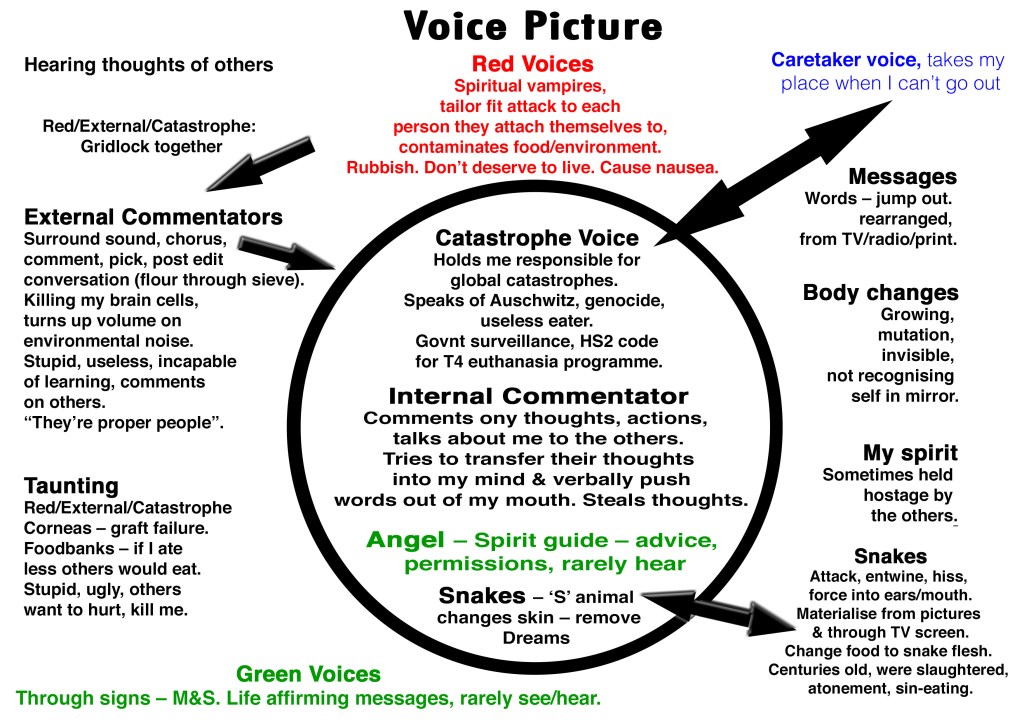
The Drugs Do/Don’t Work

a collage of pills, drugs, money medic and corporate domination

We know psych meds harm people

We also know psych meds help people

We know corporations, whether they produce food, shoes, or medicine, seek monopolies, political power, and to maximise profits at the expense of society. Big Pharmaceutical  corporations, like all corporations, have structural capitalist imperatives which are harmful towards democratic societies. However we should not confuse the valid critique of corporate capitalism for a blanket declaration that we don’t ever need food, shoes, or medicine.

RITB supports people’s own decisions, whatever works for you to live your best life, whilst demanding we have real choices not just meds and/or CBT/DBT/mindfulness/recovery school.

We also know that calls from predominantly professionals led cohorts seeking model primacy to shut down Big Pharma, in itself, doesn’t magically stop people from becoming ill/distressed. Nor does a different theory of distress and illness  by a different elite of professionals in charge give service users, survivors and disabled people liberation from oppression. We do not seek a new boss (same as the old boss) we seek to overturn the power structures themselves.

The social determinants are frequently cited, well here it is in glorious technicolor – austerity for 15 years, now being intensified will be a human catastrophe on a far greater scale if not stopped.

Consider what immediately helps – fighting for people to have the means to live – or being ideologically ‘correct’. 

Dead people validates no-ones theories, unless you are a genocidaire.

Individual Placement and Support (IPS) – The Miracle Cure? 

A colourful rainbow childs graphic surrounds a still showing two joyous people form the Shiny Happy People POP video

The UK Government is proposing the biggest cuts in history under reforms to the benefits system, they are claiming Individual Placement and Support (IPS) will offset lost benefits for many, with the stated aim of getting people into work and  simultaneously tightening eligibility criteria for benefits, like Personal Independence Payments (PIP).  One of our members who has deep experience of IPS writes about the reality:

“If you want to work, you can work.” This was the mantra of my first IPS Employment Specialist at the mental health trust. She was forceful, blunt, and unrelenting in her conviction that I could land a full-time job in record time and in so doing, of course, she would meet her target. This is what I wanted to hear.

Work, or rather, the lack thereof, has always been my Achilles Heel. My career in International Relations meant everything to me, and by everything, I mean it defined me. I was making a difference. My international projects were making a difference, particularly those in the countries most affected by Chernobyl. I worked crazy hours, put myself in danger marauding round the exclusion zone collecting soil samples to be tested for radiation back in the UK. I took my annual leave and used this to monitor my projects overseas. I WAS my work. When I was diagnosed with PTSD after the sudden deaths of colleagues in Belarus while working on one of my projects, I continued. My doctor desperately tried to get me to go off sick as my toxic, bullying employer was already driving people to burnout and breakdown. But I continued. I continued out of a sense of duty to the people I was helping through my work. I continued as without the words on my business card, I was nothing. I did not exist. 

In the end, I had no choice. I had become so unwell through a combination of PTSD and self-medication with alcohol, that the inevitable happened. One day at work, I was at a management meeting. I was asked a simple question about one of the projects in Zimbabwe. I suddenly realised that I had ceased to care. I still had enough self-awareness to know that something profoundly wrong had happened to my personality. I knew the real me cared deeply but she was no longer there. She had been extinguished. I left the room, packed up my desk and walked out. I was to be signed off work for a year on full pay during which time suicidal depression, self-neglect and self-medication with alcohol meant that I nearly died more than once. 

After a year, I was retired on ill health grounds at 32 – an age when most people are only just starting on the ladder towards a successful prosperous existence. Devoid of my identity, I unravelled. It all went. My purpose. My home. My health. My sanity. I fell into the Twilight Zone, disconnected from reality and from myself. I found myself homeless in London and I jumped on the merry-go-round of hospitalisations, in an out of grotty B&Bs and dangerous hostels, being preyed on by people taking advantage of my vulnerability. I was stabbed. I was raped. I was abused. I still have scars, both mental and physical from this time. The original trauma had long since diminished into insignificance. New layers of trauma were being added all the time.

Early after discharge from my first long admission to a mental health ward, I stumbled into a meeting of my local branch of Mind. It happened to be about employment and was addressed by Doctor Rachel Perkins, a leading proponent of the Recovery model and very much of the view that Recovery and Work are bound together. She was convinced that people like me could work and indeed should. I believed her. Years after that first encounter, I did some work with Dr Perkins. I clearly remember her assertions that “everyone should be on work-related activity”. I recall wondering whether she meant people in comas or dying. Sadly, I believe when she said “everyone”, she did indeed mean absolutely everyone. 

A lot of water has passed under the bridge since I first fell under the spell of Fairy Godmother Rachel Perkins who waved a wand so that I would triumph over these inconvenient mental health glitches that almost kill me every time they hit me, and be transformed into an active, valued, and tax-paying member of society.

I have been in the main dependent on Benefits since I lost my career and my health in the late 1990s. Since then, I have tried so hard to get back into paid work. I have voluntarily gone on every employment support scheme going. I have had voluntary roles but even those I could not sustain. I had a period working freelance but even then, I yet again experienced workplace bullying and ended up going through more breakdowns. Rather than being “workshy” I tried so hard to continue working even in extremis. I would work from hospital wards. I wrote articles on ward computers. I even had a business suit in the wardrobe in my room in the mental health unit so I could break out and attend work-related events. 

Anyone with even the scantest knowledge of how my mental illness ( I make no apologies for calling it what it is) could see that could see that I am not able to sustain employment for any length of time. My health fluctuates to such extremes that it feels like there are two versions of me – the one who can appear utterly together and ready to take on the world, or the other who implodes and becomes so unwell, so neglectful of herself, that hospitalisation is the only outcome. I have shown this repeatedly. 

So once again I was in a familiar state of feeling like an abject failure while I was having art psychotherapy – one of the few therapies that has had a positive impact on me. It had taken a couple of years to get the referral, but it had eventually happened, it was working, and I started to feel “normal.” This is where the red warning light should have come on. Often when I feel and appear most ‘normal’ it is when I am most unwell. My art frequently reflected my sense of guilt for not working. I asked my Art Therapist if I could be referred to an Employment Specialist. I was amazed to hear back very quickly and there I was, sitting with this bullish and buoyant IPS Employment Specialist who was a similar age to myself and who categorically assured me that I would get a job. I would be rushed into employment, and I would have tailored support to ensure that I was able to sustain that. I should have remembered that if something seems too good to be true, then it is. 

The first job I went for was in patient engagement in a Mental Health Trust. After a very pleasant interview, I was advised that I was far more suited to a more senior role and that they would be back in touch with me when a vacancy came up. The second interview was ironically, for an IPS Employment Specialist role within the very Trust whose IPS service I was accessing. My Employment Specialist was utterly convinced that I would get one of the roles going and that, what fun, we would soon be colleagues. She coached me for the interview telling me in no uncertain terms that I must not say anything negative, that I must maintain an air of positivity throughout. She said, “if anything, you have to be extra positive.” I wish I had listen to the alarm bells as surely, something this “ra ra” in nature would have to be completely inappropriate for dealing with the complex issues of many if not most, people in secondary mental health services. Too lat. I Had been enculted like an attendee at an Amway pyramid selling rally.

The interview was a disaster. Most of my professional experience comes from using my lived experience of mental health issues, of homelessness etc. as the foundation for academic study then my freelance consultancy work. I knew the Trust involved had pioneered “lived experience professional” roles and in fact I had been involved at the very outset of discussion on this as a service user representative. It did not occur to me that unless a role was advertised as being a “peer support” role of some kind, I would not be able to use my lived experience. I delivered what I thought was a first-class presentation and was pretty satisfied by the lunch break that I was doing well. I was taken aside by the IPS manager who was conducting the interview and advised strongly that I should stop alluding to my lived experience as I would not be able to do this in an IPS role unless it had “peer” in the title. I was blindsided by this. I knew that I would not be able to do the job if I had to keep one hand tied behind my back. I had been so buoyed up by the conviction of my IPS specialist that I would “ace” (her word) the interview, that I allowed myself to believe that my days as a “benefit scrounger” were over. I broke down in tears. The manager uttered something like “no need to get upset, Darling…” and that was the final straw. I cried my eyes out in the toilets and reached out on social media for support from my network. I finally managed to pull my fragments together to put a fragile mask back on  I emerged to pretend to the other candidates that I was fine as I did not want to worry them. I forced myself to go into the room for the second part of the recruitment process, a one-to-one interview. I have no idea at all how I got through it. I left with one of the Peer Support workers who saw my distress Tweet and took me to a café to provide much-needed support. 

So, it was back to the drawing board. I arrived for an appointment with my Employment Support Specialist which I hoped would help me to look at what had gone wrong. Gone was the over-the-top positivity. It was clear that I had blotted my copy book. I found myself, instead of being supported, being berated for taking to social media to look for support, although I had not mentioned anyone involved by name or indeed where I was having my interview. My sole motive was to try to get help as I was locked in a toilet in a state of complete emotional meltdown. However, she lectured me on bringing the Trust into disrepute. It was a shocking tirade. I walked out, again in distress. 

At this stage I submitted a written complaint to the Trust. It was suggested that I rejoin the IPS scheme but with another specialist. I met him and he seemed very pleasant but only doing the job part-time as he was training to be an art therapist. very quickly got another interview which took place online. A couple of weeks later, I was telephoned to say I had got the job. My immediate reaction was to say, “are you MAD?”  – only half joking. At last, I was going to be “normal,” that the decades of struggle in and out of health, of instability, of zero self-worth – had ended. This IPS thing was obviously magical. It sprinkled fairy dust on my troubled meaningless life and told that that I was going to be allowed to go to the Ball. In my euphoria, I had forgotten what happens to Cinderella at midnight…

Dressed in my new outfit provided by the charity Smart Works which gives clothes to women who are returning to the workplace, I looked “normal.” I could even convince myself that I WAS normal. They gave me an NHS ID badge. This had to be it. I had a badge again with a title on it. I was a “Social Prescribing Link Worker” for a Primary Care Network. I was given a laptop and  phone. This was it. I was back. Why did the anxiety grow rather than dissipate? Why was I having nightmares already in week one?

To begin with, I put my anxiety down to understandable nerves after all, my last regular job had involved people dying and my own health being ground into nothing. I had weekly meetings online with my line manager and the IPS Employment Support Specialist. At first these went all right. My manager assured me I was doing fine. The employment specialist too assured me I was doing fine. Increasingly, however, I was NOT doing fine. I had started to feel completely exhausted. My eating became disordered. I would collapse on my sofa as soon as 5pm came. I was working from home so I would fall asleep for three hours as soon as I felt I could log off. I felt paralysed. I was too terrified to make phone calls. I had always been phobic of phones, but it became acute while at work. I was struggling to manage the IT. The use of jargon made me feel as if I had been teleported onto another planet. I was not pulling my weight. I kept bursting into tears. I had to leave so many rooms as the noise was overwhelming me. I felt a strong need to punish myself for being the dead weight in the team – the token ‘mental’ in the room. 

And worse than that, I started to feel for the patients. Many of them were being passed around from pillar to post and then dumped on me as a social prescriber as the GPs had no time to deal with their complex issues. I identified with them. I would read their records and see that they were being neglected in the same way I had been. That was when the flashbacks started.

The tone of the cosy chats between me, my manager and my Employment Support Specialist started to change. Although couched in touchy feely management speak, the meetings became unpleasant. I was reprimanded again for using my lived experience at work. I had been trying to advise colleagues why, in my experience, patients might react in a negative way towards something they said or did. I illustrated this with my own experience. I was told that this was “triggering” for the team. At this, I was furious. I genuinely believed that my young inexperienced colleagues would welcome my input, but my manager did not think so. The Employment Specialist could see that I was distressed by this but the only “support” he offered was to advise me to “draw a picture of my anger.” That was it. Nothing else. 

That weekend, I had started to dread Monday from roughly 10 am on the Saturday. The anxiety built up and built up. I attended my usual online AA meeting, and I told them I was worried about my health. Later that night, I knew. I just knew. I knew that I could not continue working there. 

The next morning, I phoned in sick. Almost immediately, there was a combination of deep relief, but this was quickly replaced by guilt and a desire for self-punishment. I had proven finally that I was a failure. On paper this was a job I could do with my eyes closed. In practice, I was in a permanent state of terror, had flashbacks when awake, and nightmares all night. 

I was back in a very dark place again, darker than it had been for many years. As for the “support” – one might have expected given the fact that I was by now becoming seriously unwell, that the support would be heightened. In fact, the reverse was true. It became noticeably clear that I was now a “failed placement.” It did not help that the Art Psychotherapy had ended due to the long-term sick leave of the therapist. She had come back then gone away again as quickly as she arrived. I had a perfunctory call from a senior member of the team that covered Art Psychotherapy and Employment Support, advising me that the therapist was not going to be replaced, and I was to be discharged. I was at this time a suicidal wreck, but the response was to send me as quickly as possible to a familiar place – out of sight out of mind.

As I was therefore summarily discharged from secondary mental health services, I was no longer entitled to use the Employment Support Service. What this meant for me was that I had to negotiate the fallout from the “failed placement” and somehow get myself back on Benefits. I was submitting sick notes despite knowing that I would not be going back there. I would have preferred to take my own life than go through that excoriating pain of sitting at my dinner table with my laptop meant to be working my way through lists of patients but feeling absolutely paralysed mentally and physically. In short, I was on my own. 

I am still not fully out of the woods. The whole episode has meant that I have had to restart my Benefits claim from scratch and the DWP refuse to use the information they have on file for me covering many years of being on Limited Capability for Work Related Activity. The impact of this means that I am having to go through the gruelling assessment process again which means living on a lower “assessment rate” of Benefit and having to supply sick notes as if they have never seen me before. 

I regret the day I got sucked into the rainbows and unicorns’ world of IPS. The theory is great. The IPS Employment Specialist will be “embedded” in the clinical team. The problem is, there was NO clinical team. There was an invisible Art Psychotherapist who was long term off sick, and besides the part time Employment Support worker, there was no other support whatsoever. 

My own research into IPS, conducted when I was being urged to apply for an Employment Specialist role, showed a worryingly cult-like culture. I read that IPS staff must show their “compliance with the brand” and that the brand is all about positivity, even when there is truly little to be positive about. The roles are also target-driven. Is it any wonder that the specialists attack the work with the zeal of a timeshare salesperson? 

Of course, my experience may not be typical. I am sure there are some who are placed in appropriate roles at the right level, with the right support,  and can sustain those jobs. Lucky them. My suspicion is however, based on the speed at which I was jettisoned from services after I became a ‘failed placement,’ that there is no room for failure in the rictus-grinning positive world of IPS. It must muck up the stats no end to have people start a job then end up becoming more unwell than when they started. It felt like someone pressed a button on the waste disposal chute and down I went, into the skip where the failures lie in a groaning heaving mass, no longer presenting an uncomfortable truth – that IPS may well work for some, but for others, it is dangerous, deeply damaging, ending up in increased costs to the worthy taxpayers due to having to pick up the pieces of the shattered failure on the floor. 

These days, it seems certain that even the barest minimum of support for mental ill health will be tied up in some way with the “work cure.” Those of us on the scrap heap where the “failures” are dumped, unless we again climb out of the pit and show willingness to try repeatedly until we eventually peg out altogether, have no significance, no rights, no consequence, and no future. I have devoted myself to making my life matter by doing what I can to help others even while dangerously ill myself. I was named one of ’50 Inspirational Women in the UK’ for achievements largely outside paid work, done voluntarily because I care. 

Now it seems, I am ‘economically inactive,’ my diagnoses have been doled out too readily and there is nothing wrong with me at all. I am a shirker, a scrounger and a feckless workshy wastrel. And all this scapegoating is meant to motivate and empower me into work. 

I may not have much self-worth left, but even I can see that I deserve better. We all do.

It Costs More to be Disabled, Whatever the Government Says.

A lovely Romantic image of IDS and Liz Kendall surrounded by lace and alert holding a defunct half penny coin.

We asked members and followers about their mental health disability costs, whether in work or in receipt of ESA, UC, PIP. This is what they told us:

  • “Paying for support the NHS no longer offers” 
  • “Needing to throw out £15 worth of food because voices have changed or ruined it some way”
  • “Needing cabs because public transport causes too much anxiety”
  • “Needing a lot of cleaning products because of OCD or eating difficulties”
  • “Wasting money on fresh food and then being too unwell to cook and buying takeaways is the big ongoing one. Paying for therapy so I can get therapy that doesn’t harm me. Paying for help with cleaning/organising/ although I don’t currently have any help with cleaning.”
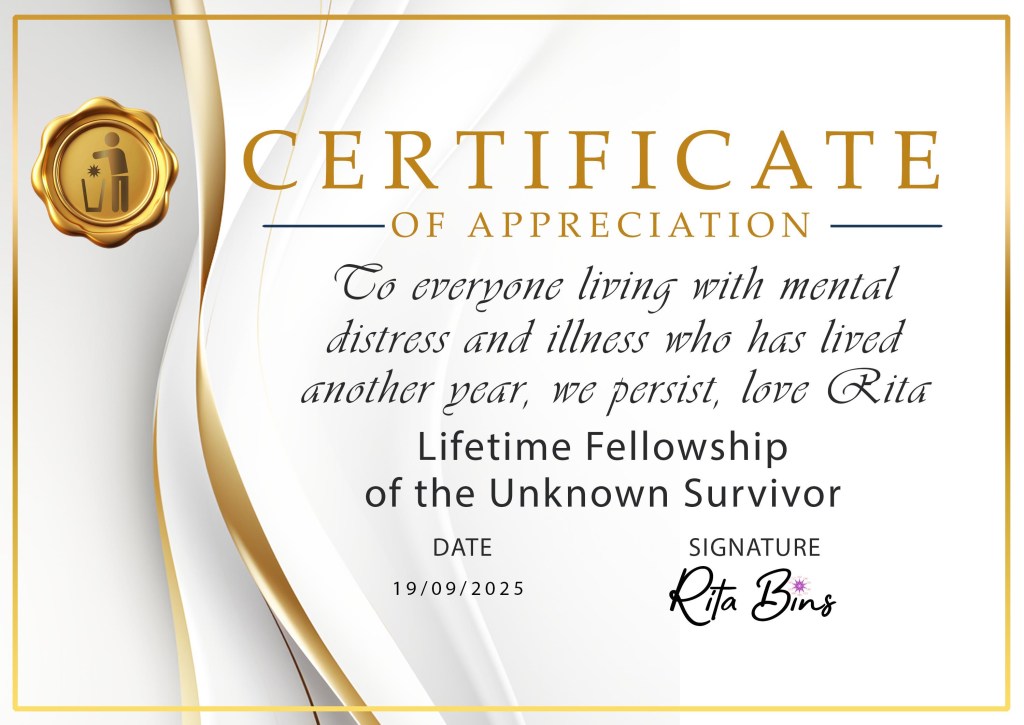
  • “For a child – paying for assessments and reports and legal representation to get health and education needs recognised and met.”
  • “Paying £1000 for ADHD diagnosis and then running out of money to títrate properly because the GP wouldn’t accept shared care. NHS psychiatrist diagnosed ADHD but wouldn’t prescribe stimulants. The GP tried to internene to help me and the psychiatrist told the GP she didn’t want to prescribe ADHD stimulant medication to a woman in case they try to use the to lose weight. So years of lost income due to burnout and trauma of undiagnosed, then diagnosed but unmedicated and unsupported ADHD and complex trauma. The true financial losses cannot be fully calculated, but I am costing the state far more now, and will continue to do so, than if had adequate therapy that recognised the full extent of my trauma and helped me in a knowledgeable and supportive way, ADHD diagnosis, medication and support around executive functioning early in my life.”
  • “Throwing food away as I’m full of good intentions when I buy it but really struggle when it comes to preparing it due to depression and ED. Plus a lot of food goes past it use by date as I’m 100% reliant on deliveries. Carers won’t actually “cook” just microwave meals.”
  • “Paying for delivery charges from food to clothes, Amazon etc. currently can’t leave the building in my own let alone visit shops. (Full time wheelchair user living in an unadapted home)”
  • “Extra heating costs as in home all the time and can’t move around to keep warm as in in a wheelchair.”
  • “Taxi fares-hospital appointments, dentist, anywhere really. Last week I spent £60 on taxis just to get an Xray done.”
  • “Chiropodist at home.”
  • “Hairdresser at home which I feel really guilty about as “no-one sees me anyway)
  • Care alarm £30 monthly”
  • “Subscription to Amazon Prime as I can’t deal with random deliveries (PTSD ) and the prime videos provide a much needed distraction.”
  • “Monthly contribution towards my motabilty scheme power chair ( £100)”
  • “No energy to cook at times so dependent on expensive deliveries. I forget to put stuff in the fridge. I forget I’ve even bought stuff. I feel embarrassed even writing this stuff”
  • “I find the whole throwing food thing super distressing- voices telling me to think about starving people all over the world including UK underscored with food bank statistics and the scrounging benefit claimants rhetorics. The voices play a whole goddam symphony on this one!”
  • “Uber one for cabs, food deliveries, courier service etc because I don’t get out easily”
  • “Yarn and knitting stuff to stave off depression and anxiety and boredom”
  • “Therapy online that helps me”
  • “Support for cleaning/organising/divesting (hoarding) not covered by social care”
  • “Paying for taxis for partner to get home from work and back again during the day, (not including going to work and coming home) to provide support”
  • “Paying for takeaway when I’m too unwell to cook, or have been too unwell to get to the supermarket/place a delivery order for groceries so there’s no food in.”
  • “Paying for train travel to see family and friends then being too unwell to go that day and too overwhelmed to change the ticket (when that’s even possible).”
  • “Paying for the heating to be on a lot more so my energy levels aren’t worse than they would be without it (which would lead to a domino effect wherein my activity levels drop, so my mood and focus drops, so my ability to do other things that help kee p me well drops).”
  • “Years of lost income is something I always forget to include because work has been so impossible for me for so long due to inaccessible workplaces, inaccessible working conditions, inflexibility and punitive nature of the benefits system, and lack of access to good care under the NHS. Some of that couldn’t be helped, it’s just a feature of having several conditions that interact, but I am absolutely capable of some small amount of paid work, just not under the conditions that are made available to me, not without coming to harm and eventually burning out again and becoming more ill than I am now.”
  • “Delivered food because prep is not possible. Things having to be thrown away due to contamination”
  • “Debt – depression spending or manic spending, or spending related to attempting to acquire a lifetimes supply of non-perishable essentials in fear of the next review
  • *Paying for physical healthcare diagnostic tests or treatment because of diagnostic overshadowing ie all in your head, it’s ‘just’ anxiety, or you’re too ‘risky’ for a treatment by virtue of MH
  • “Paying for extra food or specialised because of ED”
  • “Paying for extra cleaning products or clothing because of OCD or ED”
  • “Paying for injury dressings”
  • “Paying for advocacy no longer available”
  • “Cabs because public transport causes panic”
  • “I pay £120 per week to see my (incredible, life changing) autism-informed ex NHS clinical psychologist. it eats all of my PIP, leaves absolutely nothing, but her approach, experience and expertise has helped me more in four months than CMHT has in 13yrs”
  • “Decent noise cancelling headphones to make going out in public manageable. Unfortunately the media would file this under ‘flat screen televisions’ in the list of things we shouldn’t be allowed to scrimp and save for.”
  • “I pay for physio. The NHS physio isn’t working. I even asked my orthopedic team who they would recommend and I pay for it. For some reason NHS physio isn’t fully trained in my hip problem.”
  • “I am also paying for some blood tests because some of my physical health is being out down as mental health issue. Even though previous bloods have come back abnormal”
  • “I’m in Canada, so maybe not relevant but Ive been priced out of treatment for my life long MH issues. Therapy: $200/session, Doc rec’d EMDR: $1000/month for 2 sessions. My disability cheque only covers rent and without effective treatments, working for the extra is a pipe dream.”
  • “I’m lucky that my therapist doesn’t charge extortionate rates but I pay him approx £300 per month. If I need to see a psychiatrist (which I do reluctantly), it’s £200+ for approx 10-15 mins”
  • “Paying for long term care such as therapy but also holistic treatments like theraputic massage etc to help with pain, stress.”
  • “Bath wipes, no rinse body cleanser, shampoo etc for when showering isn’t possible. Expensive compared to regular versions.”
  • “Healthy food is also really essential for wound care.”
  • “My disability costs me on average £400 more per month than someone without a disability. I’m not listing all the costs publicly. I don’t claim any benefits because I don’t have the spoons to work and fight for PIP”
  • “Stress induced psychosis spending on fixing things that don’t actually need fixing! Also heightened vulnerability to scams”
  • “Lack of energy or fatigue – results in paying people to do things which you could do yourself if you were not fatigued, depressed or lacked energy Also executive dysfunction. Causes massive costs – bank charges and fines just one example (not remembering or missing things)”
  • “Games because a game world makes sense when that world out there never does, Audible books so I can function around the house, VR and technology to leverage my affinity and allow me to exist, mobility scooter so I can leave the house without becoming non functioning.”
  • “Witnessed people having to throw food away eg as they haven’t been well enough to cook it, store it safely, forgotten to eat it, had no money to top up the electricity to cook it, or items eg washing up liquid to wash pans safely and no money to replace cooking utensils ….”
  • “Pain, psych and other meds not available on NHS so have to pay hundreds of extra costs in private prescription EVERY month. 4 months after sudden deaf, no help from NHS ! Have to get private consultation and therapy. Costing £1000s, now crowdfunding. CFS so need ready meals”
  • “£40 a week for a cleaner as I can’t manage it anymore £80 on a dog walker to help on my bad days, £50 on private health care to assist when the nhs refuses to treat me as too complex £160 a month chiropractic treatment That’s before easy prep gf food etc”
  • “Paying extra rent for a ground floor flat Being so ADHD/BPD I don’t even know my budget and what I’ve spent Paying for cabs because exhaustion Higher energy bills because I’m home all day Paying for massages because my body seizes up”
  • “Extra costs because you can’t shop around, can’t access discounts, can’t remember reward cards, get sold bad deals. I had a friend who ended up with two mobile contracts because the first network didn’t cover her area.. sold in person by same shop!”
  • “Clothes and shoes bought that don’t fit, but because you then have a bad patch, you comprehensively miss the return window.”
  • “My private prescription is £120 per month. The NHS says it will take over the prescription once I’ve seen their specialist – I’ve been waiting over a year – they say it will be at least another 6 months, maybe more!”
  • “£120 a week for psychologist counselling sessions as the nhs mental health team in Northamptonshire doesn’t know how to deal with me because of my physical health I don’t fit their regimented thinking. I get 1/4 of my pension (as I was too young to be ill) and pip”
  • “Not getting paid for actual work, either because you forgot to check if it was paid work when you agreed to do it, or because you can’t actually manage to invoice the work or expenses.” 
  • “Not getting an equivalent rate of pay to a non-disabled person”
  • “trauma therapy, supplements to help my brain and body cope with the strain of trauma and work more normally. Extra delivery charges when I can’t go out. Care charges. Cost of mistakes … getting scammed when vulnerable or impulsive”
  • “Transport is a big one. And food too, executive dysfunction makes it difficult to meal plan. Dressings, self help workbooks, cleaner, handyman and gardener, OTC painkillers and supplements, ear plugs, eye masks, weighted blankets and cushions, fidgets, sensory friendly clothes…”
  • “Daring to buy something new to eat[YUK ready meals] but too-long & stringy meat/poultry fibres/veg skins in it so choke when swallowing, or such strong YUK fake taste =gag, so bin it=cereal & cheese yet again for eve meal. Forgetting food [incl planning probs]so goes out of date.”
  • “Paying the rest of my wages because I’m only able to work part time”
  • “I use my PIP for private EMDR therapy. We’re presently processing traumatic events from my time in NHS mental health services”
  • “Standard open rail tickets, as advance tie you to fixed trains and you don’t know how fast you will be able to do a transfer.”
  • “Ready prepped things like veg because I can’t use a knife safely. All the different gadgets I buy that should help but turn out to not”
  • “Private assessment/diagnosis for complex dissociative disorder unobtainable via the NHS. Pet insurance (owner trained mental health assistance dog).”
  • “Spending weeks sorting out things because What they vs. What actually happens is as different as different gets.”
  • “My son is always throwing food out because it ‘smells off’ . It costs a fortune to replace.
  • Receive PIP. – electric bill because of long OCD-related showers. Also when depressed become too exhausted to get ready for bed so fall asleep on floor/with lights/heating on – dental treatment following not brushing my teeth when depressed – pre-payment certificate for meds”
  • “I’ve been paying for private therapy since 2018 because i gave up on the NHS after repeatedly being told that they couldn’t help me and on more than one occasion let me check myself out and wander out of A&E into the night after presenting myself as actively s**cidal”
  • “I’m not safe with a kettle due to SH, so I had a hot water dispenser which I accidentally killed last week and had to replace straight away. No waiting for the sales.”
  • “food goes to waste because i forget it exists. i lose things and forget i had them and buy more. i spend more than i should, perhaps on like hobby stuff because i am disabled and stay at home a lot, trying to find ways to stay busy and not let the brain worms win. someone else”
  • “Using gallons of hot water /heating to bathe a skin condition multiple times a day. Needing cotton clothes, which are getting rarer and more expensive Buying hibiscrub and dressings because my GP won’t prescribe them.”
  • “I end up throwing food away too – and beating myself up about it because food waste is “bad”. Can’t get an ADHD diagnosis because of how expensive it is and can’t face the hassle. Therapy is the big cost for me.”
  • “Throwing away food because I’m too distressed or confused to prepare it. Then ordering takeaway or delivery food. Replacing things that I have thrown out because I believe then to have been contaminated.”
  • “Therapy a big one as NHS doesn’t offer long term everything is in 6 or so sessions. Heating bills as feel the cold. Dressings at times. Ready meals and select foods. Private assessments for neurodivergence as 3-7 year wait lists. Private dentists as feel criticised by NHS dentists (even if available) making comments about acid erosion from eating distress history”

Current political and media messaging is suggesting that not only are people faking their conditions, but even if genuine they have no associated additional costs. The cost of living for people with mental illness/distress is no less pressing than the extra costs for people with physical illness or disability; benefits are essential to support a basic, acceptable standard of living.

Continuing austerity will simply mean worse lives and more deaths. It is most explicit in the growing presence of fascist groups, but on Social Security the consensus across the established political and media community is barely different: The society they envisage does not include us.

An Epistle of Cruelty: Life in the parallel shadow penal state of the DWP

RITB admins put out a call for testimony of what life is like living whilst receiving DWP benefits. It was painfully clear that many survivors are now afraid to speak even under pseudonym. People are silenced, and they are terrified of being noticed by the State apparatus. Therefore a Content Notice on these testimonies as they include distressing detail of bureaucratic violence, harm, and distress.

The Daily Telegraph and The Jeremy Vine Show recently put out messaging that is distressingly reminiscent of Nazi propaganda. Recalling the co-ordinated media activity of the Osborne era where scrounger rhetoric was used to make harsher and lethal policies acceptable under austerity. [Please read this letter collected by Jay Watts].

The treatment and stigmatisation of claimants is similar to the vilification of refugees. We should always act intersectionally and support each others struggles, and never fall for divide and rule messaging or pitting one groups rights against another’s. Whilst citizens do not face being drowned or rendered to Rwanda, some have had their citizenship removed and been deported, fulfilling the fascist National Front of the 1970’s policy demands. Political parties win votes competing to be crueller to both. No political party represents either group in a humane way. New Labour’s Immigration Act 1999 removed recourse to public funds for people ‘subject to immigration controls‘, the slow removal of benefits from disabled people suggests a similar policy aim, but being hampered by human rights law, disability organisations, and public opinion; the famous problem of democracy Thatcher lamented to Pinochet.

We now also have a political and media campaign against Trans people, with the country’s Human Rights organisation, the Equality and Human Rights Commission, being manipulated to now support the removal of human rights, to the alarm of the United Nations. The hostile environment while acknowledged openly by government in respect of refugees is less explicit for other demographics, but nevertheless we can feel the enmity.

The recent footage of a 6am DWP & police raid and increased whipped up hatred towards claimants has deeply distressed many people:

The following testimony is collated from a wide range of individuals who responded to our callout, they offer a snapshot of the impact on health of being a claimant. Of what it is like living under the parallel shadow penal state of the DWP-

  • “I cannot talk about it here. I even have the thought they might see through my alias and work out who I am and punish me”.
  • “I know that I only deserve to live if I’m employed, that’s the message”.
  • “The two most vilified groups of people in the UK for political purposes are refugees and claimants. Those groups are despised. We are subhuman”.
  • “If the Bill is passed, job centre staff will be deciding who’s fit for work with the threat of sanctions. I’m stockpiling medication, I won’t survive”.
  • “As a too ill for employment disabled person I have survived solely on ever decreasing and hard to get so called social security for most of my adult life, spanning decades of so called welfare reforms, cuts, austerity, and recessions. Family tax credit, Job seekers allowance, Incapacity benefit, income support, disability living allowance, ESA, PIP and soon to be UC. I have a life threatening an ever growing fear of the DWP”.
  • “Disability fraud in social security is 0.2%, the media portrays it as 98%”.
  • “An assessment centre is referred to as The Kremlin”.
  • “The impact of DWP processes and their media has had a direct impact on my mental health to the degree that I would rate it worse than my illness, worse than being sectioned and forcibly medicated, worse than being stiched with no local anaesthetic, worse than surviving a suicide attempt. It has become enmeshed into my depression, paranoia, voices I hear, the feeling of being a target for anyone’s malicious reporting, feeling constantly surveilled, under house arrest.
  • “I sometimes hear my thoughts in the voice of Ian Duncan Smith and my voices blame me for being in this position. They say outside “they’re proper people,not scum like you”.
  • “If I were offered fast painless euthanasia, I would take it, to be free of living in fear”.
  • “I hate post, all envelopes, I feel sick at the sight of them and have vomited at the sight of envelopes I suspect are from the benefit offices. Sunday is the only I can breath – no post – but it means I’m afraid to leave my home to stay with family or friends because I fear receiving a letter or form which needs immediate attention. So I feel a prisoner in my home and afraid of leaving it for longer than 24 hours”.
  • “I know that the DWP have an algorithm that targets people for benefit fraud. That they can covertly use, physically surveillance, data from airlines, supermarkets, online purchases, CCTV, audio recordings and phone conversations, monitor bank accounts and social media searching photos and locations and encouraging neighbours to don claimants in…. all to try and prove people are lying. This all has a profound detrimental effect on my mental health and I’ve done nothing wrong”.
  • “I looked up how much you get for selling a kidney or a lobe of liver thinking of if after the general election and proposed Bill removing the WCA letting job centre staff decide who’s fit for work or not, i know I wont survive it. I was disappointed to learn that organs don’t sell for that much”.
  • “I tried to end my life during a DWP assessment process a few years ago which resulted in me being detained under the MHA.  One of the reasons I haven’t walked away from the iatrogenic harm that MH services cause me is because it would be even more difficult to prove I am ill and get enough benefits to survive on if did”.
  • “I used to be an activist, I did unpaid work which was valued by universities, NHS Trusts, nursing & medical schools. I also did work with fellow SUs and groups. I ceased all voluntary work in fear of that being interpreted as being fit for full-time work which unfortunately I am not.”
  • “I was never able to sustain full-time employment, and even consistent part-time work wouldn’t be viable for because every year for my entire adult life I have typically lost about 3-4 months of the year with my mental health. There are few employers who would tolerate 4 months sick leave every year. With voluntary work, it carries a different weight and stress because I know I can step down if I need to, I can space myself and plan to do it during my best months of the year. The irony is I’m more productive doing voluntary work than I am doing paid work”.
  • “Work as a health outcome and a cure has become the neorecovery norm. It’s scary! I don’t take part in any in person direct protest activism after knowing that some disabled activists were shopped to the DWP. I stay anonymous and private on social media and anon at online and in person Mad events because of the fear of DWP spying on me”.
  • “The neoliberal Government and media strategy is to portray benefit claimants as fraudsters, cheats and scroungers this makes me feel stigmatised, stereotyped and underserving. The welfare system is deliberately hostile and cruel. The Government is trying to kill off vulnerable disabled people. They cover up the deaths caused by the system”.
  • “Just filling the form out raises the depression levels. All negative questions. Some impossible to estimate how many hours in a day do u?? Then the interview process, being asked why you haven’t managed to kill yourself yet! Which made me feel even lower, a total failure!!”
  • “I was once accused of fraud when I failed to ask DWP for permission for permitted work of a few hours and for 6 weeks. Years later I got a letter telling me to attend the job centre and I had no clue why. A scary place with security guards at the door. I freaked out so bad when there that I ended up in a crisis house. I’ve never done paid involvement work since. They can even track gift vouchers which are seen by them as earnings. Volunteering can also be seen as being fit for paid work”.
  • “They ignore medical notes and evidence. They ignore the doctors, your specialist. They are only interested in failing you”.
  • “DWP was responsible for the death of my brother”.
  • “Best thing about lockdown 1 was knowing the letters had stopped. Felt as if I could live for the 1st time in years as I wasn’t exhausted by 24/7 in fear. That dread resumed as soon as we heard the letters were starting up again”.
  • ” I’m using the PIP to find private therapy because NHS was bad. You see a lot of benefit stigma as well and that’s pretty rubbish. I feel like a failure and a burden all the time and I don’t tell people usually that I’m on any sort of benefit”.
  • “I dread being asked “what do you do?”, the judgement extends to healthcare even. I avoid speaking to anyone in the supermarket, I stay indoors and take the rubbish out at night”.
  • “I know DWP want me dead, deaths are a cost saving”.
  • “I’m autistic and was in receipt of PIP. Because of how my autism presents I feel I have to be reassessed every time the tiniest thing changes, even if it’s just a fluctuation  rather than a change.  This means I’ve subjected myself to multiple reassessments  as there’s no way of just telling them about the small fluctuation without a full reassessment. The whole process has made me sick with anxiety, not knowing how long it will take, worrying about whether I’ll have to see someone face to face that doesn’t understand my condition.  In my last reassessment they took information over the phone from an unqualified member of staff that wasn’t listed as a contact on my form that didn’t give the correct full amount of information.  Calling the DWP causes me lots of stress and anxiety as I often need the toilet whilst on the phone and get stuck waiting for over an hour.  When there is no position in the queue information it can lead to a lot of uncertainty.  Even though I’ve been 100% honest in my claim i feel worried when I see cars outside that people are watching me.”
  • “The recent DWP advert stressed me out so much I ended up cancelling my claim as I couldn’t go through another reassessment. If the DWP had an online system where you could report  minor changes without the need for a full reassessment it would help to reduce the stress the whole process causes”
  • “I’ve attempted suicide, been paranoid and psychotic and detained under the MHA. I think that there is more threat to my life from the benefits system than anything else. Yet, I’ve read all my clinical notes and I don’t see the fact that the DWP has caused many mental health crises recorded anywhere”
  • “I’m due a PIP review for severe mental health issues. Last time I had a review, I didn’t sleep. I was anxious. Just filling out the form is distressing. This time, I have no supporting evidence for anything because my CMHT have barely seen me and not listened and not helped me. I’ve misplaced my crisis team summary from last time I was under them and I’m too scared to call anyone to ask for any further evidence because I’m fobbed off all the time. The PIP review has me even more anxious this time because I’m lacking the evidence.”
  • “A recent video by DWP was shared on Twitter which featured the DWP minister in a stab vest saying “ We will track you down. We will find you. We have a very particular set of skills” and showed suspects in handcuffs, doors being smashed down and wailing sirens. Watching this video sent me into what the mental health crisis team called a “psychotic episode” and led to a police welfare check and other scary things”.
  • ” I’m using the PIP to find private therapy because NHS was bad. You see a lot of benefit stigma as well and that’s pretty rubbish. I feel like a failure and a burden all the time and I don’t tell people usually that I’m on any sort of benefit”
  • “I’m constantly paranoid my benefits will be stopped. I get very specfic delusions when real bad it becomes part of my paranoia that I’m being watched”.
  • “I think it’s the division that has been sowed by the media, the manipulation of data to present a point of view that stigmatises people”
  • “They don’t like it if you’re on alternative medication and penalise you if you’re not what they consider a high enough dose. It’s like they want you numbed and overdosed. They don’t allow for fluctuations of the conditions”.
  • “Last summer had interview for 4 hrs work which would have been a big challenge but a +ve step for me & I was likely to get the job but I pulled out due to fear of impact on benefits & being reassessed as fit for work just because of doing 4 hrs/week”.
  • “I live in constant fear of assessment & struggle to do new things worrying how they will twist it so they don’t have to give me the benefits I need to live”.
  • “I just exist, waiting for the gestapo to push me to suicide, no hope nothing”.
  • “The process is humiliating and 3.5 hr phone assessment was horrendous, nearly killed me and got to go through it all again in a few months, not even been two years yet”.
  • “If you have a pain condition you’re caught in a particularly Kafkaesque trap because doctors don’t want to prescribe opioids any more but if you’re not on them the DWP don’t believe you have chronic pain”.
  • “The benefits system, especially disability benefits system, is a special kind of hell on earth designed to make us feel subhuman, which is what most people think we are”.
  • “I literally can’t have a romantic partner because I’ll never be allowed to move in with them without losing all my benefits. My condition (ME/CFS with hEDS) is incurable so I will be alone for the rest of my life because of DWP policy”.
  • “Friends & family talk all time about ppl they know who are “fiddling” their disability benefits because “ you can see they aren’t really ill”, they always follow up with “not you, we don’t mean you” & I have to decide again whether to have another rant about invisible illnesses”.
  • “Am not on benefits anymore but I can still feel that fear. The recent video from the DWP brought it all back. The feeling of being watched, never knowing who or when. Being told by a support worker that I was worrying over nothing. Feeling like a fraud and doubting myself all the time. It was exhausting”.

Journal of Social Policy: In-work Universal Credit: Claimant Experiences of Conditionality Mismatches and Counterproductive Benefit Sanctions Published online by Cambridge University Press: 01 December 2020

I’ve been made to feel like a pariah for so long now it has entered my DNA

Despite being on benefits all my life, I still feel hounded by the department. There have been times in my life and I’ve been frightened to leave the house in case somebody anybody reports me for being able to breathe and walk brackets (not that the walking part is a problem anymore )

In 2014, I was I was chosen to carry the Commonwealth torch as part of the games  in Glasgow.  I was nominated for my services to the community in a voluntary capacity. After much paranoia and anxious I decided not to  participate as I was terrified that somebody might to decide to interview me, film  me and upload my details and then I will be reported to the DWP for those very same services to the community.

 I’ve done various bits of voluntary work since I moved to Scotland in 2010. I’ve never told to the DWP. Due to the fear of them thinking this means I’m fit for a 37hr week. Instead I’ve taken the risk of flying under the radar and constantly worrying something I was going to get found out prosecuted for fraud and jailed .  

My peer support worker expenses used to get paid every three months by cheque. It wasn’t a huge amount of money but I had to put it through my bank account and  worried constantly  the DWP would access my account and find me out. I could probably have told them that I was volunteering still remained in receipt of benefits but I wasn’t prepared to take that risk. I also used to lecture in a paid capacity from time to time but couldn’t risk this  and most universities don’t have an alternate way of paying somebody on benefits…

Paranoia of  the dreaded brown envelopes is always there  but especially heightened when you are waiting for a decision on  a new claim or review  . Recently I have a pip review which took 10 months from start to final decision. Every day I dreaded the post only Sunday was a respite They also started to play stupid bastardised and sometimes use white envelopes so nothing was safe! . . You can never rest  because they keep moving the goal posts so any sense of stability is lost..

I was offered , a paid role as a support worker but it was part time and I was terrified about dealing with the DWP. How pomfret would it take for them to sort out a new claim with the daily envelope waiting again.. What if I became unwell again and had to stop working? Would I be believed? What if they dithered over my clam and didn’t pay my rent? Would I become homeless again? I couldn’t cope with that.Best not to rock the already precarious boat!

I often feel wrong in accessing leisure activities as  There is always that feeling I can’t really be that sick if I can go the cinema. Sick people have to be sick all of the time or not at all. that’s how the bastards make you feel. Maybe I’d be spotted having a good time.

The mental health system is set up to make you feel less than, a burden, at it! And if you have a PD  label forget being taken seriously. I have a history of chronic addictions which are often seen as self inflicted and the DWP compounds these internalised briefs. Oh and forget being a single mother: I once had all my disability benefits stopped when I returned home after a 5 month hospital stay with my baby daughter. Apparently motherhood means cured. 

When people ask me what I do that seems like an admission of failure to say I’m “just” on benefits. My worth is apparently based  on my capacity as an earner, a financial contributor. Now I’m  wheelchair bound it’s easier because it’s obvious something is wrong but I spent decades worrying that I wasn’t that ill and that everyone knew it! Or that my obvious problems with alcohol and drugs were seen as self inflicted and a drain on the state. I still limit who gets to know that part of me.,

I’ve asked for increases in medication purely for evidence of not being recovered. I have continued to take high doses medication. I’ve  totally lost track of whether I need it or not but it looks good for the DWP. 

Dealing the with the DWP exhausting and brings up all the feelings of basically not being good enough. Less than, a burden, a non entity. I’m finding doing this for RITB extremely triggering and I know there’s no threat. But what if a binner thinks I’m a fake and have just conned everyone for the past 40years? What if I’ve conned myself? I’ve been made to feel like a pariah for so long now it has entered my DNA.

Further Reading: Deaths by Welfare Project

A Tribute to Nick Dilworth

Nick Dilworth died unexpectedly in January after an accidental head injury. This is not right, it is not fair and the world is a much worse place without Nick being in it. But the world is often wrong and unfair, Nick knew this so very well and because he was a truly great and good man, he dedicated his life to fighting against this unfairness and wrongdoing. Nick was a friend, an ally of disabled people, and had nerves and principles of steel, he did not back down. When many ignored what went on in the world social security and the department of work and pension and disability benefits, Nick remained a steadfast combatant, I don’t know how many lives he saved, but undoubtedly, he saved many. And for those who passed, he never forgot, he extracted justice for the families. There were no riches or status in this work, that is how we know he was a good man, he did it because it was right, he did it because he was our ally. The world is poorer without him. 

As a measure of the man, on announcing his death on social media there has been now for many days a series of reactions, sympathies expressed and shock sadness and praise for his work and life. It was often on social media where his detailed in-depth articles were shared, where he drilled into the deep statistical information and exposed government lies and obfuscation. On one memorable occasional he proved that a well-known journalist was mathematically illiterate and was promulgating a statistical lie in support of the government, of course the hack blocked Nick and kept lying, but the whole world saw how corruption and lies are how murderous state policy is excused by the cowardly. 

Nick was also a very kind and caring man privately, all the finest attributes of a gentleman and none of the nonsense. That he could come across as an upper-class legal expert was a great asset to campaigns, where so many had dismissed victims as working class scroungers, Nick speaking alongside us meant our message was heard by people who otherwise would have switched off. He was funny and could be wickedly scandalous with his humour, which fitted well with the gallows humour often needed to cope with the obscenities being perpetrated by the British state on disabled people living in poverty. Make no mistake we are targeted for democide, and when we fought back Nick was right there on the front line with us. No one is gone from the world while there are people alive to remember them with love.

The service will be on Friday March 3rd at Marldon St John the Baptist Parish Church, starting at 2.30. Donations should go to Cancer Research. This is being facilitated by the Funeral Directors:

Online at stockmanandloram.co.uk/donations or sent care of:

Kim Palmer,
Funeral Director,
Stockman & Loram Funeral Service,
19 Holwell Road,
Brixham,
TQ5 9NE

We don’t know everyone who knew Nick, so if you knew him, admired his work or were helped by him, please continue to write this tribute to Nick by commenting or adding a message when you share it on social media.