I am a voice hearer, I developed a form of testimony of my voices, something that I could share with others and do with other voice hearers.
A simple template that could be used by voice hearers, or with their friends, family, peers, within hearing voices groups.
For a voice hearer to share with a mental health professional as a starting point for conversation about voices, or something initiated within that support.
The important part of this process is that the voice hearer is leading it. This isn’t about diagnosis, formulation or treatment, it is a simple method of testimony of experience, entirely in the voice hearers own words.
How to do your Voice Picture
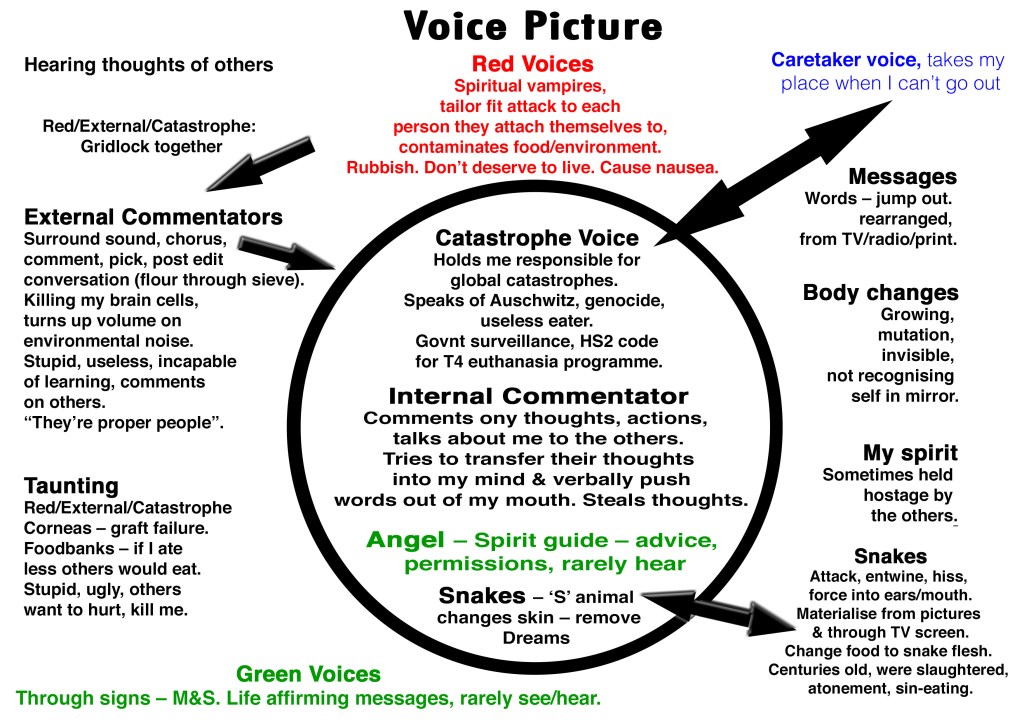
Take a piece a paper, A4 or larger and draw a circle in the middle, this represents your head.
Voices can often be heard inside and outside of our heads, or with external voices (or thoughts or sounds) crossing over to inside our heads, and vice versa.
Some of us also see our voices/entities, or have tactile voices we feel, or someones all three, hearing, feeling and seeing.
Identify your voices
Give your voices/sounds, be they individual or groups names. Identify numbers of them, gender, colours, what they say, how they say it.
You can write as much or as little as you like, a single word, or several sentences.
Voice Recreation
This is producing anything from a small snapshot of your voices to however sophisticated you want to get!
You could use your own voice, that of friends, other voice hearers, create sounds, use everyday objects for creating sounds.
Then record it on anything from your mobile phone to using sound software.
Your voice picture and soundscape are your personal testimony for you to do whatever you wish with, whether it’s a personal conversation with yourself and your voices, or something you share with others to say “these are my voices”.

 Recovery in the Bin