Voice pictures & recreation – a survivor-led approach

I am a voice hearer, I developed a form of testimony of my voices, something that I could share with others and do with other voice hearers.

A simple template that could be used by voice hearers, or with their friends, family, peers, within hearing voices groups.

For a voice hearer to share with a mental health professional as a starting point for conversation about voices, or something initiated within that support. 

The important part of this process is that the voice hearer is leading it. This isn’t about diagnosis, formulation or treatment, it is a simple method of testimony of experience, entirely in the voice hearers own words. 

How to do your Voice Picture

Take a piece a paper, A4 or larger and draw a circle in the middle, this represents your head.

Voices can often be heard inside and outside of our heads, or with external voices (or thoughts or sounds) crossing over to inside our heads, and vice versa.

Some of us also see our voices/entities, or have tactile voices we feel, or someones all three, hearing, feeling and seeing.

Identify your voices

Give your voices/sounds, be they individual or groups names. Identify numbers of them, gender, colours, what they say, how they say it.

You can write as much or as little as you like, a single word, or several sentences.
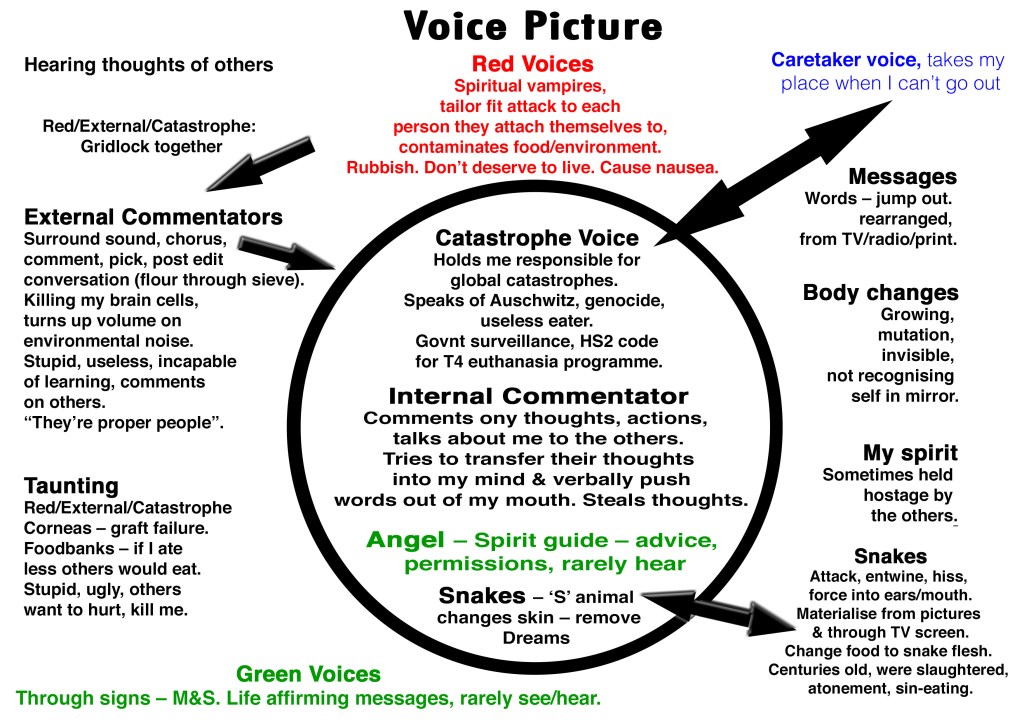
Voice Recreation

This is producing anything from a small snapshot of your voices to however sophisticated you want to get!

You could use your own voice, that of friends, other voice hearers, create sounds, use everyday objects for creating sounds.

Then record it on anything from your mobile phone to using sound software.

Your voice picture and soundscape are your personal testimony for you to do whatever you wish with, whether it’s a personal conversation with yourself and your voices, or something you share with others to say “these are my voices”.
Surviving Trauma – and Being Treated Like the Problem

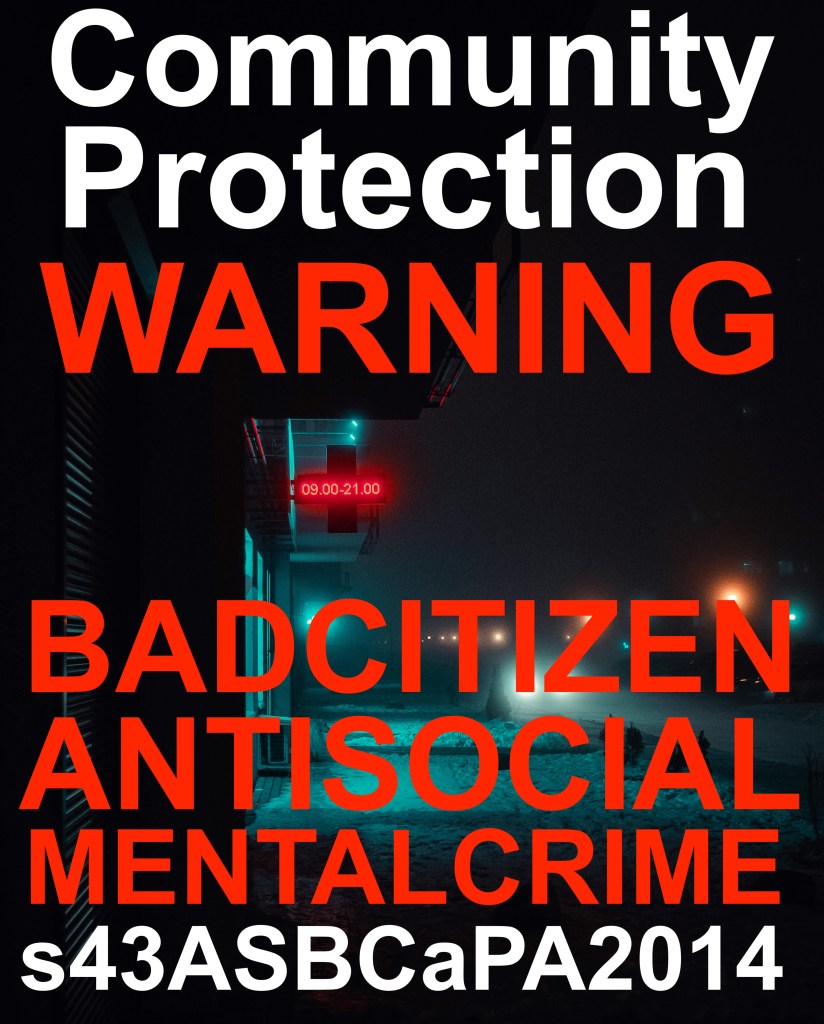
Text on dark street: 
Community Protection Warning
Bad citizen
antisocial
mental crime
s43ASBCaPA2014

If you met me in everyday life, you probably wouldn’t guess much about my past.

I work. I have hobbies. I have friends. I have interests, hopes, dreams, and the usual regrets people carry through life. On the surface, I’m just another person getting on with things.

What you can’t see is what I’ve survived.

I’m a survivor of complex childhood trauma, including child sexual abuse. I’m also autistic and live with bipolar disorder and complex PTSD. These things shape my life every day, even when they aren’t visible.

Like many people with trauma histories, I’ve spent years trying to rebuild a life while navigating systems that often struggle to understand people like me. Again and again I’ve encountered the same barriers: a lack of awareness about autism in women, a lack of understanding about trauma, and mental health services that too often fail the people who rely on them most.

The hardest part is the bitter irony at the centre of all this.

The people who abused me never faced consequences.

Yet somehow I have ended up the one being labelled as the problem.

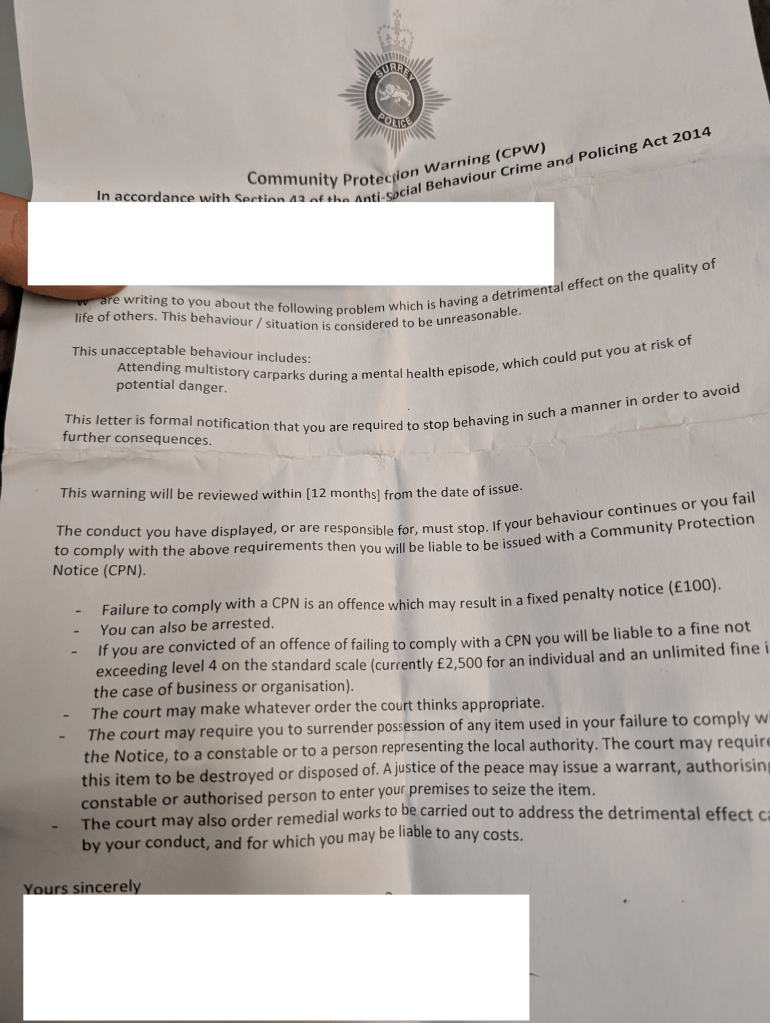
After a suicide attempt, I received a Community Protection Warning from the police.

It’s difficult to describe what that feels like. When someone reaches the point of attempting to end their life, they are already at the edge of what they can carry. In that moment, the response you hope for from public services is care, protection, and understanding.

Instead, I was treated as though my distress itself was the issue that needed controlling.

The experience left me feeling as though surviving trauma had somehow become something I could be punished for.

Conversations I’ve had since suggests the current use of Community Protection Warnings may be a replacement for earlier “demand management” initiatives such as the High Intensity Network and Serenity Integrated Mentoring (SIM) model. Those schemes were widely criticised for criminalising people in mental health crisis.

What troubled me even more was the reasoning described in the Professional Standards Department response.

The justification for the action appeared to centre on reducing police demand and resources, rather than safeguarding someone in crisis.

A clinician involved in my care later reported a phone call with the officer responsible for the warning. During that conversation, the officer was told that the measure had caused harm and increased my risk of suicide. According to the clinician’s account, the officer indicated that this outcome was considered acceptable because it reduced police demand and was part of a wider approach rather than a decision specific to me.

Reading that was devastating.

It suggested that the harm caused wasn’t an unintended consequence. It was something that had effectively been weighed against resource pressures — and deemed acceptable.

Living with trauma and mental illness can sometimes feel like walking through the world with invisible injuries. You learn to keep it invisible. You build a life around them as best you can.

I understand more than most the reality of the funding pressures facing police. Pressures greater than NHS & social care but with less public awareness.

But being labelled now as the problem rather than a person needing help, or not even being seen as a person at all has hurt.

No one in suicidal crisis should face the threat of being criminalised for surviving.

And no system designed to protect the public should knowingly accept the risk that its actions might push someone closer to the edge